Project Summary
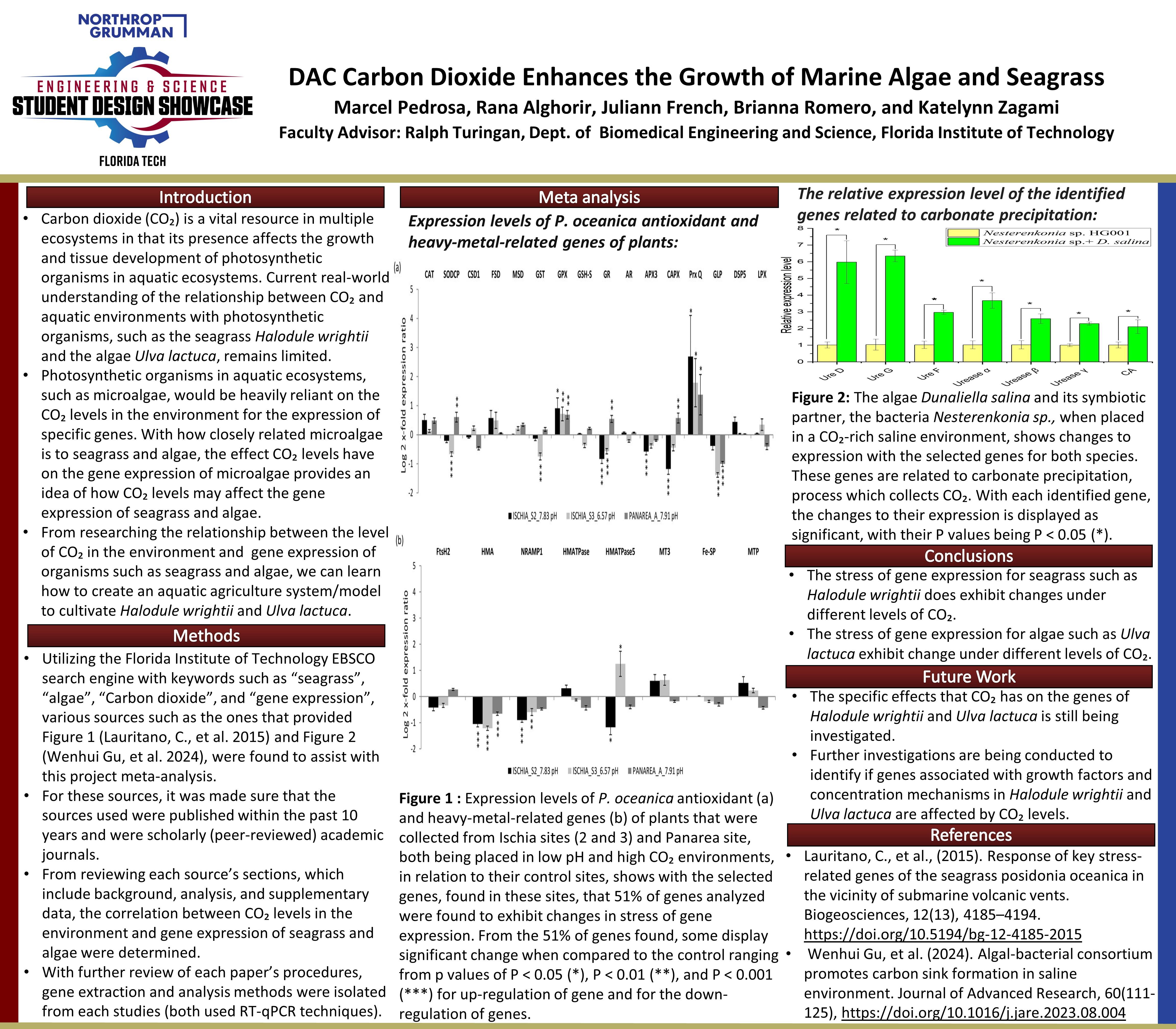
Carbon dioxide is a vital resource in multiple ecosystems in that its presence affects the growth and tissue development of photosynthetic organisms in aquatic ecosystems, and current real-world understanding of the relationship between Carbon dioxide and aquatic environments with photosynthetic organisms, such as the seagrass Halodule wrightii and the algae Ulva lactuca, remains limited. From researching the relationship between the level of Carbon dioxide in the environment and gene expression of organisms such as seagrass and algae, we can learn how to create an aquatic agriculture system/model to cultivate Halodule wrightii and Ulva lactuca.
Project Objective
Our goal is to determine if the different levels of Carbon dioxide effect the stress of gene expression of seagrass and algae.
Manufacturing Design Methods
Utilizing the Florida Institute of Technology EBSCO search engine with keywords such as seagrass, algae, Carbon dioxide, and gene expression, we will find sources to assist with this project meta-analysis. For these sources, they will be made sure to fit the criteria of being published within the past 10 years and be a scholarly (peer-reviewed) academic journal. From reviewing each source’s sections, which include background, analysis, and supplementary data, the correlation between Carbon dioxide levels in the environment and stress of gene expression of seagrass and algae will be determined. With further review of each section’s procedures, gene extraction and analysis methods were extrapolated.
Analysis
With analysis of Lauritano, C., et al. 2015, data with seagrass, and Wenhui Gu, et al. 2024, data with algae, it was determined that there is a correlation between the Carbon dioxide levels and stress of gene expression of seagrass and algae, as indicated with both data p-values exhibiting significant change (P
Future Works
The specific effects that Carbon dioxide has on the genes of Halodule wrightii and Ulva lactuca is still being investigated. Further investigations are being conducted to identify if genes associated with growth factors and concentration mechanisms in Halodule wrightii and Ulva lactuca are affected by Carbon dioxide levels.
Other Information
Lauritano, C., Ruocco, M., Dattolo, E., Buia, M. C., Silva, J., Santos, R., Olivé, I., Costa, M. M., & Procaccini, G. (2015). Response of key stress-related genes of the seagrass posidonia oceanica in the vicinity of submarine volcanic vents. Biogeosciences, 12(13), 4185–4194. https://doi.org/10.5194/bg-12-4185-2015
Wenhui Gu, Songcui Wu, Xuehua Liu, Lijun Wang, Xulei Wang, Qi Qiu, & Guangce Wang. (2024). Algal-bacterial consortium promotes carbon sink formation in saline environment. Journal of Advanced Research, 60(111–125), 111–125. https://doi.org/10.1016/j.jare.2023.08.004
![]()