
/prod01/fit-cdn-pxl/media/header-images/showcase-header.jpg)
Mathematical Sciences and Systems Engineering
Determining Material Transport Method for Lunar Colony using Differential Equations Modeling

Team Leader(s)
Project Manager: Anthonie PageTeam Member(s)
Scott Meeson, Anthonie Page, Matas VaitkeviciusFaculty Advisor
Dr. Gnana Bhaskar TenaliProject Summary
Large–scale lunar construction requires transporting vast quantities of material from Earth to the Moon. Two competing infrastructure concepts are high–cadence reusable rocket launches and a space elevator system (“Galactic Harbour”). While rockets have proven operational feasibility, they suffer from high marginal cost per ton and discrete failure risks. In contrast, a space elevator provides continuous throughput but introduces time dependent mechanical risks such as sway stabilization, fatigue, and transfer slip at the apex hub. The purpose of this work is to develop a unified mathematical framework that compares both systems under consistent assumptions and evaluates which system achieves a target delivery of 100 million metric tons most efficiently.Project Objective
To rigorously stress-test the economic and temporal viability of Earth's two primary heavy-lift paradigms—Super Heavy Rockets and Space Elevators—against the 100 Million Metric Ton requirement for permanent lunar colonization. To build an unbiased, unified mathematical model using a Stochastic Jump-Diffusion Framework. This ensures both infrastructures are evaluated under symmetrical technological learning curves and subject to real-world probabilistic hazards (MMOD strikes and launch failures). To map out the true financial burn rate of a civilizational-scale logistics chain by applying a continuous Net Present Value (NPV) decay a long period of time.Analysis
The Space Elevator is economically unviable in Low Earth Orbit (LEO). The simulation proves that continuous MMOD hazards not only throttle logistical throughput by forcing the tether offline but also create an unrecoverable financial trap. Delivering 100 million tons to the lunar surface is a multi-millennial endeavor. Even when operating a maximum-capacity super-heavy rocket fleet governed by Wright's Law, achieving the infrastructure required for an independent 100,000-person colony takes around 1500 years.Acknowledgement
We would like to thank Dr. Tenali and Dr. Mosincat for their help in presenting this model, as well as for being excellent teachers.
Stochastic Network Resilience Under Random Failures
Team Member(s)
Blake GisclairFaculty Advisor
Dr. Ryan T. WhiteProject Summary
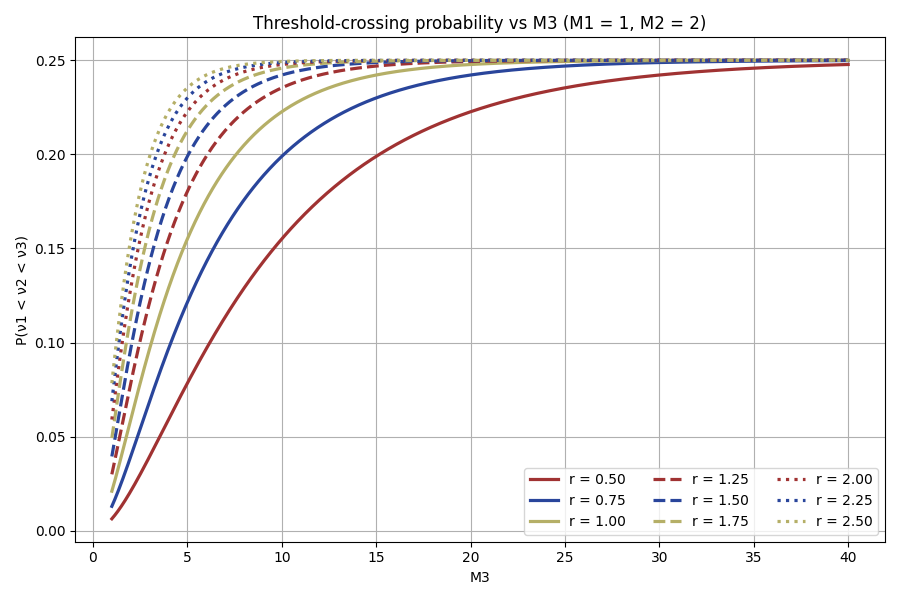
This project studies how stochastic networks respond to random failures by analyzing the probability that different forms of cumulative damage reach critical levels in different orders. Rather than looking only at whether a network eventually becomes unstable, the project focuses on how that instability develops and which damage pattern is most likely to appear first. To do this, the work models repeated random failure events, tracks how losses build over time across several network measures, and applies analytical probability methods to derive closed-form expressions for selected threshold-crossing outcomes. The works aims to use transform-based analysis to describe system behavior in a mathematically rigorous, but still understandable, way. By connecting these results to questions of vulnerability, the project helps show how local random failures can accumulate into broader system-level risk and how those patterns can be used to better understand network resilience.Project Objective
The objective of this project is to derive useful probability expressions for threshold-crossing behavior in a stochastic network model and to use those results to assess resilience under random failures. By determining how likely different critical-loss sequences are, the project aims to provide a clearer basis for evaluating network weakness, interpreting overall risk, and guiding strategies that improve reliability and reduce vulnerability.Acknowledgement
I would like to thank Dr. White and the NETS Lab for their continued support throughout my undergraduate career.The Invisible Shield: Why Our Stomach Doesn’t Digest Itself
Team Member(s)
Kevon FindleyFaculty Advisor
Dr. Jian DuThe Invisible Shield: Why Our Stomach Doesn’t Digest Itself File Download