
/prod01/fit-cdn-pxl/media/header-images/showcase-header.jpg)
Non COES Majors
Do ACE Scores Predict Lower Trust in the American Court System?
Team Leader(s)
Michael WesleyTeam Member(s)
Michael WesleyFaculty Advisor
Dr. Julie CostopoulosDo ACE Scores Predict Lower Trust in the American Court System? File Download
Project Summary
Trust in the American court system is a foundational pillar of the legal system, based on the public's belief that authorities will make fair and just decisions. Therefore, understanding what factors degrade the public’s faith in the system is crucial. Most research on this topic examines the amount of trust placed in the police or the government. However, there are no articles that investigate the relationship between trauma and trust in American courts. This is an issue because individuals who have any number of ACEs are more likely to encounter the criminal justice system, including courts. Understanding how trauma affects individuals' faith in the courts can inform judges on the need to take a trauma-informed approach. Furthermore, it may allow us to determine if the courts are perpetuating additional trauma onto people, creating a vicious cycle. Therefore, the current study proposes to examine the effects of trauma on trust in the American courts. Participants over the age of 18 and that resided in the United States were recruited utilizing SONA, social media, and CloudResearch (n = 122). Participants were asked to fill out a demographics survey, Court Legitimacy Scale, ACE questionnaire, and the PCL-5. A simple linear regression was used to examine whether ACEs or PCL-5 scores predict lower trust in the court system. ACEs significantly predicted lower perceived moral alignment with courts, fair court decision-making, and fair treatment by courts. PCL-5 scores significantly predicted lower perceived court accuracy, fair court decision-making, and fair treatment by courts. Overall, this suggests that both childhood and adult trauma experiences degrade faith in the American court system. Court authorities should seek to educate and explain court processes to increase transparency and trust.Project Objective
Objective 1: To explore the effect of ACE scores on belief in the legitimacy of the American court system. Objective 2: To explore the effect of ACE scores on judgments of the American court system. Objective 3: To explore the effect of trauma symptoms on belief in the legitimacy and judgment of the American court system. Objective 4: To explore the effect of trauma symptoms on judgments of the American court system.Analysis
A simple linear regression was used to examine whether ACEs or PCL-5 scores predict lower trust in the court system.Doomed to Scroll: Examining the Role of Motives in Problematic Social Media Use and Associated Psychopathologies
Team Leader(s)
Charlotte EleyTeam Member(s)
Charlotte EleyFaculty Advisor
Dr. Travis ConradtProject Summary
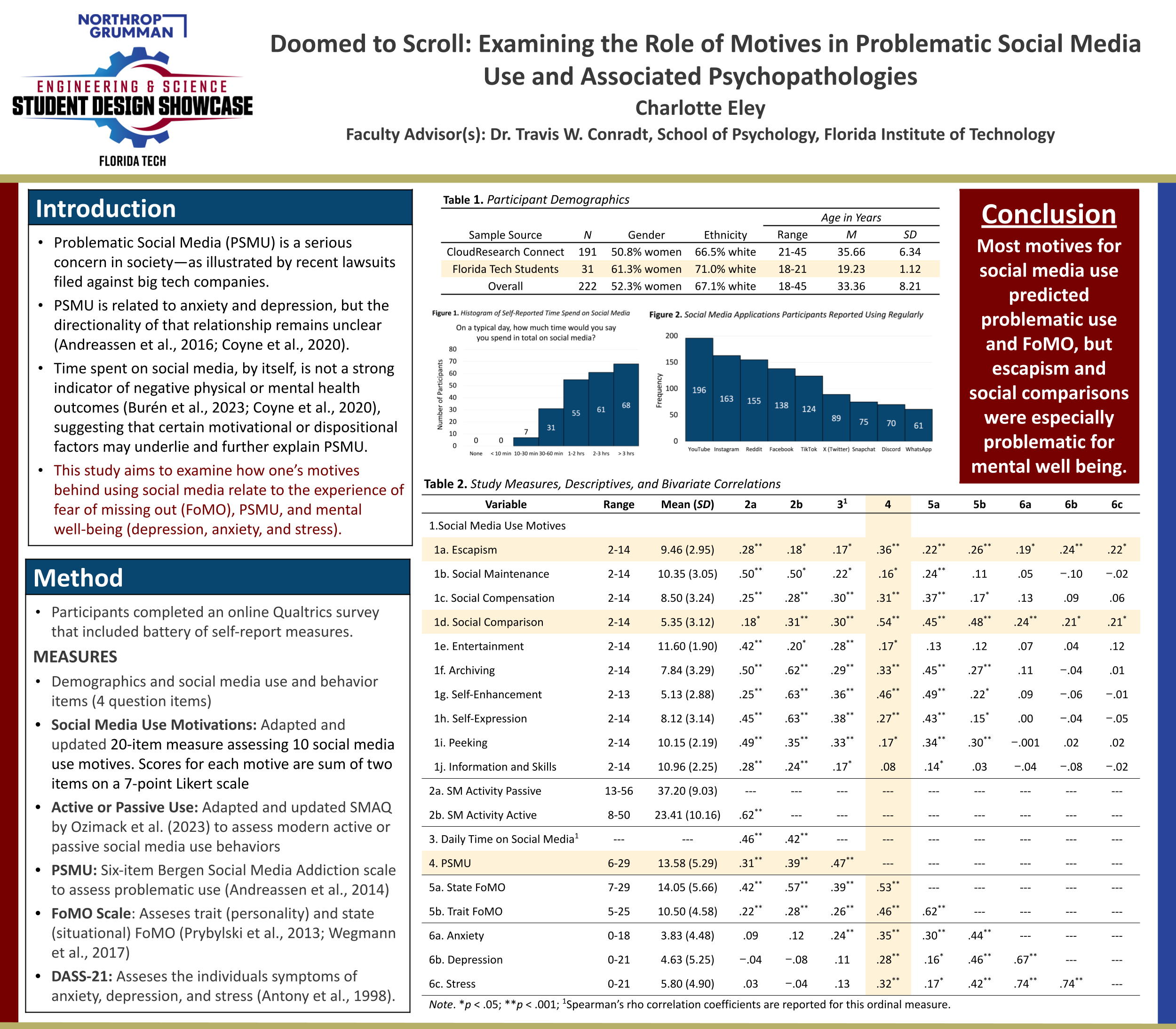
There is growing public concern that young people are becoming addicted to social media applications, a fear that is echoed both in research trends and recent, widely publicized court cases. This phenomenon is known as Problematic Social Media Use, which is characterized by an extreme overuse of social media, an obsessive need to engage with social media, and a substantial amount of distress and impairment caused by social media. A substantial amount of research has examined the various pathways to developing and maintaining Problematic Social Media Use (PSMU). Various factors may contribute to the formation of, or are caused by, PSMU. Those factors include fear of missing out (FoMO), specific social media use motives and behaviors, and symptoms of certain psychological disorders (namely anxiety, depression, and stress). While many studies have examined these factors individually or in some combination, few have taken such a holistic approach to understanding the maintenance of PSMU as to include all of these factors in one model. Thus, this study aims to examine how one’s social media use behaviors, use motives, and the experience of fear of missing out (FoMO) relate to PSMU and mental well-being (depression, anxiety, and stress). We collected participant self-report data from both Florida Tech students (N = 31) and qualifying users of online survey platform Cloud Research Connect (N = 191). We found that most motives for social media use predicted problematic use and FoMO, but escapism and social comparison use motives were especially problematic for mental well being. These preliminary findings may hold key insights for how we understand the relationship between FoMO, social media use motives, and PSMU behaviors.Effects of Mindfulness Induction Before and After Encoding on False Recognition
Team Member(s)
Jacob PhillipsFaculty Advisor
Dr. Travis ConradtSecondary Faculty Advisor
Martine FredericksonEffects of Mindfulness Induction Before and After Encoding on False Recognition File Download
Project Summary
This study builds on a prior student study (Frederickson, 2022) to examine the effects mindfulness induction has at the encoding and retrieval stages on false memory recognition for negative and neutral semantically associated (Deese-Roediger-McDermott, DRM) word lists. Participants were randomly assigned to either experience a brief mindfulness induction before learning word lists (n = 23), after learning (n =23), or to a control group (n = 21). Around the mindfulness or filler exercises (sudoku), all participants were presented with six negatively valenced and six neutral DRM word lists, each containing 10 words, and then given a 72-item recognition test that included true (target) and false (distractor) items. Findings showed that correct recognition was better for negative than for neutral target test words, but overall false recognition across all distractor types was also significantly greater for negative words. Neither word valence nor mindfulness condition showed effects on critical lure distractor words as hypothesized, but the mindfulness after encoding condition was found to have higher false recognition for negative related distractors and negative distractor words collectively. These findings suggest that administering a mindfulness exercise with eyewitnesses before they report memory information may be problematic, as mindfulness induction prior to memory retrieval broadly increased false recognition of negative emotional information.Electronic Recording of Custodial Interrogations: A Jurisdictional Analysis of U.S. State Requirements
Team Member(s)
Alyssa FoxFaculty Advisor
Dr. Brandon MaySecondary Faculty Advisor
Dr. Travis ConradtElectronic Recording of Custodial Interrogations: A Jurisdictional Analysis of U.S. State Requirements File Download
Project Summary
Electronic recording of custodial interrogations is a safeguard for preserving information, reducing false confessions, and protecting suspects, witnesses, victims, and officers. Despite empirical support and international consensus favoring mandatory recording, implementation across U.S. jurisdictions remains fragmented. This study provides a systematic analysis of electronic recording requirements across all 50 states and the District of Columbia, examining the legal mechanisms, scope, enforcement consequences, and population-specific protections governing investigative interview recordings. Results revealed that only 52.9% of jurisdictions maintained enforceable recording mandates for suspect interrogations, with only 11.8% requiring recording across all felony categories. Recording mandates concentrated overwhelmingly on serious violent offenses (homicide: 77.8%; sexual assault: 66.7%). Remedial consequences for non-compliance were predominantly weak, with only two jurisdictions providing for statement exclusion. Enhanced protections for vulnerable populations remained limited: 29.4% of jurisdictions provided juvenile-specific requirements, while only 5.9% addressed non-juvenile vulnerable adults. No jurisdiction required witness or victim interview recording. These findings document substantial variation in regulatory approaches that may influence the effectiveness of recording as a safeguard against wrongful convictions. The analysis provides policymakers and practitioners with systematic comparative data essential for evidence-informed policy development aligned with psychological research on memory, suggestibility, and false confession risk.EVIL DONE in the Age of "New Terrorism": A Red-Team Study of U.S. Lone Actor Target Selection across Weapon Conditions
Team Member(s)
Janelle JacobsonFaculty Advisor
Dr. Brandon MayEVIL DONE in the Age of "New Terrorism": A Red-Team Study of U.S. Lone Actor Target Selection across Weapon Conditions File Download
Project Summary
This study examined the decision-making process behind U.S. lone actor target selection with weapon type influence and strength of attribute influence, measured using the EVIL DONE framework (Clarke & Newman, 2006). Set within the context of the Age of New Terrorism (the methods by which technological diffusion and online radicalization have reshaped patterns of violence; Gill et al., 2017; Romyn & Kebbell, 2018) and integrating situational crime prevention with a red team simulation methodology, this study informed cognitive and situational deterrents of lone-actor target selection under varying weapon constraints.Interoperability for Human-AI Teaming and Decision-Making in Extreme Contexts
Team Member(s)
Amber KingFaculty Advisor
Dr. Brandon MayInteroperability for Human-AI Teaming and Decision-Making in Extreme Contexts File Download
Project Summary
Emergency response teams frequently struggle with communication failures, cognitive overload, and organizational barriers that prevent agencies from achieving interoperability in extreme and high-stakes contexts influenced by uncertainty and time-sensitive applications. Technological systems, such as AI decision-support tools, have the potential to reduce uncertainty, improve information sharing, and foster trust in multi-agency decision-making. However, issues of AI reliability and explainability may introduce decision biases and errors of overreliance. This study investigates the effects of AI reliability (high vs. low) and AI explainability (explainable vs. ambiguous) on decision accuracy, perceived interoperability, and trust in AI within emergency response scenarios. Participants assumed the role of an incident commander and reviewed multi-agency emergency response vignettes featuring both human and AI recommendations, manipulated to present either a detailed rationale or no justification. Decision accuracy, perceived interoperability, mental workload, perceived urgency, and trust in AI were assessed using validated survey scales. We hypothesized that high-reliability AI and explainable outputs would lead to improved decision-making performance, increased trust, and enhanced perceptions of interoperability. Furthermore, we hypothesized that perceived interoperability would mediate the relationship between AI reliability and decision outcomes. The study intended to identify psychological and technological factors that shape effective human–AI teaming in extreme situations and inform improved emergency decision-making.Universal Mandated Reporting of Suspected Child Maltreatment: Knowledge and Decision-Making for Child Advocacy Studies (CAST) and Non-CAST
Team Member(s)
Sophia WeathersFaculty Advisor
Dr. Travis ConradtUniversal Mandated Reporting of Suspected Child Maltreatment: Knowledge and Decision-Making for Child Advocacy Studies (CAST) and Non-CAST File Download
Project Summary
Florida is one of eighteen U.S. states with universal mandated reporting laws, requiring all citizens to report child maltreatment. However, most research has focused on professional mandated reporters, with limited attention to how non-professionals interpret and respond to suspected child maltreatment. This study examined the effects of training using the Child Advocacy Studies (CAST) minor and compared three groups of students, including a general student sample, a pre-CAST group, and a post-CAST group. Participants' knowledge, attitudes, reasonable suspicion judgments, and reporting decisions were assessed using statutorily developed child maltreatment scenarios. Post-CAST students demonstrated significantly greater mandated reporting knowledge, more positive mandated reporting attitudes, and a lower threshold for reasonable suspicion compared to both the general and pre-CAST student samples. Pre-CAST students demonstrated significantly greater knowledge than the general student sample. Although correct reasonable suspicion determinations did not differ significantly across the three groups, the general student sample reported significantly fewer child maltreatment scenarios to CPS. Overall, this suggests that non-professionals appear capable of recognizing circumstances that meet the threshold for reasonable suspicion, but training is critical for translating recognition into appropriate mandated reporting action.Project Objective
To develop and use statutorily guided child maltreatment vignettes reflecting scenarios non-professionals may reasonably encounter to assess reasonable suspicion judgments and reporting decisions and compare outcomes across training levels.We're Playing Basketball
Team Leader(s)
Lana AmmashTeam Member(s)
Lana AmmashFaculty Advisor
Dr. Felipa ChavezWe're Playing Basketball File Download