Florida Tech Tanzania Safari Adventure 2027
/prod01/fit-cdn-pxl/media/fit-website/site-assets/images/FT-Horiz_crimson-gold.png)
May 21–31, 2027, 11 days/10 nights with expert guides to give you the very best wildlife experience.
The College of Engineering and Science in collaboration with the Office of Advancement is pleased to offer a unique safari experience in Tanzania for Florida Tech alumni, parents and friends. Iconic landscapes of the Serengeti Plains, Ngorongoro Crater and the Baobab woodlands of Tarangire will provide dramatic backdrops as we search for the Big Five—lion, leopard, rhino, elephant, and buffalo!—and so much more. With any luck, we will find ourselves in the middle of thousands of wildebeest and zebra during the Great Migration. Don’t worry, safety will remain our number one priority!
Enjoy upscale accommodations, excellent food, and great company in a small-group experience. We will have three safari vehicles tailored for photography, allowing everyone to have a window seat!
Group size is limited to 16 guests plus your two Florida Tech leaders, Drs. Mark Bush and Rich Aronson. Mark and Rich have worked together for years leading expeditions to the Galapagos, the Amazon, and east Africa. They have reconnoitered the sites on our itinerary and can vouch for the high-quality experience the Tanzania Safari Adventure will offer. In the evenings, Mark and Rich will host natural-history discussions about what we’ve seen in the field.
Price: $7875 per person double occupancy, excluding international airfare, health insurance and visa. Please note, all guests will need to be at least 21 years of age upon traveling to Tanzania.
Deposit of $2500 per person due May 1, 2026.
Balance of $5375 per person due February 1, 2027.
Single occupancy is not available, but a booking for the solo traveler is possible if we can find a roommate of the same gender.
For more information on arranging your participation or content of the trip, the physical conditions, and what we can expect to see, contact Mark Bush at mbush@fit.edu or Rich Aronson at raronson@fit.edu.
Please remember it takes approximately two days to fly from the US to Tanzania. Days shown are in-country beginning on Day 1, which is May 21st and ending on Day 11, which is May 31st. The return flight travels with the clock, so you arrive back in the US a day after leaving Tanzania; the minimum trip duration starting from the US is May 19th– June 1st, 2027.
We will gather at Arusha Planet Lodge. If you want to arrive a day early to get over jet-lag (recommended), that can be booked at additional cost through our local coordinator KatiKati Tours: https://www.katikatisafaris.com/
The lodge has a wooded lot, and e-bird reports 89 species from the grounds.
Arusha Planet Lodge: https://planet-lodges.com/lodges/arusha-planet-lodge/.
An early start for a full-day tour through Arusha National Park (Park entrance is 30 minutes from hotel). Spectacular views of Mt. Meru—one of the Rift Valley’s most beautiful mountains—rising above the forest. This park is small by African standards but includes a diversity of habitats including lakes and the only rain forest we will encounter. We will take an easy, 45-minute hike to a beautiful waterfall.
Highlights: Cape buffalo, plains zebra, Masai giraffe, bushbuck, waterbuck, dik dik, duiker, wart-hog, black-and-white colobus monkey, Sykes’s (blue) monkey, olive baboon, and a huge diversity of birds (e-bird reports 616 species). (A note on the wildlife-highlights in our itinerary: this is Nature so we can’t guarantee anything. Wildlife-spotting is hit-or-miss, but we include what we think to be likely sightings based on our previous visits to these sites.)
Day 3: Two- to three-hour drive to Tarangire National Park. This park is famed for its Baobab trees and offers wetland, woodland, and scrubland habitats. The drives between parks are truly a highlight of the trip, providing an overview of the landscape and their wildlife corridors between the parks. We pass through several towns, which offer insight into Tanzanian society. We arrive at the park in time for a morning game drive along the life-giving Tarangire River, where elephants and predators are most active. As the day warms, we venture into the iconic baobab-dotted landscape for incredible wildlife viewing and a scenic picnic lunch. After a late-afternoon game drive, we transfer to our camp for dinner.
Ever been in a ‘tent’ with a hardwood floor a kingsize bed, desk and en-suite bathroom?
Here’s your chance!
Conserve Safari Tarangire Tented camp :
https://www.conservesafari.com/conserve-safari-tarangire.
Highlights: lion, spotted hyena, black-backed jackal, elephant, impala, dik dik, topi, plains zebra, Cape buffalo, olive baboon, vervet monkey, mongoose (several species), blue wildebeest, hippo, ostrich, the spectacular lilac-breasted roller, and many more birds (e-bird reports 421 bird species).
Days 4 and 5: Tarangire NP
Tarangire is a huge park, with many different habitats ranging from savanna with baobab to large wetlands and woodlands. Over two days we will explore the less-visited southern portion of Tarangire National Park, looking for leopards and other predators. Getting off the beaten track will increase our chances of seeing the shyer creatures.
Day 6: Tarangire and Drive to Serengeti National Park
After an early morning game drive and picnic breakfast in Tarangire, we head to the Serengeti. This is a four-hour drive, but there is plenty to see on the way, including the eastern escarpment of the African Rift Valley. We stop for views from the rim of the Ngorongoro Crater before entering Serengeti National Park by the Knob-Hill Gate. There's nowhere in Tanzania where you have a better chance of seeing big cats than in the Central Serengeti. For the next two hours, we will do a game drive through unforgettable Serengeti landscapes.
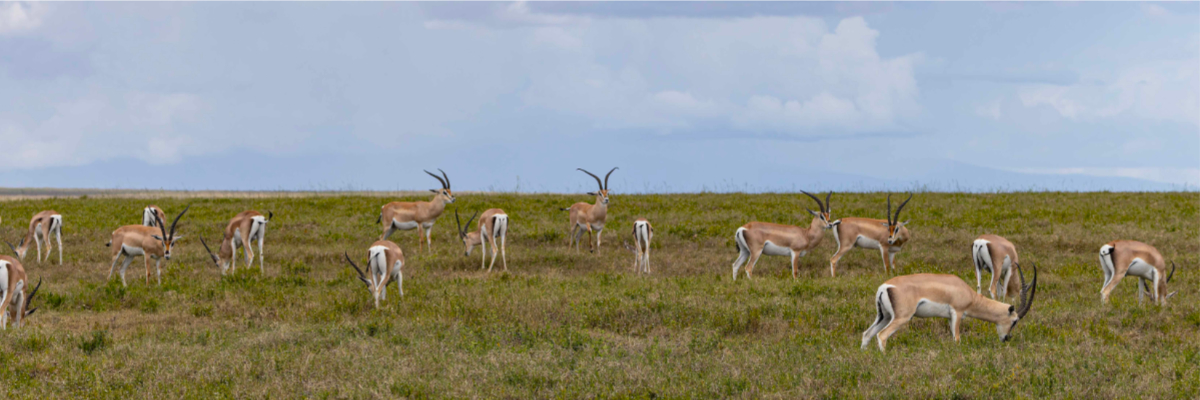
Highlights: lion, spotted hyena, black-backed jackal, elephant, impala, topi, Thomson’s gazelle, Grant’s gazelle, plains zebra, Cape buffalo, olive baboon, blue wildebeest, leopard, cheetah, serval, hippo, secretary bird, three species of vulture, and a diversity of raptors (e-bird reports 519 bird species).
Days 7 and 8: Serengeti National Park
Full days of game-driving in the Serengeti (dawn to dusk), searching for the best wildlife sightings. ‘Serengeti’ means ‘Endless Plain’ in Swahili, and the Big Sky is overwhelming. We will be looking for herds of Wildebeest, zebra and Topi as they assemble for the Great Migration. These are not just incredible sights, but the sounds of thousands of wildebeest is unforgettable. And where there are big herds the predators won’t be far away.
An optional add-on of a hot-air-balloon ride (predawn until about 9:00 am) will be offered at $540 per person.
Day 9: Serengeti and Drive to Ngorongoro Crater
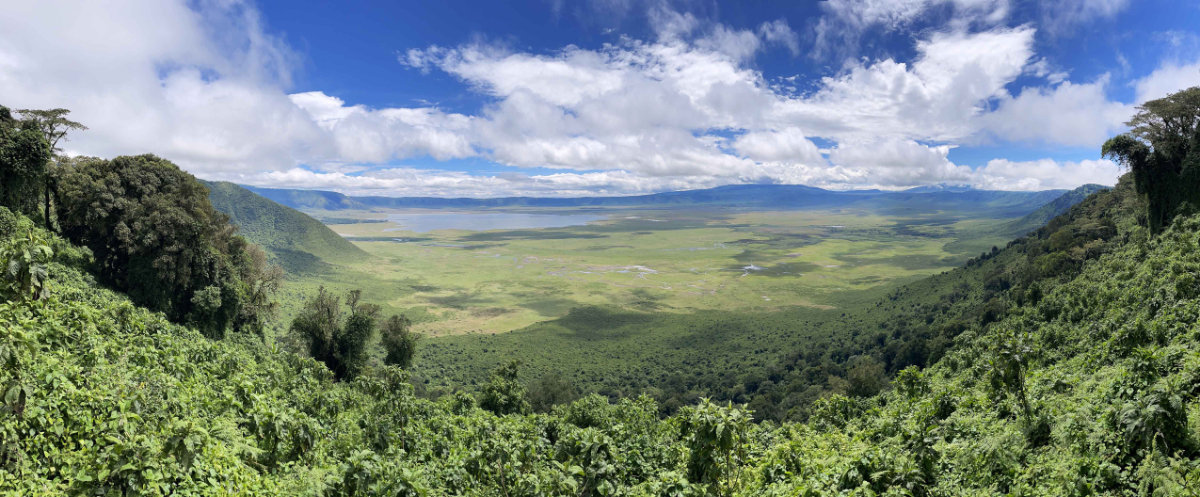
Early morning game drive in the Serengeti. After lunch, we transfer to the rim of the Ngorongoro Crater. There are amazing views from the hotel down into the crater. But don’t forget to look in the woodlands around the hotel for animals (especially birds) of montane woodlands that we won’t see anywhere else.
Full-day game drive in the Ngorongoro Crater. Ngorongoro is a special place and the first time you descend onto the crater floor is like no other safari experience in Africa. This is a world unto itself, one where we encounter some of the crater’s 600-strong population of hyenas, as well as critically endangered black rhinos. The elephants sport larger-than-average tusks, and more than 50 lions live in the crater.
The crater walls make a wonderful backdrop for the huge diversity of wildlife. The forested walls and savanna floor contrast with shore birds and flocks of flamingoes in and around Lake Magadi, which provide a splash of color.
Highlights: black rhinoceros, lion, hyena, jackal, elephant, Cape buffalo, sacred ibis, yellow-billed stork, gray crested-crane, and many others (e-bird reports 636 bird species).
We transfer to Kilimanjaro International Airport stopping along the way for lunch. Mount Kilimanjaro is often socked in with cloud, but it may be possible to get a decent view of it along the way. Services end at the airport.
Arrive Home on June 1st.
The lodges have been selected to offer exceptional service and quality:
Arusha Planet Lodge: https://planet-lodges.com/lodges/arusha-planet-lodge/
Conserve Safari Tarangire Camp: https://www.conservesafari.com/conserve-safari-tarangire
Jackal’s Lair Camp: https://planet-lodges.com/lodges/jackals-lair-camp/
Ngorongoro Serena Safari lodge: https://www.serenahotels.com/ngorongoro
Farm of Dreams Lodge: https://www.tripadvisor.com/Hotel_Review-g790144-d8436440-Reviews-Farm_of_Dreams_Lodge-Karatu_Arusha_Region.html
On Day 1, you will be met at Kilimanjaro International Airport (JRO) by a representative of KatiKati Tours, and there will be a 1-hour (30-mile) drive to our hotel in Arusha.
Notes on weather
We are going in the ‘shoulder season’ to get the best prices but also to avoid the crush of high-season tourists in June and July. It is chilly in the mornings and so a down puffer jacket is a great thing to pack. Midday it will be in the low 80s. A good sunhat is essential.
Health notes
Avoiding biting insects is a good precaution. Long sleeves and pants are recommended, with socks and shoes especially at dawn and dusk. Wear earth-tone clothing. Do not wear black or blue because those colors attract biting tsetse flies.
We strongly recommend you consult your doctor for the best advice on immunizations and related matters.
From websites:
Needed: Malarial prophylaxis, Hepatitis A; Poliomyelitis (adult booster); Tetanus.
Other vaccines to consider: Diphtheria; Hepatitis B; Meningococcal Meningitis; Rabies; Typhoid.
Yellow fever vaccination is not necessary unless coming from a yellow-fever country.
Hepatitis A is usually given as a single initial injection, with a second dose 6–12 months later. Two doses should protect you for at least 25 years.
Packing List
We will provide a full packing list nearer the time, but traveling light is encouraged and we ask that you pack in soft-sided bags so your luggage can be stowed in the trucks.
Visas
US citizens are required to get a multiple-entry visa ($162…it says $100 but there are additional fees). Visas can be purchased easily on-line or if you wait in line at Immigration on arrival at Kilimanjaro International Airport. https://evisaentry.com/destinations/tanzania
Questions? Please contact Mark (mbush@fit.edu) or Rich (raronson@fit.edu).
/prod01/fit-cdn-pxl/media/site-specific/wwwfitedu/development/images/classy/Tanzania-Arusha-Planet-Lodge.png)
/prod01/fit-cdn-pxl/media/site-specific/wwwfitedu/development/images/classy/Tanzania-Arusha-Planet-Lodge.png)
/prod01/fit-cdn-pxl/media/site-specific/wwwfitedu/development/images/classy/Tanzania-Arusha-Planet-Lodge-1.png)
/prod01/fit-cdn-pxl/media/site-specific/wwwfitedu/development/images/classy/Tanzania-Arusha-Planet-Lodge-1.png)
/prod01/fit-cdn-pxl/media/site-specific/wwwfitedu/development/images/classy/Tanzania-Sykes-Monkey.jpg)
/prod01/fit-cdn-pxl/media/site-specific/wwwfitedu/development/images/classy/Tanzania-Sykes-Monkey.jpg)
/prod01/fit-cdn-pxl/media/site-specific/wwwfitedu/development/images/classy/Tanzania-Cheetah.jpg)
/prod01/fit-cdn-pxl/media/site-specific/wwwfitedu/development/images/classy/Tanzania-Cheetah.jpg)
/prod01/fit-cdn-pxl/media/site-specific/wwwfitedu/development/images/classy/Tanzania-Serengeti-National-Park.jpg)
/prod01/fit-cdn-pxl/media/site-specific/wwwfitedu/development/images/classy/Tanzania-Serengeti-National-Park.jpg)
/prod01/fit-cdn-pxl/media/site-specific/wwwfitedu/development/images/classy/Tanzania-Conserve-Safari-Tarangire-Tented-Camp-1.jpg)
/prod01/fit-cdn-pxl/media/site-specific/wwwfitedu/development/images/classy/Tanzania-Conserve-Safari-Tarangire-Tented-Camp-1.jpg)
/prod01/fit-cdn-pxl/media/site-specific/wwwfitedu/development/images/classy/Tanzania-Elephants.jpg)
/prod01/fit-cdn-pxl/media/site-specific/wwwfitedu/development/images/classy/Tanzania-Elephants.jpg)
/prod01/fit-cdn-pxl/media/site-specific/wwwfitedu/development/images/classy/Tanzania-Giraffe.jpg)
/prod01/fit-cdn-pxl/media/site-specific/wwwfitedu/development/images/classy/Tanzania-Giraffe.jpg)
/prod01/fit-cdn-pxl/media/site-specific/wwwfitedu/development/images/classy/Tanzania-Hippo.jpg)
/prod01/fit-cdn-pxl/media/site-specific/wwwfitedu/development/images/classy/Tanzania-Hippo.jpg)
/prod01/fit-cdn-pxl/media/site-specific/wwwfitedu/development/images/classy/Tanzania-Lions.jpg)
/prod01/fit-cdn-pxl/media/site-specific/wwwfitedu/development/images/classy/Tanzania-Lions.jpg)
/prod01/fit-cdn-pxl/media/site-specific/wwwfitedu/development/images/classy/Tanzania-Ngorongoro-Crater.jpg)
/prod01/fit-cdn-pxl/media/site-specific/wwwfitedu/development/images/classy/Tanzania-Ngorongoro-Crater.jpg)
/prod01/fit-cdn-pxl/media/site-specific/wwwfitedu/development/images/classy/Tanzania-Zebras.jpg)
/prod01/fit-cdn-pxl/media/site-specific/wwwfitedu/development/images/classy/Tanzania-Zebras.jpg)