MENU

What is Space Sciences?

Get a Master's in Space Sciences

The Space Sciences Graduate Certificate

Earn an Ed.S. in Space Sciences

The Ph.D. in Space Sciences

Build deep research expertise across the space sciences.

Space sciences is an inherently interdisciplinary field that brings together astronomy, astrophysics, space physics, planetary and solar studies, and the physics of lightning. Florida Tech’s Ph.D. in space sciences supports both broad-ranging investigation and focused doctoral research within these areas.

The program emphasizes rigorous, research-intensive training aligned with the highest standards of the discipline. Students develop advanced computational, observational and analytical skills through sustained engagement in mission-driven science and fundamental discovery, producing original research that advances understanding of space and planetary systems.

Tier 1
Best National University
U.S. News & World Report
Top 5.8%
World University Ranking
The Center for World University Rankings

Why Choose Florida Tech for Space Sciences?

Florida Tech’s space sciences Ph.D. emphasizes sustained doctoral research supported by close faculty mentorship and access to advanced observational, computational and instrumentation resources. Located in the heart of the Space Coast, the university maintains long-standing research relationships with government laboratories, research centers and industry organizations.

The space sciences Ph.D. program at Florida Tech offers a close-knit academic environment with individualized mentorship and strong access to research opportunities. Small class sizes and regular faculty interaction support a tailored doctoral experience focused on developing independent research skills and clarifying long-term research and career goals.

Faculty are active researchers contributing to instrumentation development, observational and computational studies, and space-based missions. Their work has included projects associated with the Gran Telescopio Canarias and NASA missions such as Juno, Parker Solar Probe and Voyager, giving doctoral students opportunities to engage directly in mission-related research and data analysis.
Florida Tech provides access to facilities that support research across astrophysics, planetary science and space physics. The Olin Physical Sciences Center houses the Ortega Observatory, the Geospace Physics Laboratory and specialized spaces for instrumentation development and computational research.

Doctoral students work with data from major space observatories including Hubble, James Webb and Chandra, as well as ground-based facilities such as the Gran Telescopio Canarias, Gemini Observatories and the Very Large Array.

As a founding institution of the Southeastern Association for Research in Astronomy (SARA), Florida Tech provides remote access to one-meter-class telescopes at Kitt Peak National Observatory in Arizona, Cerro Tololo Inter-American Observatory in Chile and the Instituto de Astrofísica de Canarias in the Canary Islands.

Ph.D. students in space sciences explore astrophysics, planetary science and heliophysics, working on projects that span stellar and planetary systems, exoplanets, solar wind interactions and space instrumentation.

Other research areas include supermassive black holes and galaxy evolution, astrophysical jets, massive stars, cosmic ray propagation and energetic radiation from terrestrial and planetary lightning discharges.

This broad research landscape allows students to pursue original research across the space sciences while developing deep expertise within a focused area of study.

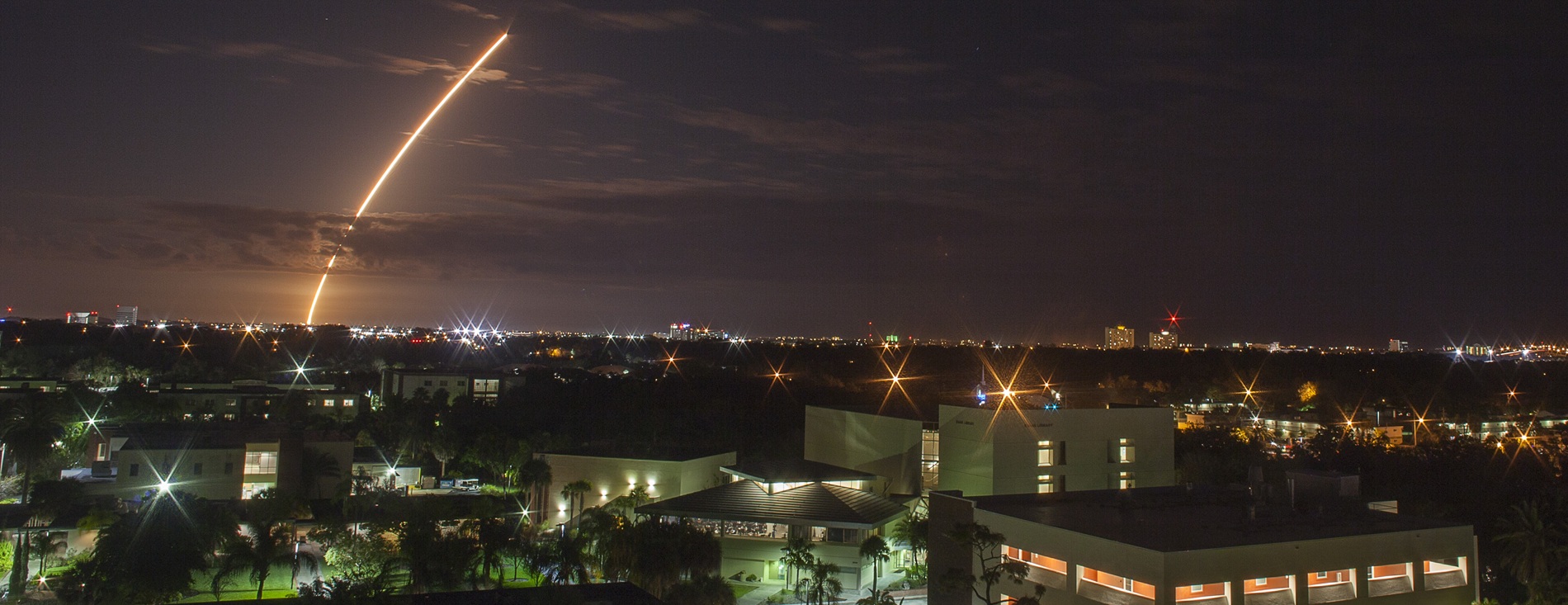
Florida Tech’s location in the heart of the Space Coast gives students direct access to one of the world’s most active hubs for space research. Proximity to NASA-Kennedy Space Center and major industry and government partners creates opportunities for collaboration on ongoing missions, instrumentation development and data-driven research.

Doctoral students engage with tools and data that support space exploration, satellite operations and atmospheric and geospace studies, with research often conducted in partnership with organizations such as NASA, Lockheed Martin, L3Harris Technologies and Northrop Grumman.

Academic units at Florida Tech may offer graduate student assistantships to full-time, degree-seeking graduate students on a competitive basis.

Teaching Assistants (TAs) support faculty in teaching undergraduate and graduate courses, including tasks such as grading, tutoring and conducting office hours. First-time TAs attend a teaching assistant seminar to prepare for their responsibilities.

Research Assistants (RAs) collaborate with faculty on projects funded by government agencies, private sponsors and university research funds.

For current information about assistantships, please contact the Department of Aerospace, Physics and Space Sciences.

Florida Tech offers a safe and welcoming campus environment that supports advanced research alongside personal well-being. The campus includes extensive green spaces, such as the Joy and Gordon Patterson Botanical Garden, along with facilities like the Holzer Health Center and Clemente Center for health, fitness and stress management.

Located minutes from the Indian River Lagoon and 72 miles of Atlantic beaches, the university combines access to outdoor recreation with proximity to industry and government organizations that contribute to research collaboration and career development.

Graduate students from around the world come together at Florida Tech in a campus community that fosters international collaboration and innovation. This environment encourages students to work across cultures and perspectives, preparing them for research and professional settings around the globe.

International Student and Scholar Services (ISSS) supports international students throughout their academic journey, providing guidance on immigration matters, serving as a liaison with sponsoring agencies and foreign governments, and sharing information about campus and community resources.

Careers in Space Sciences

Graduates of the space sciences Ph.D. pursue careers in academic research, government agencies and the commercial space sector.

Doctoral training emphasizes advanced research skills in space physics, planetary science, atmospheric and geospace systems, and computational methods. Graduates develop strong analytical, computational and observational expertise applicable across a wide range of space science research and applied science settings.

These skills support work in areas such as commercial spaceflight, defense and national security, climate and environmental research, and organizations focused on spacecraft instrumentation, mission analysis and applied space science.

Note: Employment data reflect positions commonly associated with this field. Many Ph.D. graduates go on to academic, leadership and advanced research, technical and analytical roles not captured here.

Florida Tech Career Services helps students, alumni and employers connect through career planning, job search support and recruitment resources.

For information on job outlook, pay and working conditions in this field and related fields in the United States, see the Occupational Outlook Handbook from the U.S. Bureau of Labor Statistics.

Advanced Degree Options

Explore Doctoral Research

The dissertation is the centerpiece of the space sciences Ph.D., allowing students to advance both their expertise and the field.

Doctoral research spans observational, experimental and computational studies, with recent topics including spacecraft navigation, small satellites, astrophysical and planetary observations, solar wind and space weather, and machine learning for space data analysis.

These projects develop skills and experience that support careers in academia, government research, aerospace and the commercial space sector.

Browse recent dissertations in the Florida Tech Scholarship Repository.

Explore the Space Sciences, Ph.D., Curriculum

The Space Sciences, Ph.D., Curriculum

The Florida Tech space sciences Ph.D. provides the breadth and depth expected of the highest-level degree, with focus areas including astronomy, astrophysics, space physics, planetary and solar studies, and the physics of lightning.

Students integrate advanced coursework with research, developing the analytical, computational and observational skills required for independent scientific investigation. This work culminates in the dissertation, where students make original contributions to the field of space sciences.

Students entering with a bachelor’s degree complete at least 72 semester credit hours, including the 30-credit Florida Tech space sciences M.S. curriculum.

Students entering with a master’s degree complete at least 42 semester credit hours beyond the master's degree to fulfill Ph.D. requirements.

Check the catalog for a description of all courses. Check the catalog for detailed degree requirements.

Download the Space Sciences, Ph.D., Curriculum now!

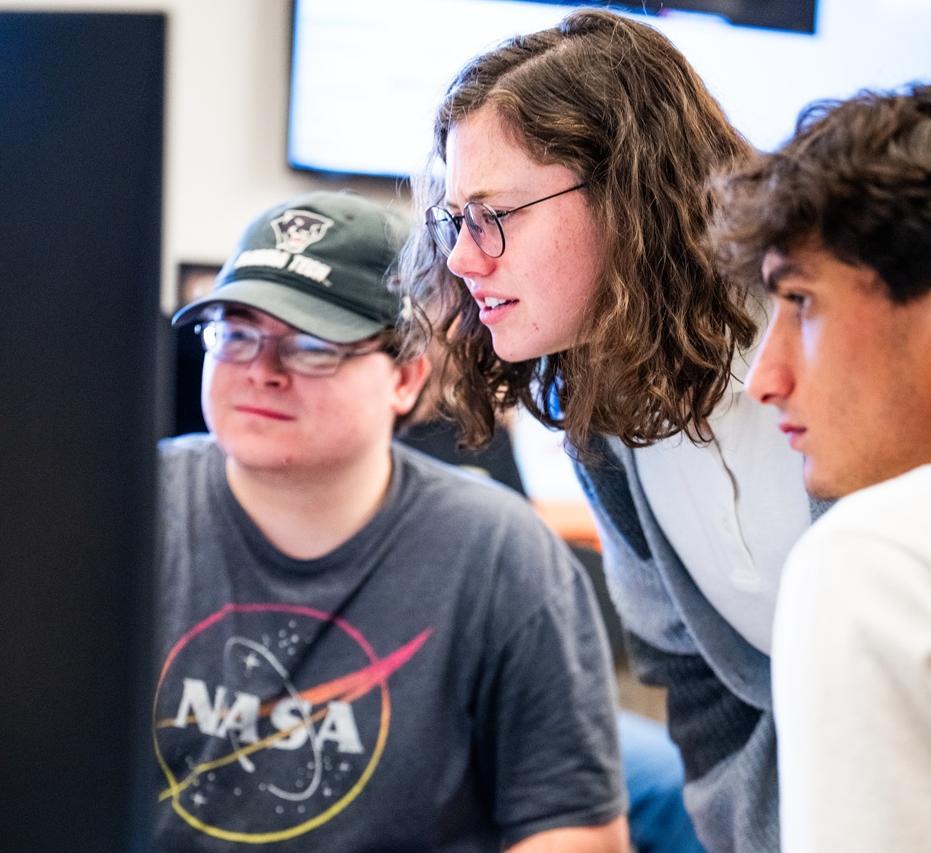
students working in the Ortega Observatory

Research Opportunities in Space Sciences

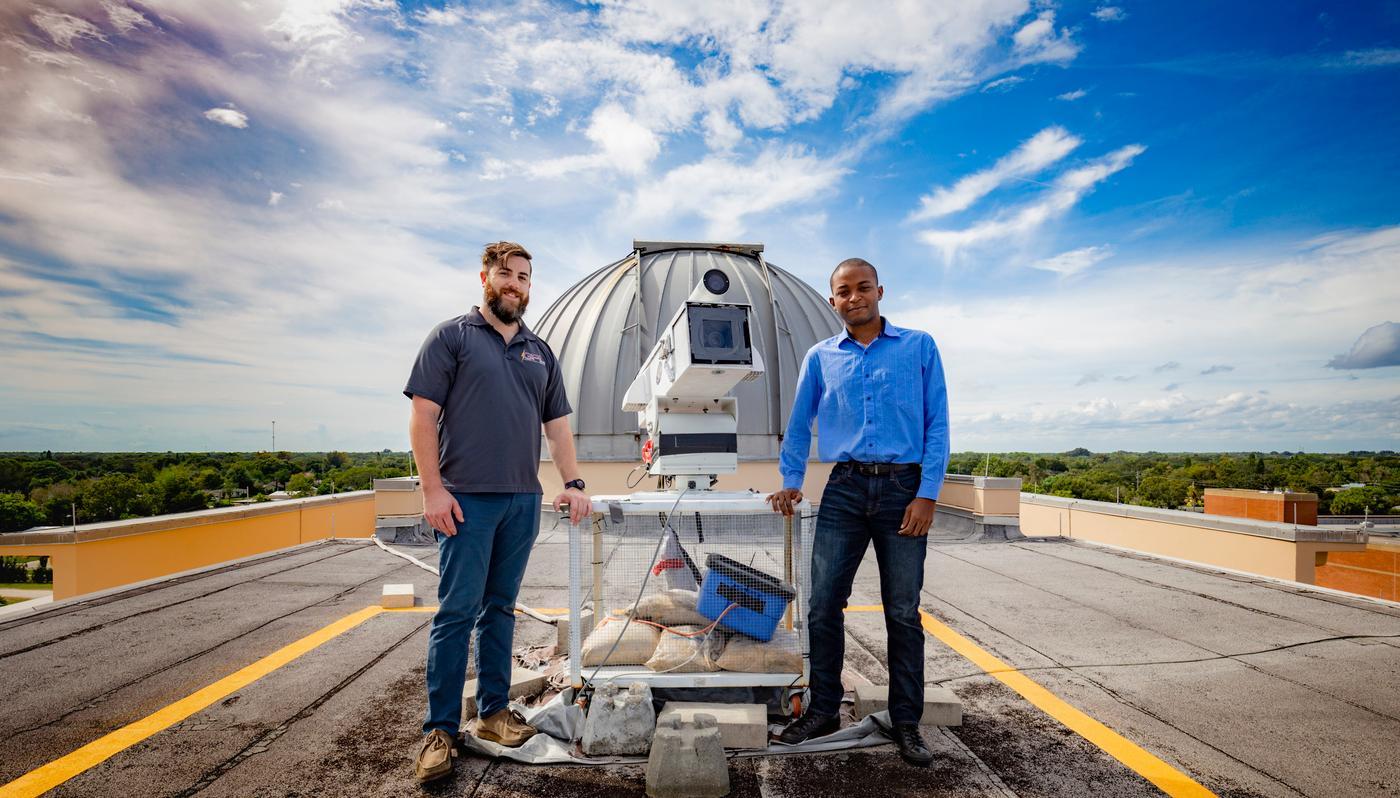
Student researchers setting up a high-speed camera on the roof of the Olin Physical Sciences building to capture images of lightning for research.

Space sciences Ph.D. students at Florida Tech engage in fundamental and applied research across a broad spectrum of topics.

Faculty lead projects in space physics, planetary science, astrophysics, heliophysics, orbital mechanics and space instrumentation, providing opportunities for students to participate in mission-focused research, instrumentation development and satellite data analysis.

Doctoral students gain experience with observational data, numerical modeling and computational analysis, developing skills essential for careers in academia, government research and the commercial space sector.

The Geospace Physics Laboratory studies solar–terrestrial interactions, space weather and particle and radiation processes in Earth’s magnetosphere, including solar wind modeling, detector development and atmospheric electricity phenomena such as lightning and transient luminous events.

Planetary science and astrophysics groups explore planetary atmospheres, exoplanets, stellar systems and high-energy astrophysical phenomena, conducting observational and simulation-based research with ground- and space-based telescopes and developing instrumentation for current and future missions.

Learn more about Space Sciences at Florida Tech on the Aerospace Physics and Space Sciences website.

Loading...
Edit Page