MENU

What is Ocean Engineering?

Get a Master's in Ocean Engineering

The Ocean Engineering Graduate Certificate

Earn an Ed.S. in Ocean Engineering

The Ph.D. in Ocean Engineering

Advance the frontiers of ocean engineering through original, interdisciplinary research.

Florida Tech’s Ph.D. in ocean engineering prepares researchers to address complex problems in coastal, marine and offshore systems with a combination of advanced coursework, hands-on laboratory work and field-based studies.

The program offers a research-intensive environment with specialized facilities, cutting-edge tools and a collaborative culture that fosters interdisciplinary expertise and innovation.

Doctoral students work closely with faculty to conduct original research that contributes to the field and prepares graduates for leadership roles in industry, government agencies or academia.

Tier 1
Best National University
U.S. News & World Report
Top 5.8%
World University Ranking
The Center for World University Rankings

Why Choose Florida Tech for Ocean Engineering?

Florida Tech offers a research-focused environment with expert faculty, advanced facilities and direct access to the Atlantic Ocean and Indian River Lagoon. Students benefit from hands-on study, field-based research and strong connections to marine and engineering industries, gaining the skills and experience needed to solve real-world challenges in coastal, marine and offshore systems.

Florida Tech offers a research-intensive environment where ocean engineering doctoral students develop interdisciplinary expertise under faculty who are leaders in marine and coastal innovation.

Small classes and focused research groups support close mentorship as students design and conduct original research, while collaboration with faculty and peers broadens perspectives and strengthens engineering approaches.

Advanced coursework, specialized research facilities and hands-on laboratory and field training prepare students to become independent engineers capable of addressing complex challenges in marine, offshore and coastal systems.

Research is central to the ocean engineering Ph.D. at Florida Tech, giving students the opportunity to make original contributions to the field. Doctoral research is tailored to students’ academic and professional interests and spans a broad range of marine and coastal engineering challenges.

Areas of research focus include:

  • Coastal engineering and resilience: coastal structures such as breakwaters, revetments and seawalls, nature-based solutions including reef balls, oysters and vegetation, and coastal hazards and morphodynamics such as beach erosion and barrier island dynamics
  • Marine materials and sustainability: corrosion, materials science, mineral exploitation and waste disposal
  • Naval and ocean vehicle systems: naval architecture, shipbuilding including small craft, and underwater vehicle development
  • Hydrodynamics and marine instrumentation: fluid dynamics, ocean energy and the design of marine instrumentation and positioning systems

Doctoral students in ocean engineering at Florida Tech engage with a broad network of experts, creating meaningful opportunities for fieldwork, applied research and professional networking. These partnerships extend doctoral research beyond campus and support collaboration with organizations actively addressing real-world marine and coastal challenges.

Students may work alongside leading organizations, including:

  • Federal and government agencies: U.S. Space Force (45th Weather Squadron), NASA-Kennedy Space Center, NOAA, U.S. Army Corps of Engineers, FEMA, U.S. Coast Guard, National Weather Service.
  • Leading research institutions: Woods Hole Oceanographic Institution, Scripps Institution of Oceanography, Hubbs-SeaWorld Research Institute, Harbor Branch Oceanographic Institute.
  • Nonprofit and professional organizations: Marine Resources Council, Society of Naval Architects and Marine Engineers, and various industry partners.

These collaborations support research in coastal observation, environmental monitoring and applied engineering, expanding both technical expertise and professional networks.

Florida Tech’s Ph.D. program in ocean engineering provides a research-intensive environment with access to a range of state-of-the-art laboratories. Students conduct original research in areas such as fluid mechanics, wave dynamics, underwater technology, corrosion and materials performance.

Research facilities include the structures laboratory for advanced materials testing, the fluid mechanics laboratory for flow and pressure experiments, and the underwater technology laboratory for work with robotic systems, sensors and electronics.

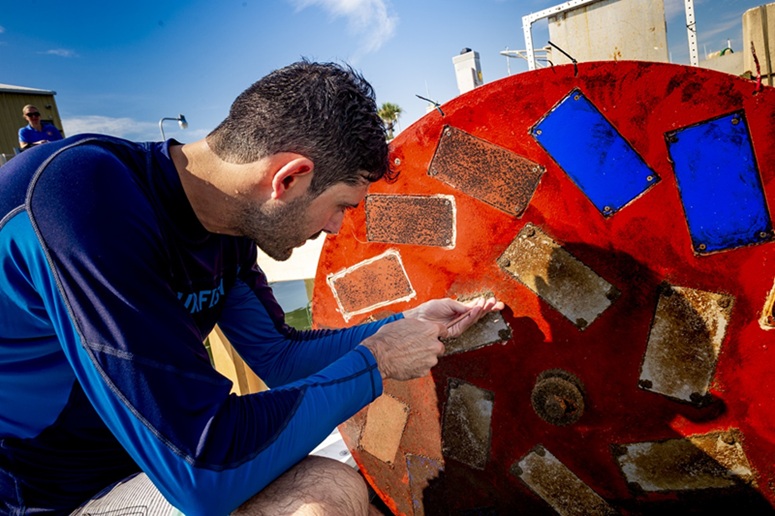
Located minutes from campus, the Mertens Marine Center and the Ralph S. Evinrude Marine Operations Center provide direct water access and support research projects ranging from shallow-water studies using small vessels to offshore work conducted through chartered platforms. The marine materials exposure site in the Indian River Lagoon enables testing of biofouling and corrosion resistance under real-world conditions.

Academic units at Florida Tech may offer graduate student assistantships to full-time, degree-seeking graduate students on a competitive basis.

Teaching Assistants (TAs) support faculty in teaching undergraduate and graduate courses, including tasks such as grading, tutoring and conducting office hours. First-time TAs attend a teaching assistant seminar to prepare for their responsibilities.

Research Assistants (RAs) collaborate with faculty on projects funded by government agencies, private sponsors and university research funds.

For current information about assistantships, please contact the Department of Ocean Engineering and Marine Sciences.

Florida Tech’s Space Coast location offers an exceptional setting for advanced ocean engineering research. Proximity to the Atlantic Ocean and the Indian River Lagoon gives doctoral students access to a range of coastal and marine environments that support hands-on experimentation, field testing and long-term monitoring of marine and coastal systems.

Access to extensive shoreline and active marine and engineering organizations supports applied research and professional experience with government agencies, consulting firms, offshore operations, aquaculture ventures and private marine technology companies.

The region’s high-tech corridor further enables collaboration with scientists and engineers across related disciplines, expanding the scope of research projects and strengthening career opportunities for doctoral students.

Graduate students from around the world come together at Florida Tech in a campus community that fosters international collaboration and innovation. This environment encourages students to work across cultures and perspectives, preparing them for research and professional settings around the globe.

International Student and Scholar Services (ISSS) supports international students throughout their academic journey, providing guidance on immigration matters, serving as a liaison with sponsoring agencies and foreign governments, and sharing information about campus and community resources.

Florida Tech offers a safe and welcoming campus environment that supports advanced research alongside personal well-being. The campus includes extensive green spaces, such as the Joy and Gordon Patterson Botanical Garden, along with facilities like the Holzer Health Center and Clemente Center for health, fitness and stress management.

Located minutes from the Indian River Lagoon and 72 miles of Atlantic beaches, the university combines access to outdoor recreation with proximity to industry and government organizations that contribute to research collaboration and career development.

Careers in Ocean Engineering

The Ph.D. in ocean engineering prepares graduates for advanced technical and leadership roles where they design, direct and innovate. They lead research teams and serve as experts in academia, government and industry worldwide.

Doctoral training builds deep expertise in hydrodynamics, coastal processes, marine materials, ocean energy, instrumentation and underwater systems, equipping graduates to address complex global challenges in ocean infrastructure, exploration and resource management.

Graduates pursue roles across a variety of sectors:

  • Industry and innovation: senior ocean engineer, naval architect (R&D), offshore renewable energy engineer, ROV/AUV systems engineer, subsea pipeline engineer, marine operations director
  • Government and regulation: coastal or hydrographic engineer, research engineer (e.g., national laboratories), environmental and coastal resilience engineer, ocean data scientist/analyst.
  • Academia and consulting: university faculty/researcher, postdoctoral fellow, project manager—offshore or coastal systems.

With doctoral-level skills in advanced numerical modeling, experimental methods and specialized field research, graduates contribute to innovation in offshore engineering, ocean-technology companies, national laboratories and critical environmental and regulatory agencies.

Note: Employment data reflect positions commonly associated with this field. Many Ph.D. graduates go on to academic, leadership and advanced research, technical and analytical roles not captured here.

Florida Tech Career Services helps students, alumni and employers connect through career planning, job search support and recruitment resources.

For information on job outlook, pay and working conditions in this field and related fields in the United States, see the Occupational Outlook Handbook from the U.S. Bureau of Labor Statistics.

Advanced Degree Options

Explore Doctoral Research

The dissertation is the centerpiece of the ocean engineering Ph.D., giving students the opportunity to advance both their technical expertise and the field itself.

Through laboratory experiments, numerical modeling, prototype development and real-world field studies, doctoral research addresses challenges in areas such as marine systems, coastal structures, underwater vehicles, hydrodynamics, ocean instrumentation, corrosion and renewable energy.

Browse recent dissertations in the Florida Tech Scholarship Repository.

Explore the Ocean Engineering, Ph.D., Curriculum

The Ocean Engineering, Ph.D., Curriculum

Florida Tech’s Ph.D. in ocean engineering features a rigorous, multidisciplinary curriculum designed to prepare students for advanced research and independent scientific investigation.

Students have access to advanced coursework across ocean engineering, naval architecture, oceanography, environmental science, meteorology and marine biology, providing the breadth of knowledge needed to succeed in ocean engineering while allowing students to gain significant depth in a chosen area of specialization.

The program combines advanced coursework with hands-on laboratory experience and field-based study, equipping students to conduct innovative research in coastal, ocean and offshore environments.

Doctoral candidates complete a minimum of 42 credit hours beyond a master’s degree and culminate their studies with a dissertation that makes an original, independent contribution to the field.

Check the catalog for a description of all courses. Check the catalog for detailed degree requirements.

Download the Ocean Engineering, Ph.D., Curriculum now!

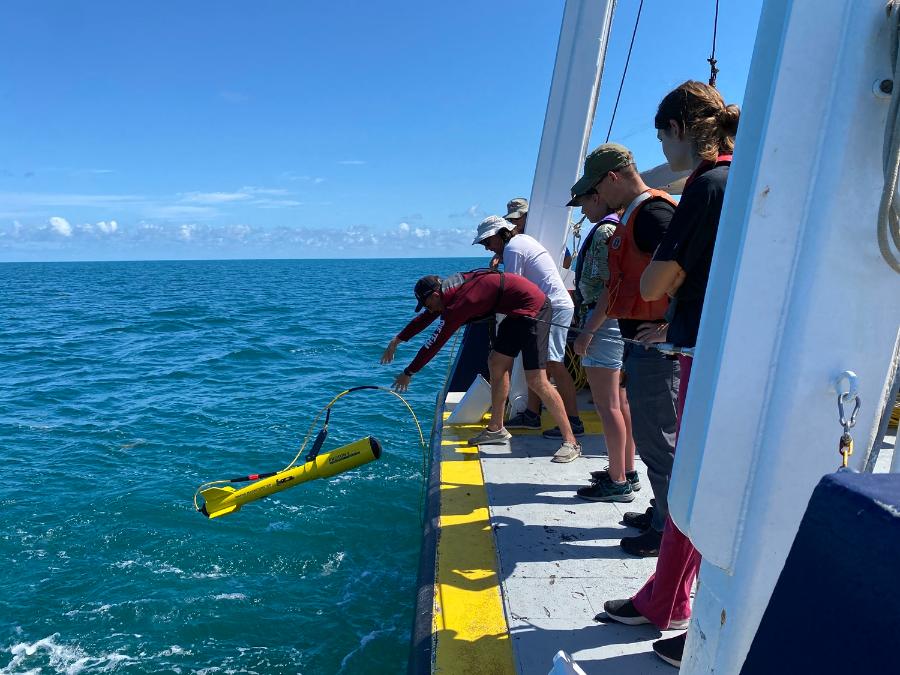
Students launching an ROV on a research cruise

Engineering Solutions for Marine Environments

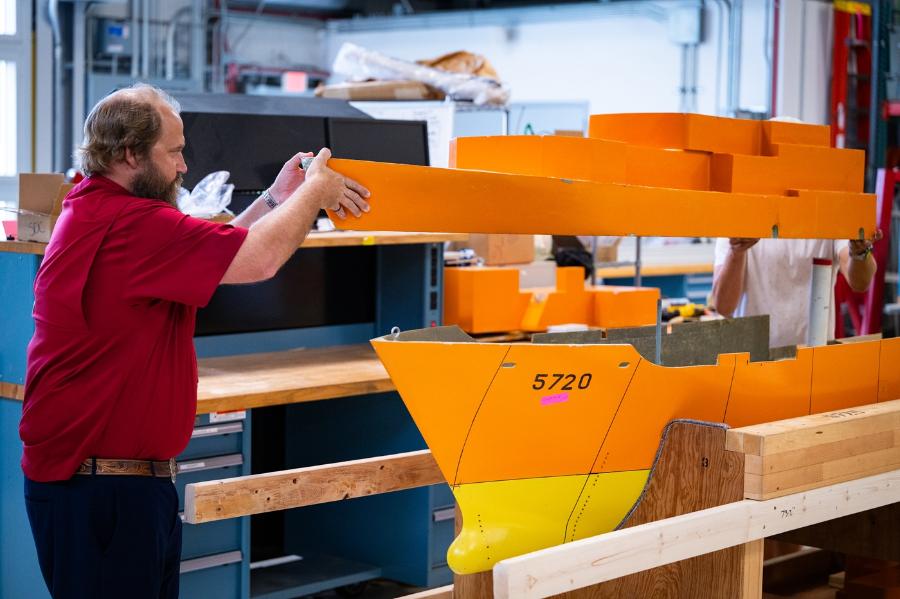
Dr. Travis Hunsucker working with a scale self-propelled model of a U.S. Navy research ship

Florida Tech faculty bring deep expertise to ocean engineering and marine sciences research across a wide range of marine and coastal systems.

Their work spans studying water flow and its interaction with ships, offshore structures and coastal environments, as well as developing technologies to harness ocean energy.

Faculty investigate biofouling and other surface effects on marine structures, explore materials and protective solutions, and develop strategies to enhance coastal resilience.

Research in underwater vehicles, robotics, and marine sensing and instrumentation supports monitoring and analysis of ocean and coastal conditions, generating insights that guide engineering solutions and sustainable practices.

Learn more about Ocean Engineering at Florida Tech on the Ocean Engineering and Marine Sciences website.

Applied Ocean Engineering Research

Researchers at Florida Tech tackle real-world challenges by combining engineering innovation with environmental awareness.

Together, these labs provide hands-on opportunities to address challenges across marine, coastal and offshore systems.
Loading...
Edit Page