MENU

What is Physics?

Get a Master's in Physics

The Physics Graduate Certificate

Earn an Ed.S. in Physics

The Ph.D. in Physics

Build expertise for advanced work in academia, research and industry.

Florida Tech’s Ph.D. in physics combines rigorous coursework with sustained, hands-on research in areas such as high-energy physics, astrophysics, plasma science and aerospace applications.

Students work closely with faculty to develop an individualized research path that spans experimental, observational and computational approaches to physics.

Doctoral research draws on globally connected projects, advanced instrumentation and interdisciplinary collaboration. From particle and detector physics to space and atmospheric systems, students gain the depth and independence required to make original contributions to physics and its practical applications.

Tier 1
Best National University
U.S. News & World Report
Top 5.8%
World University Ranking
The Center for World University Rankings

Why Choose Florida Tech for Physics?

Florida Tech emphasizes doctoral research as an active, mentored process. Faculty work closely with Ph.D. students from the earliest stages of inquiry through dissertation, helping them define meaningful research questions and develop the skills needed for independent investigation. Students conduct sustained research using advanced instrumentation, computational tools and interdisciplinary methods. This research-focused environment supports original contributions to both fundamental physics and applied scientific challenges.

Physics doctoral students are immersed in Florida Tech's rich research culture, where scientists and engineers explore the behavior of matter and energy across the universe and in practical aerospace contexts.

Faculty conduct research in high-energy particle physics, space physics, astrophysics, planetary science, plasma processes and the physical dynamics of atmospheres and oceans. Students have opportunities to work in specialized laboratories such as the High-Energy Physics Lab and the Geospace Physics Lab, as well as on aerospace and space-system challenges involving orbital mechanics, aerodynamics, propulsion and spacecraft dynamics.

This breadth supports doctoral research that connects fundamental physics with applied discovery, from subatomic particles to planetary systems.
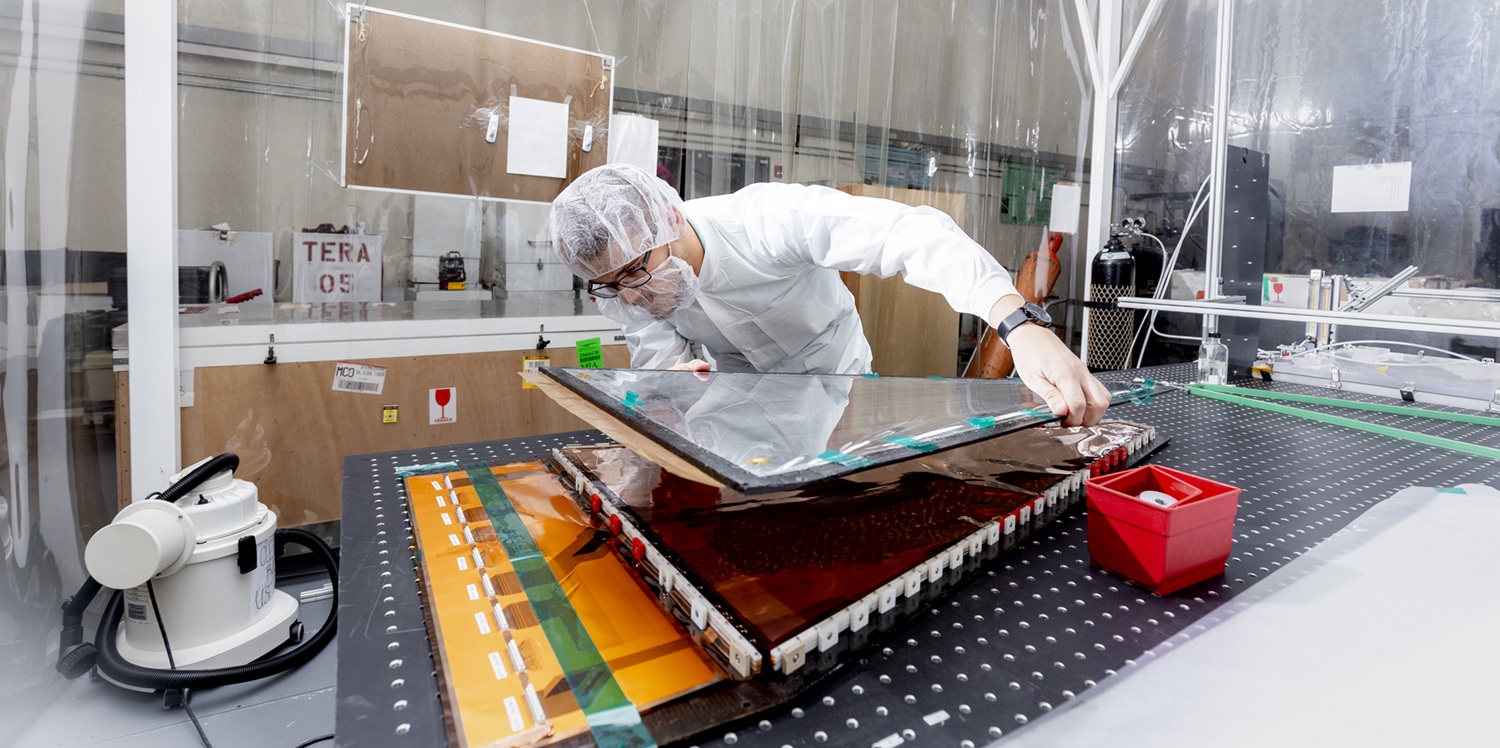
Florida Tech’s physics faculty bring global research experience into the classroom and lab, with work ranging from particle studies at CERN to advanced computational methods in high-energy physics. Faculty lead and contribute to research in detector design, dark matter, high-energy astrophysics and advanced modeling, and participate in international collaborations such as CMS and RD51. These connections link students directly to active research networks worldwide.

The F.W. Olin Physical Sciences Center is home to the Department of Aerospace, Physics and Space Sciences. It houses state-of-the-art instrumentation such as gas electron multiplier detectors and an array of small and large telescopes. Many research projects take place in this building, including a large Mars chamber and a muon detection system for the Large Hadron Collider.

Olin Physical Sciences features a rooftop observatory, as well as a geospace laboratory with a clean room for spacecraft instrumentation projects and a 3,500-square-foot high bay physics research hall for magnetic levitation launch systems and high-energy physics research.

Florida Tech is ideally located for physics students, in the heart of the Space Coast high-tech corridor. NASA-Kennedy Space Center on Cape Canaveral is just north of us, and the region is home to numerous aerospace and high-tech companies.

Students benefit from Florida Tech’s strong connections to leading organizations both locally and globally, gaining access to research collaborations and networking opportunities that can shape their careers.

Some organizations that provide Florida Tech physics students with hands-on opportunities include:

  • CERN, Switzerland
  • L3Harris Technologies
  • NASA-Kennedy Space Center
  • Lockheed Martin

Academic units at Florida Tech may offer graduate student assistantships to full-time, degree-seeking graduate students on a competitive basis.

Teaching Assistants (TAs) support faculty in teaching undergraduate and graduate courses, including tasks such as grading, tutoring and conducting office hours. First-time TAs attend a teaching assistant seminar to prepare for their responsibilities.

Research Assistants (RAs) collaborate with faculty on projects funded by government agencies, private sponsors and university research funds.

For current information about assistantships, please contact the Department of Aerospace, Physics and Space Sciences.

Florida Tech offers a safe and welcoming campus environment that supports advanced research alongside personal well-being. The campus includes extensive green spaces, such as the Joy and Gordon Patterson Botanical Garden, along with facilities like the Holzer Health Center and Clemente Center for health, fitness and stress management.

Located minutes from the Indian River Lagoon and 72 miles of Atlantic beaches, the university combines access to outdoor recreation with proximity to industry and government organizations that contribute to research collaboration and career development.

Graduate students from around the world come together at Florida Tech in a campus community that fosters international collaboration and innovation. This environment encourages students to work across cultures and perspectives, preparing them for research and professional settings around the globe.

International Student and Scholar Services (ISSS) supports international students throughout their academic journey, providing guidance on immigration matters, serving as a liaison with sponsoring agencies and foreign governments, and sharing information about campus and community resources.

Careers in Physics

The individualized physics Ph.D. curriculum allows students to align advanced coursework and research with their academic and professional goals.

Florida Tech’s research strengths support preparation for academic positions, teaching, theoretical or computational physics, and technical roles across industry and government that require advanced physics expertise.

Specialized training in plasma physics, orbital mechanics, atmospheric physics and aerospace dynamics prepares graduates for research laboratories, government agencies, private space companies and other high-skill scientific roles. Graduates develop strong analytical and computational skills that support work across a wide range of physics research and applied science settings.

Note: Employment data reflect positions commonly associated with this field. Many Ph.D. graduates go on to academic, leadership and advanced research, technical and analytical roles not captured here.

Florida Tech Career Services helps students, alumni and employers connect through career planning, job search support and recruitment resources.

For information on job outlook, pay and working conditions in this field and related fields in the United States, see the Occupational Outlook Handbook from the U.S. Bureau of Labor Statistics.

Advanced Degree Options

Explore Doctoral Research

The dissertation is the centerpiece of the Ph.D., giving students the opportunity to advance both their expertise and the field of physics.

Students gain hands-on experience in experimental, observational and computational physics. Recent projects include particle and high-energy physics experiments, astrophysical studies, plasma turbulence, detector and sensor development and applied physics in aerospace and engineering contexts.

Browse recent dissertations in the Florida Tech Scholarship Repository.

Explore the Physics, Ph.D., Curriculum

The Physics, Ph.D., Curriculum

The physics Ph.D. at Florida Tech is awarded to students who achieve both broad and deep understanding of physics and demonstrate independent research capability. Successful candidates are expected to contribute to fundamental physics or its practical applications.

The program combines coursework with hands-on research, with students developing advanced problem-solving skills and preparing for independent scientific investigation. This research culminates in the Ph.D. dissertation, where students make original contributions to physics.

Students entering with a bachelor’s degree complete at least 72 semester credit hours, including the 30-credit Florida Tech physics M.S. curriculum.

Students entering with a master’s degree complete at least 42 semester credit hours beyond the master's degree to fulfill Ph.D. requirements.

Check the catalog for a description of all courses. Check the catalog for detailed degree requirements.

Download the Physics, Ph.D., Curriculum now!

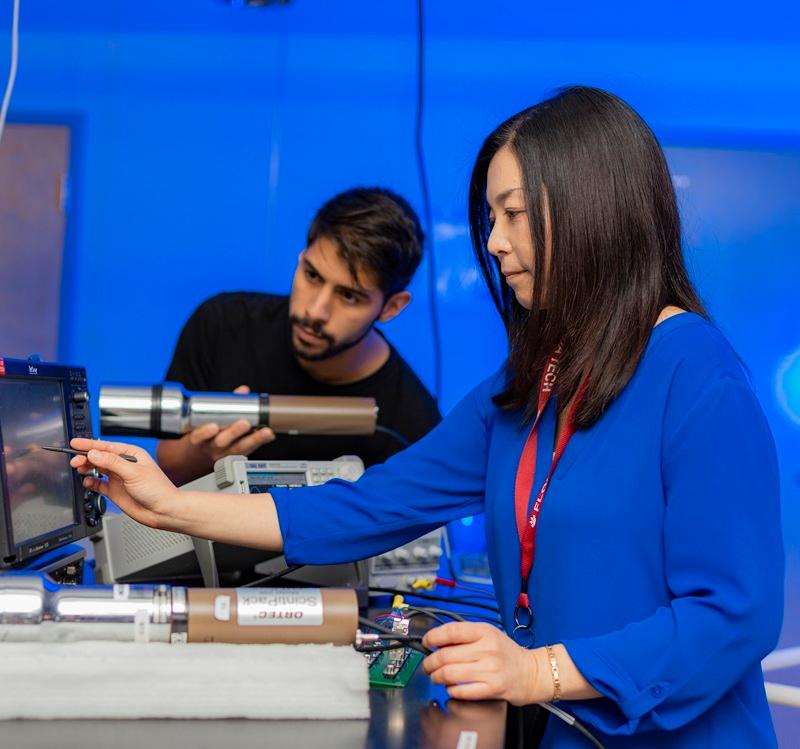
Two students collaborate in a physics research lab

Advanced Research Opportunities in Physics

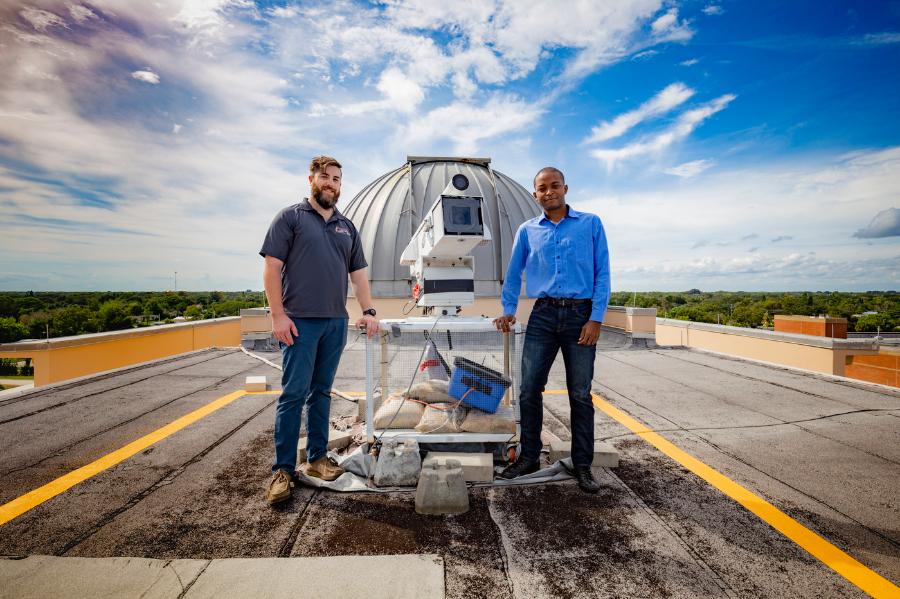
Student researchers setting up a high-speed camera on the roof of the Olin Physical Sciences building to capture images of lightning for research.

Physics Ph.D. students at Florida Tech engage in both fundamental and applied research across a broad spectrum of topics. Students work alongside faculty in experimental and theoretical high-energy physics, cosmic-ray studies, advanced instrumentation, engineering physics and physics education research.

Through hands-on projects in instrumentation, detector development, data-intensive research and computational modeling, students gain skills valued in academia, national laboratories, industry R&D and interdisciplinary research settings.

Atmospheric Electricity and Electromagnetics Group
The group studies lightning physics, electromagnetic wave propagation and advanced sensing technologies. Research includes modeling lightning strikes, improving protection strategies and investigating natural and rocket-triggered lightning with high-resolution X-ray imaging.

High Energy Particle Physics (HEP) Group
Faculty and students in the HEP group contribute to cutting-edge experiments at CERN and Brookhaven National Laboratory, studying top quarks, searching for dark matter and exploring new physics. The group also develops advanced particle detectors and supports major international collaborations, giving students hands-on experience in experimental physics at the frontiers of the field.

Learn more about Physics at Florida Tech on the Aerospace Physics and Space Sciences website.

Loading...
Edit Page