MENU

What is Human-Centered Design?

Get a Master's in Human-Centered Design

The Human-Centered Design Graduate Certificate

Earn an Ed.S. in Human-Centered Design

The Ph.D. in Human-Centered Design

Advance the science and practice of human-centered design.

In the Ph.D. in human-centered design (HCD), students conduct original research addressing complex challenges in products, services and systems. Drawing from engineering, psychology and the sciences, doctoral research examines human performance, usability, cognitive engineering and modeling and simulation in contexts where design decisions directly affect safety, effectiveness and outcomes.

With close guidance from faculty mentors, students pursue focused research in areas such as advanced interaction media, organizational design, life-critical systems and complex sociotechnical environments—preparing graduates to lead innovation in academia, government and industry.

Tier 1
Best National University
U.S. News & World Report
Top 5.8%
World University Ranking
The Center for World University Rankings

Why Choose Florida Tech for Human-Centered Design?

Florida Tech’s Ph.D. in human-centered design combines advanced research training with interdisciplinary, real-world application. Working closely with faculty mentors, you’ll design, test and evaluate complex products, services and systems, gaining insight into how technology, organizations and people interact. Graduates go on to lead research, shape how organizations work and apply their expertise to real-world challenges in academia, government and industry.

Florida Tech provides a research-driven, interdisciplinary environment where Ph.D. students in human-centered design work closely with faculty to address complex challenges in products, services, and systems.

Students conduct independent research and participate in collaborative projects integrating engineering, cognitive science and design, developing expertise in human-centered AI, cognitive engineering and usability for life-critical and sociotechnical systems.

Students use advanced facilities to study, model and evaluate complex human-centered systems, including laboratories for modeling and simulation, tangible and interactive objects, visualization, big data and human-system interaction.

Commercial aircraft and adaptable spaceship cockpit simulators, an advanced interaction media lab and 3D printing capabilities give students hands-on opportunities to study and design complex human-centered systems.

Ph.D. students receive close mentorship from faculty conducting leading research in human-centered design and AI.

Faculty expertise spans human-computer interaction, human-AI teamwork, human-centered design, cognitive science, human-facing software engineering, multi-agent systems and intelligent communication. They guide students in designing research programs that advance human-centered methods, usability and system performance in real-world contexts.

Florida Tech is located in the heart of Florida’s Space Coast, a region known for technology innovation.

Proximity to NASA-Kennedy Space Center, industry partners and government organizations provides opportunities for research collaboration and professional engagement, supporting both doctoral research and career development.

Academic units at Florida Tech may offer graduate student assistantships to full-time, degree-seeking graduate students on a competitive basis.

Teaching Assistants (TAs) support faculty in teaching undergraduate and graduate courses, including tasks such as grading, tutoring and conducting office hours. First-time TAs attend a teaching assistant seminar to prepare for their responsibilities.

Research Assistants (RAs) collaborate with faculty on projects funded by government agencies, private sponsors and university research funds.

For current information about assistantships, please contact the Department of Electrical Engineering and Computer Science.

Florida Tech offers a safe and welcoming campus environment that supports advanced research alongside personal well-being. The campus includes extensive green spaces, such as the Joy and Gordon Patterson Botanical Garden, along with facilities like the Holzer Health Center and Clemente Center for health, fitness and stress management.

Located minutes from the Indian River Lagoon and 72 miles of Atlantic beaches, the university combines access to outdoor recreation with proximity to industry and government organizations that contribute to research collaboration and career development.

Graduate students from around the world come together at Florida Tech in a campus community that fosters international collaboration and innovation. This environment encourages students to work across cultures and perspectives, preparing them for research and professional settings around the globe.

International Student and Scholar Services (ISSS) supports international students throughout their academic journey, providing guidance on immigration matters, serving as a liaison with sponsoring agencies and foreign governments, and sharing information about campus and community resources.

We welcome applications from students who hold a master’s degree in human-centered design or in engineering, physical or biological sciences, computer science or mathematics from accredited institutions.

The program is well suited for applicants with strong interests in human and social sciences or the arts, particularly where those interests intersect with technology and design. Applicants with experience in industry or academia are eligible, and prior hands-on experience is highly recommended.

Please see our graduate admission requirements for more information.

Careers in Human-Centered Design

Graduates of the Ph.D. in human-centered design are prepared for advanced research, leadership and innovation roles in academia, government and high-tech industry. They apply advanced expertise in usability, cognitive engineering, human-AI systems and life-critical design to solve complex challenges in products, services and integrated systems.

Career paths include:

  • Principal or senior researcher in human-centered design or human-AI systems
  • Technical director or lead designer in aerospace, technology or industrial sectors
  • Designer and analyst for advanced cockpits, control rooms, simulators or safety-critical systems
  • Faculty member or academic researcher
  • Founder of ventures focused on innovative human-centered solutions

Note: Employment data reflect positions commonly associated with this field. Many Ph.D. graduates go on to academic, leadership and advanced research, technical and analytical roles not captured here.

Florida Tech Career Services helps students, alumni and employers connect through career planning, job search support and recruitment resources.

For information on job outlook, pay and working conditions in this field and related fields in the United States, see the Occupational Outlook Handbook from the U.S. Bureau of Labor Statistics.

Advanced Degree Options

Explore Doctoral Research

The dissertation is the centerpiece of the Ph.D., advancing both your expertise and the field of human-centered design.

Ph.D. research focuses on user-centered systems, interfaces and processes, with investigations spanning human-AI interaction, usability, cognitive engineering and modeling and simulation.

Browse recent dissertations in the Florida Tech Scholarship Repository.

Explore the Human-Centered Design, Ph.D., Curriculum

The Human-Centered Design, Ph.D., Curriculum

The Ph.D. in human-centered design provides advanced, research-focused training for students with master’s degrees in HCD or related fields. Faculty work closely with each student to design a plan of study and guide independent research, building expertise in design processes, usability, research methods and modeling and simulation.

Students without prior HCD coursework complete core courses to establish a strong foundation, while those with a Florida Tech M.S. in HCD can choose electives aligned with their research goals.

Guided by faculty mentorship, students progress from structured study to original research that advances human-centered design and prepares them for independent scholarly work and leadership in academia, government or industry.

The program requires at least 42 credit hours beyond a master’s degree.

Check the catalog for a description of all courses. Check the catalog for detailed degree requirements.

Download the Human-Centered Design, Ph.D., Curriculum now!

Students working together on a project

Hands-On Human-Centered Design Research

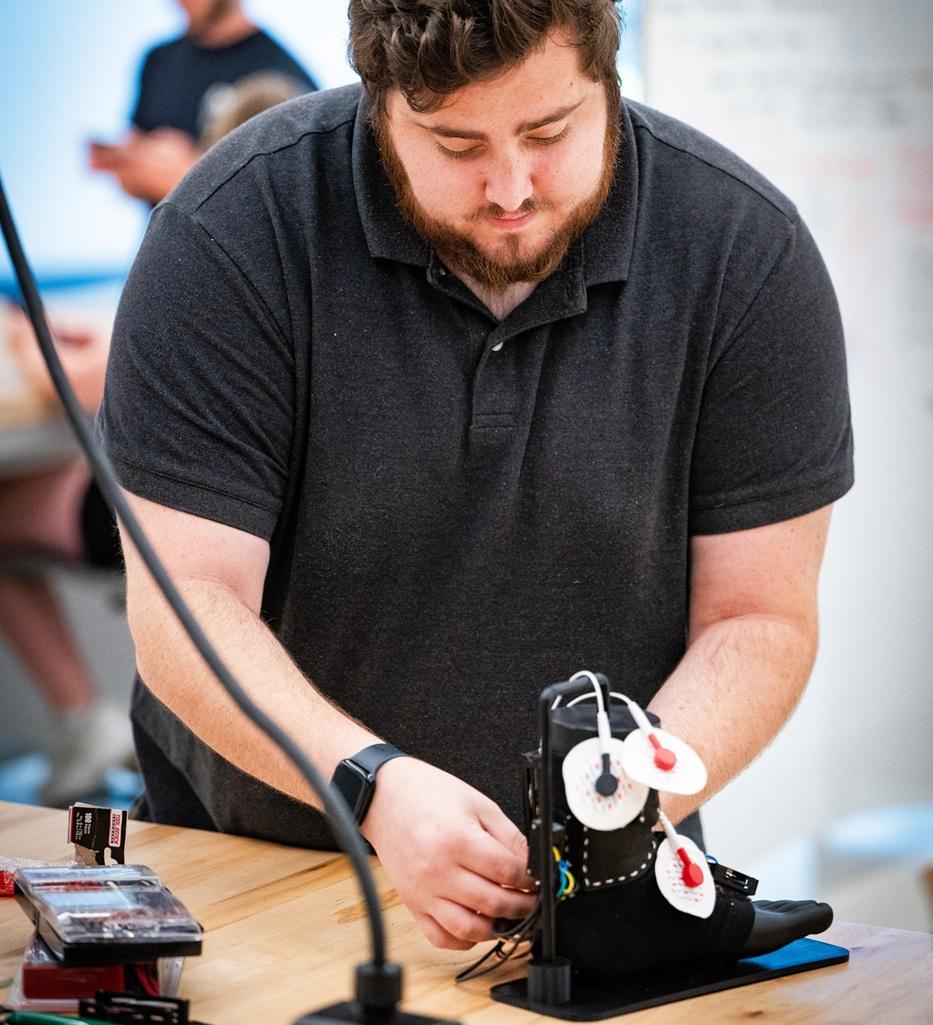
A student works with sensors on a model foot

Collaborative Research and Mentorship

Ph.D. students work closely with faculty mentors on projects that integrate human factors, usability, cognitive engineering and interactive systems, gaining hands-on experience with complex, real-world challenges.

Faculty guide students through curriculum planning and research design, helping them identify meaningful problems, select appropriate methods, and develop innovative solutions that push the boundaries of human-centered design.

This mentorship ensures each project is rigorous, impactful and directly connected to practical applications, preparing students to lead independent investigations and contribute new knowledge to the field.

Advanced Tools and Impactful Outcomes

Students leverage state-of-the-art laboratories for modeling and simulation, interactive devices, advanced cockpit and medical simulators, visualization tools and 3D prototyping. They use these resources to design experiments, test prototypes, and evaluate human-system performance in realistic settings.

Research outcomes span life-critical systems, software and hardware interfaces, organizational processes and advanced interaction media.

This hands-on work equips graduates to lead projects that enhance human performance, improve safety and usability, and shape the design of high-tech systems across industries ranging from aerospace and healthcare to interactive technology and organizational design.

Learn more about Human-Centered Design at Florida Tech on the Electrical Engineering and Computer Science website.

Loading...
Edit Page