/prod01/fit-cdn-pxl/media/fit-website/site-assets/images/FT-Horiz_crimson-gold.png)
/prod01/fit-cdn-pxl/media/header-images/keuper1.jpg)
Read prior editions of the "Provost's Pulse," a periodic newsletter and conversation-starter by the Provost for faculty and staff.
Greetings and welcome to our new academic year! In 2025-26, we selected three senior leaders: the Associate Provost for Research / Chief Research Officer (CRO), the Dean of the College of Engineering & Science, and the Dean of the College of Psychology & Liberal Arts. These leaders were selected based on national searches and will work closely with me to steer the academic enterprise at Florida Tech.
This academic year, we will conduct national searches for the Dean of the College of Aeronautics and the Dean of the College of Business. I encourage faculty, staff, and students to participate in these important searches by attending forums with the candidates once they are selected for campus visits. Best wishes for academic year 2026-27!
A reprint of an article from May which describes the CRO and Deans as well as the synergistic qualities that they bring to our university follows:
Florida Tech’s Three New Academic Leaders:
Different Disciplines, Shared Approaches
A Q&A with Provost John Z. Kiss
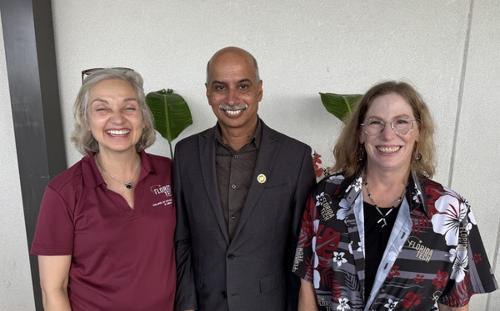
Left to right: Dean of the College of Psychology & Liberal Arts Dr. Leslie Matuszewich, Dean of the College of Engineering & Science Dr. Sambandamurthy Ganapathy, and Associate Provost for Research and Chief Research Officer Dr. Amy Adamson.
Over the last seven months, after extensive national searches, three academic positions have been filled that are essential to the success of Florida Tech and its students: the associate provost for research/chief research officer; and the deans of the school’s largest college, the College of Engineering and Science, and the College of Psychology and Liberal Arts.
They are scholars in biology (Amy Adamson), physics (Sambandamurthy Ganapathy) and psychology (Leslie Matuszewich), respectively, with the unique interests, academic backgrounds and research reflected in their varied fields.
Adamson was associate dean for research for the College of Arts and Sciences at the University of North Carolina Greensboro, where she was a faculty member in the Biology Department since 2000 and associate dean for research since 2019. She earned her Ph.D. in biology from The Johns Hopkins University and a B.S. in biochemistry from the State University of New York at Geneseo. Adamson’s scholarly work has focused on the molecular interactions between Epstein-Barr virus and human cells, with a focus on how the virus initiates intracellular changes that can trigger metastasis.
Ganapathy was associate dean for research in the College of Arts and Sciences and interim director of the Quantum Institute at the University at Buffalo (UB). He has been a faculty member in the Physics Department at UB since 2006 where he also served as chair of graduate recruitment, director of graduate studies and as department chair. He earned his Ph.D. in physics from the Indian Institute of Science. Ganapathy is an internationally recognized scientist working at the intersection of material science, quantum physics and interdisciplinary research.
Matuszewich was senior associate dean for research and graduate affairs in the College of Liberal Arts and Sciences at Northern Illinois University (NIU). As an associate professor in the Psychology Department at NIU, Matuszewich focused her research on the effect of stress on motivated behavior and dopaminergic systems in the brain. She has also served as department chair and director of undergraduate studies. She earned her master’s degree and Ph.D. in behavioral neuroscience of psychology at the State University of New York at Buffalo.
For the search committees that worked with the national firm, for the students, faculty and staff who attended candidate forums, and for Florida Tech Provost John Z. Kiss, who made final recommendations, the candidates boasted impressive CVs, extensive teaching and administrative experience and track records of strengthening the programs and departments they led.
But as the university’s top academic official, Kiss brought another layer of criteria to his evaluations as he looked beyond their accomplished scholarship and career successes. He talked about this in a recent interview. Answers are edited lightly for length and clarity.
QUESTION: Why are deans and top administrator positions such as chief research officer important to a university and its students? They aren’t usually in the classroom that much. So what is it they do to move their area or college and our students in the direction they think is best?
JOHN Z. KISS: Deans and senior leaders like the chief research officer matter because they shape the conditions that allow students, faculty and academic programs to thrive. Their work is mostly behind the scenes, yes, but it has a direct impact on the quality of education, the opportunities available to students, and the long‑term strength of the university.
QUESTION: Can you talk about what that impact is?
KISS: For instance, deans oversee departments and programs, making sure curricula stay current, rigorous and aligned with industry and research trends. They recruit strong faculty, mentor them, and ensure they have the resources to teach and conduct research effectively.
The Chief Research Officer focuses on the university’s research mission, which benefits students in ways that are not always obvious at first glance. For instance, the CRO helps secure grants, partnerships and infrastructure that allow students to participate in meaningful research.
In this role, Dr. Adamson will also support faculty scholarship, and when faculty have strong research support, they bring cutting-edge knowledge and real-world problems into the classroom. And raising the university’s profile, which exciting research can do, enhances the value of students’ degrees and attracts top faculty and collaborators.
QUESTION: Do you see a through-line in these three hires?
KISS: I do see a strong commonality among these three recent hires. First, all three subscribe to the teacher-scholar model for faculty. At its core, the teacher‑scholar model says that excellent teaching grows out of active scholarship, and active scholarship is strengthened by meaningful engagement with students. I have embraced this philosophy during my academic career, and I know all three new senior administrators see its merits, as well.
All three also have a strong record of collaboration and are real team players. As provost, I value my team, which includes deans, associate provosts and others, so I am very pleased to have a strong group that will be highly collaborative.
Finally, Drs. Adamson, Ganapathy and Matuszewich all have strong records in interdisciplinary collaborations. Working toward solutions of large-scale societal issues requires this approach as does providing a modern education to our students.
QUESTION: It must be rare that a provost has the opportunity to guide the hirings of multiple university deans and its top research officer, much less in relatively rapid succession. There are committees and multiple voices offering their input, but have you yourself, faced with filling these positions, ever thought about them collectively? Do you think about any similarities or even differences that could be complementary?
KISS: Yes, I think the approach of these three senior leaders will be complementary. For example, as part of the “Programs Driven by Innovation” pillar of our strategic plan, I want to focus on building our research enterprise. Thus, the CRO must work closely with the two new deans on this endeavor. It turns out that Drs. Ganapathy and Matuszewich, as former associate deans for research, clearly have expertise and experience in this area. I also would like to foster interdisciplinary collaborations among our colleges, and the two deans and the CRO will play a role in these efforts.
QUESTION: As we conclude, what are your final thoughts about the newest members of your team?
KISS: We had a rigorous national search to find our three new leaders. I am very excited to have Dr. Ganapathy and Dr. Matuszewich join us in July and am pleased Dr. Adamson has already started in her new role. I consider myself fortunate to have this trio on my already strong team as we all work together to make Florida Tech the best it can be!
If you have not yet had the opportunity, please join me in welcoming our newest academic leaders to Florida Tech. Thanks for all that you do and I look forward to working with all of you on our continued success.
Sincerely,
John Z. Kiss, Ph.D.
Provost & Senior VP for Academic Affairs
L3Harris Professor
I love interacting with students - and it keeps me grounded.
I have always said that spending time with students keeps me grounded, and it's absolutely true. My days in the Office of the Provost are busy with strategic planning, faculty hiring, academic programs, research, budgets, technology, and more. It is meaningful, important work that has me deeply focused on the administrative side of things.
Being around students, seeing their curiosity and passion, helps remind me why the work we do matters so much. So I make it a point to find opportunities for this uplifting engagement.
Not long ago, after a long day of meetings, I visited Dr. Howard Chen's evening planetary science class. The topic was exoplanets, and the students were presenting their research. Their excitement was contagious! Hearing them talk about their projects genuinely turned my entire day around. As I later told people in our office, "The students saved the day!" Moments like that are why I'm here.
One of the things I love most about Florida Tech is how naturally students and faculty interact. We’re a place where people know each other, where collaboration happens easily, where students feel comfortable inviting faculty, and even administrators, into their world. I get invited to all kinds of student events and say ‘yes’ to as many as I can—club showcases, award ceremonies, class visits, you name it.
I also have guest‑lectured in several classes. Dr. Drew Palmer’s space biology course was a recent favorite, where I talked about my work with NASA on plant development in space. I’ve spoken in the biomedical engineering seminar series, as well. These opportunities always leave me energized.
Student organizations keep me busy, too—in the best way. I’ve attended the ARES Student Showcase, the Student Government Association Awards and others. President Nicklow and I also meet monthly with Student Government Association leadership to hear directly from them about what’s happening on campus. Those conversations are invaluable.
Recently, I attended the Farmer Scholars dinner and had the opportunity to engage with the impressive student recipients of Florida Tech’s most prestigious financial award. In April I will be attending several honor societies events, including Tri-Alpha, which recognizes the academic achievements of first-generation college students, and Phi Kappa Phi, the multidisciplinary collegiate honor society. Then there is the Honors Convocation which celebrates outstanding accomplishments of our undergraduate and graduate students. Seeing these examples of student excellence inspires me!
Even with my administrative responsibilities, I still maintain a small research group of one master’s student and several undergraduates. Our postdoc keeps the lab running day‑to‑day but staying connected to research and mentoring students is something I genuinely enjoy.
I believe that academic leaders are most effective when they stay close to the people their decisions affect. When I talk with students, I learn where our curriculum feels strong, where it needs updating, and where students feel supported—or not. Those insights shape better decisions than any report ever could.
Florida Tech’s size and student‑centered culture make it natural to build real relationships across the campus community. I’m looking forward to many more student events this semester. Keep those invitations coming!
Florida Tech is thriving because of the talent, energy and innovation of our faculty, staff and students. To keep building on that momentum, strong leadership is essential. The choices we make in filling key roles will help shape our future as a university—expanding research, enriching teaching and creating new opportunities for our community. With that in mind, I’d like to share why national searches matter and why we are pursuing them now for several important positions.
The importance of national searches in senior leadership positions
Florida Tech stands out as a strong R2 university due to our commitment to both high-impact research and quality teaching. With our growing portfolio of funded research across disciplines, we have built a reputation for tackling real-world challenges through innovation and interdisciplinary collaboration. Faculty lead cutting-edge projects in partnership with industry leaders like L3Harris Corporation and NASA, while actively involving both graduate and undergraduate students in hands-on research experiences. At the same time, the university maintains a strong focus on teaching excellence, ensuring that students receive rigorous academic training supported by expert faculty. This dual emphasis on research and instruction reflects Florida Tech’s mission to prepare students not only as scholars but as problem-solvers equipped for leadership in STEM and beyond.
To maintain our momentum, we are conducting three national searches for senior leaders (Deans of COES and COPLA, and the Chief Research Officer) this year. Several faculty members have asked me why we are doing national searches. The simplest answer is that as a national university, it is important to do national searches.
The Strategic Importance of National Searches for College Dean Positions
In today’s competitive academic environment, the appointment of a college dean is a pivotal decision that can shape the trajectory of an institution for years to come. Our ambitions in research, innovation, and academic excellence demand leadership that is not only experienced but also visionary. Conducting a national search for dean positions is essential to identifying such leaders, and partnering with a specialized executive search firm like Parker Executive Search further enhances the quality, reach, and rigor of the process.
In our national searches, internal candidates are encouraged to apply. The search process aims to identify the most qualified individual, whether they come from across the country or from within our own academic community. All applicants will be considered, and internal candidates are welcome to participate. In fact, by conducting a national search for the dean position, the university demonstrates its commitment to a rigorous selection process which would affirm the qualifications of internal candidates by evaluating them alongside a broad and competitive field.
Expanding the Leadership Horizon
A national search also allows institutions like Florida Tech to tap into a broad pool of academic leaders from across the country. By an open search, we can identify candidates who have led successful initiatives at peer institutions, secured major research funding, and built interdisciplinary programs that align with the university’s strategic goals.
Moreover, national searches signal institutional seriousness and competitiveness. They demonstrate to stakeholders (faculty, students, alumni, and donors) that the university is committed to excellence and willing to invest in identifying the best possible leadership. This can enhance institutional reputation and attract top-tier faculty and students who seek dynamic and forward-thinking academic environments.
In fact, according to Kezar et al. (2020) which references national searches for university leadership: “Higher education continues to experience immense pressures for an assortment of key changes including improving student success, assessing learning and student outcomes, implementing technology…” In a related study, Dowdall (2009) discusses executive searches in detail and points out the advantages of national searches for positions of dean, provost, and president.
Aligning Leadership with Institutional Goals
Our aspirations at Florida Tech, whether in expanding our research enterprise, enhancing student success, or forging industry partnerships, require deans who are very experienced. A national search ensures that candidates are evaluated not just on credentials, but on their ability to lead transformative initiatives. For example, a candidate who has successfully launched a research center or built a corporate partnership program at another R2 institution may bring these models to Florida Tech.
A Bright Future
Florida Tech’s strategic goals require deans who are strategic thinkers and proven change agents. A national search ensures candidates are evaluated not just on credentials, but on their ability to lead transformative initiatives. We look forward to the positive possibilities of this process as we move Florida Tech forward, together.
References:
Dowdall JA (2009) Searching for higher education leadership: Advice for candidates and search committees. Bloomsbury Publishing PLC.
Kezar A, Dizon JPM, Scott D (2020) Senior leadership teams in higher education: What we know and what we need to know. Innovative Higher Education 45:103-120.
Most faculty follow the three-legged stool rule with teaching, research, and service as the core functions of our profession. In this issue of the Provost’s Pulse, I focus on our essential teaching mission.
FACULTY AS TEACHER-SCHOLARS
During my visits to academic units last year, I emphasized one of my favorite phrases regarding the academy: the teacher-scholar model for faculty. This foundational approach to academic work integrates teaching and research. Part of the definition of the university is that we are involved in creating new knowledge. Thus, professors who are active researchers can provide enriched classroom content, and the students benefit from cutting-edge knowledge. I believe that excellence in teaching and research are complementary rather than competing priorities, each enhancing the other when artfully integrated.
One of the most beautiful examples of the teacher-scholar model is involving students in research projects. I have had both undergraduates and graduate students fully integrated into my research program in plant gravitational and space biology. Graduate students are a natural part of the research enterprise, but I have found my work with undergraduates very rewarding. My undergraduates have been particularly excited to participate in my spaceflight projects. These undergraduate research experiences are an example of a high-impact practice in education, and often students will say it was the most positive experience they had during their undergraduate careers. Research experience is beneficial for any educated person to understand how science works and how to go about evidence-based hypothesis testing.
ACTIVE LEARNING
Earlier this semester, I was asked by the College of Engineering and Science to present a seminar on my teaching philosophy—no one had ever asked me to do that—so I felt honored! I enjoyed thinking about and preparing for the talk. The key part of my philosophy was the teacher-scholar model, which supports active learning. Compared with traditional passive approaches, active learning is very effective, and I showed a pyramid (aka Bloom's taxonomy) in my slides: we remember 10% of what we read, 20% of what we hear, 30% of what we see, 50% of what we see and hear, 70% of what we discuss with others, 80% of what we personally experience, and 90% of what we do.
The Socratic Method is one example of active learning. The heart of this approach is to use guided questions as the teaching method. For example, Harvard physicist Dr. Eric Mazur revolutionized physics education with his "Peer Instruction" technique. During a lecture on Newton's Third Law, instead of simply explaining the concept, Dr. Mazur presents students with a conceptual question: "When a truck collides with a car, which vehicle experiences the greater force?" During my talk the audience gave many good examples of their use of the Socratic Method in their classes.
We also discussed many methods and examples of active learning in the classroom. Some examples included classroom discussion (rather than passive lectures), problem-solving activities, case studies, hands-on projects, and, of course, my favorite, undergraduate research. It is clear to me that our faculty practice active learning techniques in the classroom and are interested in finding ways to improve their teaching.
EVALUATION OF TEACHING
In the last part of my presentation to COES on teaching, I provided some of my thoughts on the evaluation of teaching. Teaching is one of our most important duties as faculty, but it is difficult to evaluate. Many times, we use student-based evaluations as the primary method. While student-based instruments are vital to this process, they should not be the sole basis of evaluation. Educational research points to their value but also highlights biases.
I strongly favor using multiple methods of evaluation. But first, we can improve student evaluations by not using only the end-of-semester evaluation but doing several midterm check ins with the students. It is better to have fewer questions (e.g., 5-6 is better than 30) and allow students time to write open-ended comments—I have found this type of feedback useful in improving my teaching.
What are some other best practices for evaluation of teaching? Peer review is an excellent method, which can include classroom observations by colleagues, a review of teaching materials and course design, and teaching portfolios. It is important to have multiple classroom visits by peers so they get a better sense of the class and teaching. I also recommend developing a specific rubric for evaluation. A great resource for rubrics developed for higher education is this one from Cornell.
In my experience, student-based evaluations and peer reports are the main methods in use. However, there are many other possibilities, including learning-outcome assessments, which are direct measures of student achievement against learning objectives. We also can use 360-degree feedback, incorporating perspectives from students, peers, and administrators. The University of Michigan has an engaging resource on multiple methods of teaching evaluation.
CONCLUSIONS
It is clear to me that the Florida Tech faculty care about quality teaching, which is a hallmark of this institution. I go back to the teacher-scholar model which is alive and well at our university. We also participate in the KEEN (Kern Entrepreneurial Engineering Network) project, which focuses on disseminating techniques and activities that help students learn and develop critical thinking skills. I recently attended an exciting presentation on active learning hosted by the Florida Tech Women’s Council. Drs. Proctor and Daly-Engel gave their perspectives on incorporating active learning in the classroom.
Thanks for your attention, and I hope to see you on campus soon!
John Z. Kiss
Professor & Provost
Welcome to my new periodic communication, the " Provost’s Pulse." I intend to publish these ‘pulses’ perhaps twice a semester and focus on one or two topics that are of broad interest to our academic community. In this inaugural issue, I focus on my new position as the Provost of Florida Tech and discuss my observations of the research infrastructure at the university. Please remember, while I want to share my thinking in this communication, I also want to hear from you—so feel free to drop me a line or let’s have a chat.
GETTING TO KNOW YOU
I am very grateful to serve as your new provost and am excited to be at Florida Tech. I support the new strategic plan to make Florida Tech one of the nation’s best STEM institutions. The university is on a positive trajectory, and I want to contribute to this momentum. In my first semester here, I have managed to meet the faculty in small groups, in departmental or similar-type meetings in every academic unit of the university. I even got some great answers to the question asking faculty to give a “fun fact” about themselves! It seems that we have lots of soccer players, photographers, nature lovers, among others. We also had some discussions about faculty concerns and issues. I appreciated the open and positive dialogue and will work hard to mitigate the concerns.
STAYING CONNECTED
President Nicklow and I meet with the student government leaders and the faculty senate president monthly. We also have been attending the first part of the faculty senate meetings, and these have been constructive and informative. Next semester, I am inviting the new faculty in small groups to an informal lunch so I can learn about their perspectives and their ambitions so I can help them succeed.
LOCATION, LOCATION, LOCATION
As a plant space biologist, I love living on the Space Coast. I have set up my research lab and have started mentoring undergraduates who work with me on plant space biology. Also, I have been working on establishing stronger and new collaborations with NASA and the space industry. Recently, a group of us met with Kennedy Space Center Director Janet Petro. She is very enthusiastic about providing opportunities for our students and faculty to do collaborative research. I also have met with the Space Force leadership as well as with officials from Blue Origin. Again, this company hires our graduates and can provide exciting internships for our students.
FLORIDA TECH AS A RESEARCH UNIVERSITY
As we all know, Florida Tech is an R2 national research university: "Doctoral University: High Research Activity." Thus, research is important to us and is integral to our mission as we want to create a conducive environment for inquiry and discovery.
One measure (but not the only measure) of research productivity is research expenditures. For FY24, the total research expenditure was $15.7 million. Given the quality of our faculty and the fact that we are a STEM-based institution, our external funding should be higher. So, I also have spent my first semester trying to better understand research and the infrastructure that supports research at our university.
Of course, we have a number of super-star researchers who do well with external funding and are pushing the boundaries of the frontiers of knowledge. However, I’d like to get more faculty funded. I also believe in leadership by example and recently have served as co-PI on a $2.3 million grant from NIST to support the improvement of Florida Tech's high-performance computing (HPC) facility.
Based on my observations and comments from others, the Office of Sponsored Programs (OSP) helps the faculty with research grant budgets. However, there is limited support for grant proposal development. The critical steps in proposal development are project conceptualization and strategic implementation. Well-crafted, funded proposals take time to write and frequently require proof-of-concept data. Perhaps the most critical part of a successful proposal is getting feedback, making edits, and revising the proposal prior to submission.
SUCCEEDING TOGETHER
To jump-start this process, I have engaged the services of the Hanover Group to increase the quality, volume, and success rates of our external grant applications. They have a great track record in helping faculty to identify, craft, and submit the most competitive proposals. With the help of our deans, we have identified a cohort for the Hanover Grants Academy, where the selected faculty members will receive individualized mentoring on the grant-writing process over the course of a year. We will run these academies for the next three years—each with a new cohort. The long-term goal is that if this approach is successful, we will start these proposal development services in-house at Florida Tech.
I also want to look at all aspects of research incentives, support, and administration at our university to make sure we are following established best practices. To this end, we are bringing in Dr. Terri Shelton, a former vice president for research and economic development, for a site visit in late January to evaluate our research enterprise. She will be meeting with many groups, including our recently re-established faculty research council.To aid in our evaluation, our faculty recently received a one-question survey on the research infrastructure at our university. We look forward to Dr. Shelton’s visit and recommendations to continue to improve research at Florida Tech.
STRATEGIC SYNERGY
All of these activities are closely aligned with Pillar 2 (Programs Driven by Innovation) of the university’s strategic plan. Specifically, I hope to “expand and diversify externally funded research programs to become a strong R2 research institution.” We have a strong faculty, and any improvements and changes to OSP research infrastructure will help them achieve their full potential. I am convinced that if we all work together and use external and internal analyses, we will become a stronger research university. I look forward to working with the faculty to achieve these important goals!
I look forward to working with the faculty to achieve these important goals! Thanks for your attention and for welcoming me so warmly to Florida Tech.
John Z. Kiss, Ph.D.
Provost and Senior VP for Academic Affairs
L3Harris Professor