/prod01/fit-cdn-pxl/media/fit-website/site-assets/images/FT-Horiz_crimson-gold.png)
/prod01/fit-cdn-pxl/media/site-specific/wwwfitedu/college-of-engineering-and-science/pantherworks.jpg)
Overviews
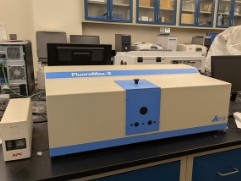
Explanation: A spectrofluorometer measures and records the intensity of fluorescence emitted from a sample in a defined range of wavelengths. Spectrofluorometers can generate excitation and emission spectra. It is one of the most sensitive analytical techniques and has low detection limits.
Key Applications: Fluorometry can be for the determination of concentration, reaction kinetics, and conformational analysis of organic and inorganic samples.
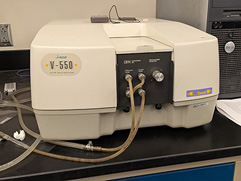
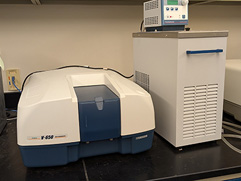
Explanation: A spectrophotometer measures and records the intensity of light absorbed and transmitted by a sample within the ultraviolet and visible light wavelengths of the electromagnetic spectrum and produces a spectrum of the measured intensity against the wavelengths at which it occurred.
Key Applications: UV/Vis spectroscopy can be used for identification, quantification, absorbance and transmittance analysis, reaction kinetics, and conformational analysis of organic and inorganic samples.
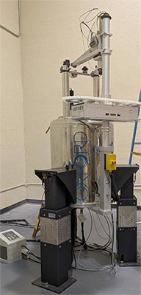 Explanation: Nuclear magnetic resonance (NMR) is a non-destructive characterization method that leverages the magnetic properties of specific nuclei to produce a spectrum of peaks. These peaks contain information about the spatial orientation, quantification, and chemical environment of atoms in organic, metal-organic, and biochemical molecules.
Key Applications: Analysis of an NMR spectrum provides information about the molecular structure, functional groups, nuclei quantification, molecular dynamics, and chemical environment of the sample.
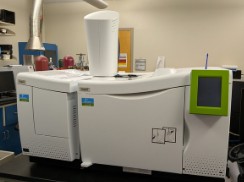
Explanation: The GC-MS combines gas chromatography with mass spectrometry to separate volatile compounds in a sample by their polarity, size, and mass-to-charge ratio.
Key Applications: Determining Volatiles and Semi-volatiles in soil, water, and crops, forensic/crime scene analysis.
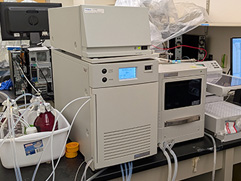
Explanation: The Waters Prep HPLC is a programmable High Performance Liquid Chromatography system, which separates, identifies, and quantifies components of a liquid mixture.
Key Applications: This system is used to separate specific compounds from liquid samples, analyze their purity, and collect them before further analysis.
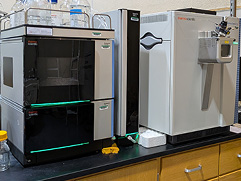
Explanation: The LC-MS combines liquid chromatography with mass spectrometry to separate analytes in liquid solutions based on their polarity, size, and mass-to-charge ratio, thereby determining their identity and structure. This LC-MS uses an orbitrap mass spectrometer system.
Key applications: Verifying compounds created during chemical synthesis, determining synthesized chemicals' structure, and identifying unknown compounds.