
Body-worn cameras (BWCs) are small, forward-facing audio and video recording devices worn by officers to document interactions with the campus community. The implementation of BWCs reflects Florida Tech’s commitment to safety, transparency, and accountability in its Department of Security operations. By providing an objective record of events, BWCs support professional conduct, enhance trust between officers and the community, and assist with accurate reporting and evidence collection when appropriate.
If you have any questions, contact Security.
Frequently Asked Questions
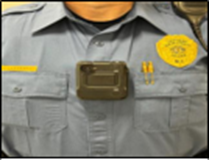
A body-worn camera (BWC) is a forward-facing audio and video recording system that is attached to the outside, upper body of an officer’s uniform or outermost garment, often on the upper chest, to capture video and audio of officer interactions. Florida Tech officers’ cameras will look like this:
A growing number of police and security departments nationwide, including many campus security agencies, are incorporating BWCs into their routine patrol protocol. Significant evidence indicates BWCs are an asset to public safety. Benefits include:
- Greater transparency and accountability in activities
- Deterring criminal activity and uncooperative behavior
- Evidence collection in cases of suspected criminal activity
- Record keeping and reporting
On-duty, uniformed patrol officers and sergeants will wear BWCs when conducting a university policy enforcement service or operation that involves contact with the community. They will activate their BWCs when responding to calls for service or engaging in public contacts initiated pursuant to the investigation of possible criminal activity or a university policy.
The camera does not automatically record and will not be activated to record until and unless the officer is responding to an event that triggers the recording protocol, such as those described in the previous paragraph.
Body-worn cameras reflect the Florida Tech Department of Security’s commitment to transparency and open engagement with the campus community. Adding BWCs to the Department’s daily operations will support public safety and enhance confidence in accountability and clarity regarding actions.
The camera worn by officers will be clearly visible, and if it is recording, a noticeable light will be illuminated. If the officer is taking enforcement action and is wearing a video camera, you can assume he/she has activated the video. You may also ask the officer if his/her video is activated.
Dependent on the situation as governed by the Department of Security’s guidelines, the officer may deactivate a camera upon request. However, this is limited to situations involving the safety of victims and/or witnesses.
At the end of each shift, officers will upload their camera’s data to a secure cloud-based storage service. The amount of time the data is saved will depend on the nature of what was captured, but most routine call data will be saved for a maximum of 30 days. Additionally, no BWC recording shall be accessed, viewed, copied, disseminated or otherwise used by an officer or employee of the department except for an official purpose specified in Florida Tech’s BWC policy or by law.
Not necessarily. According to the U.S. Department of Education, FERPA excludes from the definition of education records “those records created and maintained by a law enforcement unit of an educational agency or institution for a law enforcement purpose.” Thus, if a law enforcement unit of an educational agency or institution creates and maintains the video depository for a law enforcement purpose, then any such videos would not be considered to be education records and would not be protected by FERPA. However, if any portion of a recording is shared for non-law enforcement purposes (e.g., student discipline, Title IX investigations), that recording becomes an education record subject to FERPA protections.
Requests for release of BWC footage will be reviewed in accordance with university policy and applicable state or federal law. Florida Tech is a private institution and not subject to Florida’s public records law except where required by law or when acting on behalf of a public agency.