/prod01/fit-cdn-pxl/media/fit-website/site-assets/images/FT-Horiz_crimson-gold.png)
/prod01/fit-cdn-pxl/media/header-images/security-900X240.jpg)
The Florida Tech Emergency Operations Plan (EOP) is designed to serve as a guideline for university personnel when responding
to any disaster or emergency situation that could or does affect the university. The EOP is applicable to any human-caused and
natural disaster, including, but not limited to floods, hurricanes, earthquakes, power failures, hazardous material releases and civil
disturbances.
The EOP sets forth an operational structure and outlines basic operational procedures that shall direct those individuals and
departments that may be called upon to assist in an emergency response. Because every scenario cannot be predicted, the EOP is
designed to allow policymakers and incident managers the flexibility to adapt to events as they unfold. By establishing a framework of defined responsibilities and communication links, the EOP will help to ensure that Florida Tech’s response to an emergency is prompt, professional and well-coordinated.
A. Definition of an Emergency For purposes of planning, an emergency is defined as any situation:
- That creates an imminent danger to the lives of students, faculty, staff, or visitors at the university.
- That creates an imminent risk to university property and personal property located on university property.
- That may prevent the university from fulfilling its responsibilities to the students, faculty, staff, or visitors.
- That could cause serious harm to the reputation of the university; or
- Where the university’s resources are called upon to assist the local community, state, or federal agencies in time of regional or national crisis.
B. Purpose
- Identify planning assumptions and develop policies.
- Establish a concept of operations built on interdepartmental coordination in order to facilitate a timely and effective university response.
- Assign specific functional responsibilities to the appropriate offices and departments.
- Coordinate actions necessary to respond to an emergency and coordinate the links between the university’s local, state, and federal government agencies, and other supporting institutions or organizations.
C. Scope The scope of the EOP is as follows:
- All officers, departments, personnel, buildings, and grounds owned by Florida Tech located in the City of Melbourne, Florida. Particular departments are charged with the responsibility to provide response and recovery actions in an emergency or disaster situation.
- Response activities include those actions that support the efforts of university, local, state, and federal agencies in their efforts to save lives, protect public health and safety, protect property, and mitigate damage. The actions and activities described in the EOP are carried out under the authority of the President of Florida Tech.
D. Levels of Emergencies All emergencies and events that affect the university, large or small, are included in the framework of this plan. The level of the emergency will determine the extent to which the plan is utilized, and resources are mobilized.
- LEVEL 1: A minor incident, potential or actual, involving a department or building that can be handled by the affected department, existing university resources, or limited outside assistance; is usually a single event of limited time and impact.
- LEVEL 2: A critical event, potential or actual, affecting an entire building or buildings, or which disrupts the overall operation of the campus; could be a single or multi-hazard situation. Outside emergency services will probably be required, as well as a major response from university support services.
- LEVEL 3: A major event of significant or catastrophic proportions involving the entire university or a significant portion of the university’s campus and potentially the surrounding community. Immediate resolution is not probable and is well beyond the response capabilities of the university alone.
In the event of an emergency, the university will take immediate and appropriate actions to evaluate, direct, mobilize and coordinate its response. Depending on the level of the emergency and the need for resources, the university will activate this plan to directs its resources to best protect lives and property and to ensure the continuity of operations.
Emergencies and disaster could affect residents in the region, not just the campus. Therefore, county, state and federal emergency services may not be available immediately. The university must be prepared to respond appropriately with or without the immediate involvement of outside agencies.
Emergencies or disasters can occur at any time of the day or night and can occur when senior administrators and other members are unavailable to respond. The EOP, therefore, must be based upon roles to be filled, not individuals and must be flexible.
E. Role of Emergency Services Under law, the county governments have the responsibility for the direction and control of emergency management within their jurisdiction. The city and county emergency management directors are responsible for the development and implementation of the emergency management program designed to provide for an effective response to an emergency. The local fire chief or police chief (depending upon the type of emergency) is responsible for the command of the response and control of the incident. They serve in the role of Incident Commander. If the incident is law enforcement related on university property, the Melbourne Police Chief or their designee is the Incident Commander. The Incident Commander is also responsible for the limiting or closure of access to a building or area to anyone, even senior university officials, if the situation warrants.
The university will work with local authorities to support their efforts, as requested, and will act to resolve consequences to the university from the incident.
F. Plan Awareness All Florida Tech departments and offices are to be familiar with this plan.
G. Hazard Analysis and Assessment It is the responsibility of each department, or office, at Florida Tech to conduct its own hazard analysis and assessment concerning the area for which it is responsible. Departments may seek assistance for any hazard analysis from the Facilities Department or the Department of Security.
Florida Tech’s response to an emergency or disaster will generally involve the following phases:
- Planning and Mitigation—The process of developing or refining response plans that will ensure an orderly and effective response to an emergency and for identifying and mitigating areas of After each activation of the Emergency Operations Plan, an after-action review will be performed to determined if the response was effective or if the plan should be modified or improved.
- Response—The reaction(s) to an incident or emergency in order to assess the level of containment and control activities that may be During this phase, university priorities will be to ensure the public welfare, protect critical infrastructure and provide support to emergency response organizations/operations.
- Business Continuity—The process of planning for an/or implementing the resumption of business operations immediately following an interruption or During this phase, more in-depth forecasts of the incident will be available and campus-wide priorities for program resumption will be determined. All response activities indicated above will continue as necessary.
- Recovery/Restoration—The process of planning for and/or implementing recovery of non-critical business processes and functions after critical business process functions have been resumed and for implementing projects/operations that will allow the university to return to a normal service
Emergency response efforts shall be conducted in conformity with the mission, core values and policies of Florida Tech under the authority of its president.
Due to the unpredictable nature of emergencies, this Emergency Operations Plan will be organized according to general detection, notification, and response guidelines, followed by sections containing specific response strategies – or Incident Specific Emergency Plans (ISEP) – pertinent to different kinds of emergencies where appropriate.
It is recognized that no plan can cover all contingencies and that the Director of Campus Security and authorized staff members of the University possess authority commensurate with their responsibility to protect life and property and to employ strategies not specified in the Emergency Operations Plan.
For any questions about the Emergency Operations Plan (EOP) please contact any of the following:
Director, Department of Campus Security
321-674-8112
Director, Environmental Health and Safety
321-674-7715
Vice President for External Affairs and Strategic Advisor
321-674-6218
General
It is the responsibility of the university to ensure that it is prepared to meet the needs of the people and the institution that might be affected by an emergency incident. The President of Florida Tech is ultimately responsible for the university’s response in such an incident. The authority to declare a campus state of emergency rests with the President of Florida Tech or appointee. During the period immediately following an emergency requiring activation of the Emergency Operations Plan (EOP), when directed by the President or appointee, primary and support offices and departments will take action to identify requirements and resources needed to respond appropriately.
The EOP will be activated whenever the President, or his/her appointee, declares state of emergency. This declaration may be made at the recommendation of Provost & Senior Vice President for Academic Affairs, Vice President for Administration and Finance/Chief Financial Officer, and Director of Campus Security. The President is supported in this responsibility by the Board of Trustees, or for the purposes of this plan, in making final decision and issuing directives for the management of the emergency. Emergency Operations Center
When an emergency occurs or is imminent, it shall be the responsibility of the Director of Campus Security (DOS) to setup and staff an appropriate Emergency Operations Center (or command post), as directed.
When an emergency occurs or is imminent, it shall be the responsibility of the Director of Campus Security (DOS) to setup and staff an appropriate Emergency Operations Center (or command post), as directed.
Location
Generally, the location will be in the Department of Security office. If the duration or severity of the emergency warrants setting up an Emergency Operations Center (EOC), it will be setup in a location best fitting the situation. The key element in selecting the EOC is that it be a safe location that is unlikely to be affected by any subsequent events related to an initial disaster/emergency episode.
- The location should be centrally located, have sufficient room for 10-12 people and be convenient to all utilities if possible.
- Other factors that would determine which locations to be used include type of emergency, location of the emergency, availability of backup power, phone, and data communications.
- In a large-scale emergency, the EOC must be in a location where the emergency staff and those selected by the University’s President can conduct their respective roles in separate rooms but in close proximity to each other.
- The Director of Campus Security in conjunction with the AVP Facilities will determine the appropriate location. It is understood that due to the nature of an emergency, it may be appropriate for administrators to remain in their pre-emergency locations and conduct the emergency operations via conference call, radio, or other means.
Potential Sites
The Director of Campus Security (DOS) shall periodically verify the proper functioning of utilities, communication equipment and connections at each of the suggested sites. Potential EOC locations include, but are not limited to, the following sites:
- Department of Security Office – Building #544, Security Welcome Center
- Facilities Office – Building #540, Facilities Operations Building
- President’s Large Conference Room – John E. Miller Building
- Off-Campus Locations designated as possible EOC Sites:
- Center for Aeronautics and Innovation (CAI) (North)
- Center for Advanced Manufacturing and Innovative Design (CAMID) (South)
- The EOC, regardless of location, shall have easy access to:
- Multiple phonelines
- Multiple network connections (or wireless connectivity capabilities)
- Television with cable access
- Large campus map
- Hand-held portable radios and cell phones for team members (as needed)
- White boards
- Radio access via portable scanning radios for all of the campus (receives & transmits)
- President
- Provost & Senior Vice President for Academic Affairs
- Vice President for Administration and Finance/Chief Financial Officer Vice President for External Affairs and Strategic Advisor
- Vice President for Student Affairs and Title IX Coordinator Chief Information Officer
- Associate Vice President of Facilities Director of Campus Security
- Assistant Director of Campus Security
- Insurance Compliance Manager and Contract Specialist
Advisory*
- Executive Assistant to the President
- *EPC must be available during an emergency event
The single most effective way of dealing with a crisis situation, critical incident, or medical emergency is through the use of a Crisis Management Team (CMT). The CMT is an organized group of university-based faculty and staff members created to assist the University President in planning for and responding to university emergencies (active CMT listed on Page 9). These staff members will be trained in the implementation of the University’s Emergency Operations Plan. The President must designate staff members to serve on the CMT and designate a CMT member to act in the President’s absence. There may be instances when time-sensitive decisions have to be made quickly by the President without consulting the CMT.
The membership of the University’s CMT should consist of an immediately accessible core group of university personnel who have the knowledge and skills to deal with an emergency situation. There are no formal standards for the number of members that should be on the team. The CMT composition varies depending on the availability and expertise of the individual members and the potential hazard threatening the university.
In addition to the University President, membership will include: Provost & Senior Vice President for Academic Affairs and Vice President for Administration and Finance/Chief Financial Officer, Vice President for External Affairs and Strategic Advisor, Vice President for Student Affairs and Title IX Coordinator, Director of Campus Security, Assistant Director of Campus Security, AVP Facilities, Director of Environmental Health & Safety, and the Insurance Compliance Manager. The CMT members should be equipped with portable radios and/or cell phones.
The CMT should meet on a regular basis and discuss not only the crisis management plan but also any areas of concern in or around the university. All members should receive information and training regularly.
| Emergency Services | Phone Numbers |
|---|---|
|
Brevard County Emergency Management Office |
321-637-6670 |
|
Brevard County Sheriff's Office-Dispatch |
321-253-6658 |
|
Brevard County Public Health |
321-454-7111 |
|
Melbourne Police Department |
|
|
Emergency |
911 |
|
Non-Emergency |
321-608-6731 |
|
Melbourne Fire Department |
|
|
Emergency |
911 |
|
Non-Emergency |
321-608-6000 |
|
Palm Bay Police Department (Panther Bay/CAMID) |
|
|
Emergency |
911 |
|
Non-Emergency |
321-952-3456 |
|
Florida Tech Security |
321-674-8111 or Ext. 8111 |
|
Florida Tech Security Secondary Security Lines |
Ext. 8112 |
|
Florida Tech Emergency Information Hotline |
888-820-4636 |
|
Brevard County Health Department |
321-726-2920 |
|
Melbourne Airport |
321-723-6227 |
|
FBI - Tampa Office |
813-253-1000 |
|
FBI - Melbourne Office |
321-253-0293 |
|
US Secret Service - Orlando |
407-648-6333 |
|
National Weather Service - Melbourne (www.srh.noaa.gov/mlb) |
321-255-2900 |
|
American Red Cross - Rockledge (www.redcross.org) |
321-890-1002 |
|
Health First's Holmes Regional Medical Center |
321-434-7000 |
|
Health First's Viera Hospital |
321-434-9000 |
|
Health First's Palm Bay Hospital |
321-434-8000 |
|
Rockledge Regional Medical Center |
321-636-2211 |
|
Melbourne Regional Medical Center |
321-752-1200 |
Active Shooter—The active shooter is an individual actively engaged in killing or attempting to kill people in a confined and populated area; in most cases, active shooters use firearms and there is no pattern or method to their selection of victims. Most incidents occur at locations in which the killers find little impediment in pressing their attack. Locations are generally described as soft targets, that is, they carry limited security measures to protect members of the public.
Assembly Point—A predesigned building or outdoor location to which all persons evacuating a campus building during an emergency (fire, explosion, hazmat release, etc.) will immediately report and where they should remain until a department head, office manager, or supervisor completes an accounting for all students, faculty, staff and visitors who were inside the evacuated building at the outset of the emergency; should be at least 300 feet away from the evacuated building or site where the emergency originated.
Building Marshals—The Building Marshals program was developed to facilitate the safe evacuation of campus buildings and to assist emergency responders. This program is staffed by trained campus employees who work in the individual classroom and office buildings throughout the campus.
CMT—Crisis Management Team: Comprised of the university staff and senior administrators responsible for specific emergency support functions.
DCT—Disaster Control Team: Comprised of the university staff and senior administrators responsible for specific emergency, administrative and legal support functions.
DOS—Director of Campus Security
Emergency Alert System—The Emergency Alert System consist of warnings issued when a potentially significant emergency or dangerous situation involving an immediate threat to the health or safety of students or employees has been confirmed.
EMS—Emergency Medical Services
EOC—Emergency Operations Center; The physical location at which the coordination of information and resources to support an emergency response take place.
EOP—Emergency Operations Plan: Describes the structure and process for a coordinated university approach to an emergency.
FCP—Field Command Post: A physical location or Department of Security or other Security vehicle near the scene of the emergency.
Hazardous Material (Hazmat)—A substance in a quantity or form posing an unreasonable risk to health, safety and/or property when manufactured, stored, or transported. The substance, by its nature, containment, and reactivity, has the capability for inflicting harm during an accidental occurrence.
Hostile Intruder Incident—A hostile intruder incident is declared when there is a serious risk of danger to the faculty, staff, and students of the university from an armed or dangerous person(s) on campus.
IC—Incident Commander: The police or fire official responsible for all emergency activities; has overall authority and responsibility for conducting incident operations and is responsible for the management of all incident operations on the scene of an emergency.
ICS—Incident Command System: A formal structure for emergency management used by all local, state, and federal response agencies during an emergency response.
Immediate Notification—In case where the notification is mandated to any university official, the AVP Facilities and Vice President for External Affairs and Strategic Advisor shall also be notified. All interaction with the media will be handled through the Vice President for External Affairs and Strategic Advisor to ensure unity of communication.
ISEP—Incident Specific Emergency Plan: Detailed actions to follow in the event of specific emergency and/or addresses a specialized, incident specific application of the university’s Emergency Operations Plan.
ITR—Information Technology Resources.
Lockdown—A protocol that involves confining people in a secure place, or securing students, faculty and staff in classrooms or other buildings during an emergency or other event that may cause loss of life. During a lockdown, no one may be admitted into the locked down building until an “all clear” has been issued by the appropriate administration and/or authorities.
Secure/Shelter in Place—The term “shelter in place” means to seek immediate shelter and remain there during an emergency rather than evacuate the area. This does not include securing the building.
Size and Location of Facilities
Florida Tech is a national, private, not-for-profit, technological, coeducational, doctoral-granting, research-intensive university. It is primarily residential, though it offers select degrees online and at off-campus learning locations throughout Florida.
Located on 130 subtropical acres in the City of Melbourne on Florida’s “Space Coast”, Florida Tech’s campus includes various academic, athletic, residential, dining, recreational, performance, administrative, and multi-use facilities. It is an Arbor Day Foundation designated “Tree Campus USA.”
Faculty
There are 424 faculty at Florida Tech. About 74% of full-time teaching faculty have a Ph.D. or other terminal degree appropriate to their field.
Safety & Security
Florida Tech is committed to ensuring the safety, security, and well-being of its faculty, staff, and students. As such, the Officers that make up the university’s Department of Security actively monitor the campus, respond to emergencies, and serve the diverse needs of the Panther community 24 hours a day, seven days a week. The Department of Security can be reached at 321-674-8111 (Emergency) or 8112 (non-Emergency). This includes active coordination with local and state emergency service providers as warranted. Annual security and fire safety reports are made available to the public.
Access to Facilities
The main campus in Melbourne is open to both students and the general public. The main entrance from University Boulevard and the entrance from Country Club Road remain open and accessible to vehicular traffic 24 hours per day. All campus roads and parking lots remain open day and night.
Campus security officers monitor all activities at the campus. Officers conduct mobile and foot patrols throughout the day and night. Building security checks are performed during patrol activities. Following evening classes, Security Officers monitor and record activity in the majority of campus parking lots and other public areas, inside, and outside campus buildings.
Chain of Command
In the absence of the President, in an emergency situation only, the power to be Acting President is hereby delegated, in sequence, to the following:
- Provost & Senior Vice President for Academic Affairs
- Vice President for Administration and Finance/Chief Financial Officer
- Vice President for External Affairs and Strategic Advisor
In those instances where a decision must be made which will impact the entire university, it is anticipated that the Acting President shall confer with other Vice Presidents prior to making that decision.
When it’s necessary for a Vice President to be absent from the campus for more than one day, the following procedure shall be allowed:
- Appoint a member at the staff to assume responsibility for the
- Notify the Office of the President in
- During non-business hours, the Security Sergeant on duty is responsible to contact the Director of Campus Security, who is then responsible to contact the President or the Provost & Senior Vice President for Academic
- Response will depend on who is geographically available to handle the issue confronting the
Building Systems
Many of the main campus buildings have an emergency generator power source to provide electricity in the event of power outage. See Appendix A for a list of buildings with generators. In the event of power failure, internal 90-minute battery modules within the lighting fixtures will provide emergency lighting. There are fire extinguishers throughout the buildings, as well as fire alarm pull stations and smoke/heat sensors. The fire alarm is automatically sent to an alarm monitoring company (ATP) that will then notify the Department of Security and notify the 911 emergency response center. The City of Melbourne Fire Department (Fire Rescue) will provide both first aid and fire service response.
Role of Key Administrators
The Director of Campus Security shall make available for distribution to instructors and department supervisors all emergency procedures and information.
Role of Faculty and Staff
Deans, faculty, and staff members are viewed as leaders by students and should be prepared to direct their students to assembly areas in the event of an emergency and account for every student. Every member of the faculty and staff should read and be familiar with applicable emergency plans and familiarize themselves with emergency procedures and evacuation routs that are displayed in all classrooms, offices, and common areas. Faculty and staff are required to complete a Campus Safety assessment each academic calendar year. Faculty and staff must be prepared to assess situations quickly and thoroughly and use common sense in determining a course of action. All faculty and staff are responsible for securing their work areas. Work areas may need to be secured in advance of certain weather systems (hurricanes, floods, etc.). Specific staff members have been designed to assist mobility-impaired students. In the event of an emergency, those individuals shall report to their designated locations.
Role of Students
All students should familiarize themselves with the emergency procedures and evacuation routes in their classrooms. Students should be prepared to assess situations quickly, but thoroughly and use common sense in determining a course of action. If evacuations are necessary, students shall evacuate in an orderly manner when directed to do so by emergency personnel or when an alarm sounds. Students with mobility issues shall notify Student Affairs upon registration. Special arrangements will be made for these students.
Administrations and Logistics
Certain administrative procedures and logistics should be intact prior to and during an emergency situation. Hence, the following applies: During an emergency, some administrative procedures should be suspended, relaxed, or made optional. An example would be bypassing the process set forth for the procurement of needed equipment. Departures from normal procedures should be clearly addressed by the CMT during planning process. All offices and departments shall develop provisions for the proper documentation of all emergency expenditures. Documentation methods should follow current accounting procedures. Such accounting documentation will support the university’s requests for supplemental assistance from state and federal agencies. All departments and offices shall implement established resource controls and determine the availability and accessibility of those resources. Any additional required resources needed to respond to or support an emergency operation should be identified.
Notice of Emergency
Although it will likely be initially identified or received by the Department of Security Dispatcher or responding Security Officer, notification of an impending or existing emergency may come from any number of sources. Information received by any person connected with the university that an emergency has occurred, or is likely to occur, shall be forwarded immediately to a member of the Department of Security.
The President or designee will be responsible for any notification to the university’s legal counsel and the Board of Trustees. The Insurance Compliance Manager or designee is responsible for any notifications to insurance carriers.
In the event of a potential emergency not requiring the initial involvement of local emergency services, the identifying individual, office, or department shall contact the Department of Security who will ensure all affected departments are notified.
Key Secondary Factors
In addition to those obvious responses to emergencies such as aiding the injured, summoning police/fire/ambulance services, or enlisting the aid of other outside agencies, the Crisis Management Team (CMT) shall implement additional operations. These shall include, but not be limited to:
- Processing of calls from family and friends of students, faculty, and staff.
- Establishing a centralized liaison function to deal with outside agencies (hospitals, other governmental agencies), providing them with necessary information and other assistance, such as next-of-kin notification.
- Ensuring that the public information officer is available to handle all media inquiries and to document emergency response activities.
- Providing for the protection of essential business records and computer equipment. Timely notifications of computer operations Information Technology Resources (ITR) administrators are essential.
- Establishing a mechanism to provide for extraordinary financial demands and seek assistance of insurance carriers.
- Setting an emergency procurement operation to address extraordinary material needs.
- Ensuring the continuation of food services.
The University President is responsible for the actual declaration of an emergency. He/she shall declare a state of emergency for level 2 or level 3 incidents when upon the recommendation of the selected university department heads or members it has deemed necessary to do so (reference Page 2). A declaration of an emergency will result in the immediate implementation of emergency procedures as outlined in the EOP and /or the closure of all or part of the university.
The President shall also be responsible for declaring an end to any state emergency when appropriate.
Restricting Access to Campus
When an emergency declaration is made, only registered students, faculty, staff, and affiliates (i.e., persons required by employment) are authorized to be present on campus.
Those who cannot present proper identification (e.g., employee identification card, or other photo ID) verifying they have legitimate business on campus will be asked to leave. In addition, only those faculty and staff members who have been requested to come to campus or issued an emergency pass by the Department of Security will be allowed to enter the immediate disaster site and only once the site has been deemed safe to enter by local authorities, or the Director of Campus Security.
Immediate Actions
It is likely that the resources needed for immediate assistance to deal with various kinds of emergencies will be obvious. A list of common assistance requests and contact numbers are found in the Emergency Resource Directory (Page 8).
Police, Fire and Medical Emergencies
These services will always be summoned in the event of fire, flood, earthquake, confirmed bomb threat, environmental hazard, serious multiple injury accidents, civil disorder or mass demonstrations, chemical spill, hostile intruder/active shooter, and the like. Police and fire departments and other government related agencies have emergency response strategies in place and are well equipped to provide immediate assistance as well as knowledge of appropriate resources for secondary assistance.
Large-Scale Health or Injury Problems
The area is well-served by three hospitals within a 30-minute drive. A list of the facilities is maintained in the Emergency Resource Directory (Page 8). Triage is usually the function of first responder EMS personnel.
Utility and Mechanical Loss
The handling of utility and mechanical service losses shall be coordinated by the AVP Facilities or designee. The Facilities Department maintains an up-to-date list of private contractors to correct those problems that are beyond the ability of university personnel.
Public Information
An emergency or disaster is likely to present a need for the organized and sensitive dissemination of information for public consumption, as well as maintaining control of the media who might disrupt emergency response activities. This function shall be the responsibility of the Vice President for External Affairs & Strategic Advisor.
Ongoing Emergency Management
While the emergency/crisis is ongoing, the Vice President for External Affairs & Strategic Advisor shall continue to coordinate communication to the university with the affected departments.
Assessing a Threat or Emergency
During a state of emergency, the Department of Security with authorization from the President or his designee shall take the necessary steps to assess the emergency and to safeguard persons and property. The Director of Campus Security or designee shall immediately consult with the President regarding assessing the emergency and level of the crisis and the possible need for a declaration of a campus state of emergency.
In the event of a major crisis, emergency, or potential threat occurring on or near the campus or one that involves campus property, Security Officers and appropriate Facilities personnel will be dispatched to determine the extent of any damage to campus property. If necessary, the AVP Facilities will utilize other campus staff to assist with the assessment.
Student Resident Halls
Establishing alternate residences for resident students due to the temporary loss of a residence hall shall be the responsibility of the Residence Life staff.
Resident student shall be temporarily housed with other resident students in unaffected buildings, until such time as repairs to damaged housing facilities are completed.
Should a residence hall facility remain off-line for an extended period of time, alternate arrangements for temporary off-campus housing shall be made at the discretion of the Vice President for Student Affairs and Title IX Coordinator. A list of local hotels and other rental facilities, as well as other local institutions, shall be maintained in the Office of Residence Life.
Consideration may also be given to housing some students in the private homes of faculty and staff on a volunteer basis and/or encouraging students whose residences are within a 50-mile radius of campus to reside at home until their residence hall is reopened.
Classrooms
Large common areas in buildings on campus maybe considered for use as classrooms on a temporary basis, including meeting rooms and lounges, if they exceed 500 square feet in usable area and do not unduly disrupt other necessary operations. Very large areas may be considered for multiple uses by segmenting with portable partitions if available.
Food Service
Should the Panther Dining Hall be rendered unusable, the alternate locations on campus may be used for food service on a temporary basis i.e., the Rathskeller, Center Court at Clemente Center. An off-campus food service contractor may also be contracted to provide meals to the campus community in the alternate location(s). Alternate use of the Clemente Center may require suspension of some athletic activities.
Administrative Operations
Where possible, when an administrative function cannot be performed at its usual location, available alternate space on campus shall be utilized.
Deactivation of Emergency Operations
Deactivation of an emergency operation is dependent upon a wide range of variables that must be satisfied before such an event may occur. Some basic principles that should be followed before deactivation are:
- Ensure that all health and safety issues are resolved prior to full deactivation.
- Ensure that all vital services and facilities are re-established and operational.
- Partial deactivation of the EOP may occur only when all issues within the ISEP are resolved or completed.
- Recovery operations may be initiated during response operations.
- Deactivation of the response operation may be followed by the recovery operation.
- Final deactivation of all operational activities will only occur with authority from the University President in coordination with the CMT.
Resuming Operations—Restoration and Recovery
In situations involving structural damage or building emergencies as a result of an explosion or similar incident, hazmat incident, tornado, utility failure, structural collapse, or similar incident, the CMT should be focused on the planning for and/or implementing resumption of campus operations immediately following an interruption or disaster while the response activities (mainly concluded by the Department of Security and the Facilities Department) continue. In attempting to return the university to normal business operation (critical functions first, then noncritical) and service level, the CMT may/should:
- Hire additional temporary workers.
- Establish a recovery team, if necessary.
- Establish priorities for resuming campus operations.
- Continue to ensure the safety of personnel on the property.• Assess remaining hazards.
- Maintain security at the incident scene.
- Follow emergency notification procedures.
- Notify families of university employees and students about the status of university personnel and students on the property; off duty university personnel about work status; insurance carriers and appropriate government agencies.
- Conduct campus briefings.
- Keep detailed records.
- Take photographs of or videotape the damage.
- Account for all damage-related costs.
- Establish special work order numbers and charge codes for purchases and repair work.
- Protect undamaged property.
- Close and open buildings.
- Remove smoke, water, and debris.
- Protect equipment from moisture.
- Restore sprinkler systems.
- Physically secure the property.
- Restore power.
After Emergency Assessment
- Conduct an investigation and coordinate all investigative actions with appropriate government and local agencies.
- Conduct salvage operations. Segregate damaged from undamaged property. Keep damaged goods on hand until an insurance adjuster has visited the premises but move material outside if it is seriously in the way and exposure to the elements will not make matters worse.
- Take inventory of damaged goods. (This is usually done with the adjuster if there is any appreciable amount of goods or value). If goods are released obtain a signed inventory stating the quantity and type of goods being removed.
- Restore equipment and property. For major repair work, review restoration plans with the insurance adjuster and appropriate government agencies.
- Assess the value of damaged property. Assess the impact of university business interruption.
Incident Specific Emergency Plans
The following Incident Specific Emergency Plans (ISEP) are designed as guides to give members of the Florida Tech community a ready reference on how to respond in case of an emergency situation on or near the campus. Campus safety is a responsibility we all share. All of us play a critical role in keeping students, faculty, and staff safe on campus.
- Here is how you can do your part:
- Complete the Emergency Notification Information form located at fit.edu/security, which is the best and quickest way to get information to you in an emergency. Emergency situations develop and change very quickly. The Emergency
- Notification System keeps you informed as things change.
- Upload the Florida Tech Safe APP on your phone.
- Plan ahead. The time to think about what you would do in an emergency is now. Read through these procedures and consider how you would respond.
- “If you see something, say something!” Reporting crimes, suspicious behavior and safety concerns to the Department of Security helps to keep us all safe. Program (321) 674-8111 into your cell phone and do not hesitate to make a report.
- Always carry your Florida Tech ID card. In an emergency, you may find yourself locked out of your building or area as some doors may lock to keep intruders out. Carrying your ID card will ensure you can move about if necessary, should doors be locked.
Preparing for an Emergency
- Gather a kit of emergency Be prepared to improvise and use what you have on hand to make it on your own for at least three days, maybe longer. While there are many things that might make you more comfortable, think first about fresh water and food. Always have a ready supply of water along with some non-perishable food. If there is enough time fill up your vehicle(s) gas tank(s). When an emergency happens, gas stations are also affected and replenishing your gas tanks may be impossible.
- Make a plan for what you will do in an Be prepared to assess the situation. Use common sense and whatever you have on hand to take care of yourself. Work out a communication plan with your family in the event that cellphone and/or internet service is not available. Consider how far you would have to travel to get home and where you might go if you were unable to initially go home. Communicate in advance with your family in the event you lose communication with them and share with them where you plan to be in the event of an emergency. During an emergency, Security personnel may not be able to search for individuals.
- Be informed about what might Some of the things you can do to prepare for the unexpected are the same for both natural and man-made emergencies. However, there are significant differences among potential terrorist threats, such as biological, chemical, explosive, nuclear and radiological, which will impact the decisions you make and the actions you take.
ISEPs
Introduction
A disaster can be defined as a major catastrophe causing widespread destruction of life or property. A disaster at Florida Tech could result from a major fire, explosion, active shooter, or other hazardous events that endanger life or property.
Purpose
This plan is designed to establish standards and operating procedures, define who is in charge of the plan and assign responsibility for the coordination of the overall procedures.
Chain of Command
The following administrative personnel, in the order listed, are in charge of the plan and are responsible for the coordination of the overall procedures.
OPERATION RESPONSE
- MPD 911
- Director of Campus Security
- AVP Facilities
- Notify Chain of Command
NOTIFICATION
- President
- Provost & Senior Vice President for Academic Affairs
- Vice President for Administration and Finance/ Chief Financial Officer
- Vice President for External Affairs & Strategic Advisor
In the absence of the President, the next available administrator listed shall be designated as the Administrator-in-Charge, and he/ she shall assume the responsibility of implementing the disaster plan.
CHAIN OF ADMINISTRATOR-IN-CHARGE
- President
- Provost & Senior Vice President for Academic Affairs
- Vice President for Administration and Finance/Chief Financial Officer
- Vice President for External Affairs and Strategic Advisor
- AVP Facilities
Responsibilities
Upon notification of the disaster, the Administrator-in-Charge will survey university operations to determine if the following activities shall be initiated and/or are proceeding satisfactorily and with proper supervision:
- Local police department, fire department and first aid squads have been notified as required.
- Campus fire alarms have been activated as needed.
- Buildings and areas involved in the disaster or adjacent to the disaster area are evacuated or locked down/secured if necessary.
- The Disaster Control Center has been established.
- Communications are established on campus and with local agencies – Communications exist between the University Disaster Control Center and Command Post established on campus by the ranking service agency. (i.e., Melbourne Police Department).
- Traffic and campus entrances are in a controlled situation.
- Security on campus is maintained.
Activation of the Disaster Plan
In the event of a disaster, the following procedures will be adhered to:
- The first person to be aware of the disaster shall contact the Department of Security to report the disaster. The Department of Security will attempt to elicit the following information:
- Severity/urgency of the disaster
- Name and identity of caller
- The Department of Security will immediately call the Melbourne Police Department, the Director of Campus Security.
- The Department of Security will notify the President (or the first administrator available in the Chain of Command), who will then establish an Emergency Operations Center in the Security Office or the John E. Miller Bldg., President’s Large Conference Room and instruct all administrators listed on the Chain of Command to report immediately to the appropriate location. The responders will become the Disaster Control Team (DCT).
- All DCT members shall develop and maintain a communications network to assure that all department personnel under their jurisdiction, including students and campus visitors, are appropriately informed.
- If appropriate, Security will deliver the Crisis Box that contains campus drawings, utility information, universal card access, etc., to the responding agency or the Command Post. This information is also contained on a “thumb drive” located in each Crisis Box. There is one box located in the Department of Security and one in the Facilities Operations Building.
Emergency Operations Center
Upon notification of the disaster, the Administrator-in-Charge will designate the Department of Security office or the John E. Miller Building President’s Large Conference Room as the Emergency Operations Center (EOC).
- Communications will be maintained by telephone, radio and /or messengers between the Emergency Operations Center, the Command Post established by the police department or other service agency and other areas of the campus.
- The Administrator-in-Charge responsible for the Emergency Operations Center shall immediately:
- Check operation of communications.
- Secure persons to serve as messengers.
- Request reports from Security and other administrators relative to security, traffic control, safety of all campus personnel, the personnel pool, operation of campus utilities/building equipment and other activities for which each administrator is responsible.
- The Office of Vice President for External Affairs & Strategic Advisor will determine the appropriate locations to be utilized as the Public Information Center for news media.
General Instructions and Information
- If appropriate, upon arrival of public agencies (fire department, police department, first aid squads), a Command Post will be established by the responding agency. The responding agency will also assume command of the disaster area. All
agency personnel, university personnel and other citizens will be subject to the agency’s directives relating to the disaster. The University Emergency Operations Center will appoint a representative to be stationed at the Command Post to provide information and communicate with the EOC. - Communications: Telephone calls will be limited to emergency use. All incoming calls related to the disaster shall be directed to the EOC. Notification of the university community in the event of a disaster shall be by telephone, radio, email, text messaging, television, university website and other methods that may be available. Emphasis must be on disseminating information as soon and as effectively as possible.
- Coordination with External Agencies: Administrative contact will be maintained with a variety of local agencies (police, fire department, first aid squads, radio, television, etc.) that are located in the Command Center. To the extend possible, all communications and media releases should have the Command Post’s approval.
- Traffic Control: In order to maintain control, the following traffic flow patterns must be observed.
- Authorize university personnel entering campus shall proceed to the parking lot designated by traffic control personnel.
- All parked vehicles shall remain in place until released by Security. This action is necessary to avoid congestion that would interfere with the movement of emergency vehicles.
- University Security personnel, plus recruits from the personnel pool, will assist in directing traffic and in immobilizing parked vehicles.
- Personnel authorized to enter the campus must be prepared to produce identification on request.
- Handling Information: All official information relating to the disaster will be issued through the Vice President for External Affairs & Strategic Advisor in conjunction with the responding agencies and their Command Post.
- Security: The Department of Security shall provide security for all personnel on the campus and provide protection for all university property. The aid of personnel from the personnel pool and/or from local police departments may be enlisted as required.
- Personnel Pool: The Vice President of Human Resources will establish and direct a pool of all personnel who do not have specific assignments. The pool, located in the Office of Human Resources or in the Student Center, will furnish personnel on request.
- Liaison Personnel: Staff members assigned to the Emergency Operations Center to serve as liaison for each Senior Vice President’s office will be responsible for the following:
- Monitor the activities for which his/her department is responsible and provide timely reports to the Administrator-in-Charge of the Emergency Operations Center.
- Initiate action for his/her department resulting from requests by the Administrator-in-Charge.
- Call Screener: At the direction of the Disaster Control Team personnel will be assigned to report to the EOC to provide assistance and verify the accuracy of information distributed. Responsibilities shall include the following:
- Screen all incoming calls. Refer all calls related to the disaster to the Vice President for External Affairs & Strategic Advisor.
- Place calls to university personnel as directed by the Administrator-in-Charge.
- Keep telephone lines open for disaster activities.
Facilities
The AVP Facilities will maintain the operation of the campus facilities. He/she shall be responsible for the following:
- Make emergency repairs to university equipment damaged as a result of the disaster wherever feasible.
- Provide various materials to Emergency Operations Center personnel as required (roadblock materials, high water vehicles, etc.).
- Coordinate repairs of telephone lines, electric lines, water mains, and other utilities with service companies.
- Maintain contact with Emergency Operations Center.
Post-Disaster Plan
This section outlines a course of action to be taken in order to restore all functions of the campus so that the educational programs and activities can resume with minimal loss of time.
The Administrator-in-Charge or designee shall:
- Contact the representative of the university insurance underwriter to request the presence of an adjuster if the disaster warrants same. Request that a detailed report in writing with photographic documentation be prepared with an estimate of the cost to correct the damage.
- Contact the university architectural and engineering firm to request that it assign appropriate engineers (structural, electrical, HVAC, etc.) and others to survey the damage. Instruct the firm to prepare a detailed report in writing with photographic documentation to include an estimate of the cost to correct the damage.
- Instruct the university photographer to make a photographic record of the disaster. The photographer should work with the AVP Facilities.
- Instruct Provost & Senior Vice President for Academic Affairs to begin an immediate search for instructional space among local schools, colleges, or other institutions that may have suitable space to hold classes on a temporary basis.
- Instruct the AVP Facilities to inspect all utility services (water, gas, electric, chemicals, etc.) and other functions that could have been affected by the disaster. Render a written report with photographic documentation as may be required.
- Prepare a request to the Board of Trustees for an emergency appropriation of funds for any item not fully covered by insurance utilizing the information provided by the reports identified herein.
- Arrange with the insurance underwriter for proper handling of all personal injury or death claims.
- Have the Insurance Compliance Manager review various reports and documents as the need may arise.
- Provide appropriate information to the Vice President for External Affairs and Strategic Advisor for distribution to the campus community and the public.
Introduction
In case of an emergency or a life-threatening situation, a decision to evacuate any or all buildings will be made by the President (or designated representative), in accordance with the chain of command listed under C. Once the order is given to evacuate, staff and visitors will exit the building according to the posted instructions in the area. Director of Campus Security shall notify the President and will also contact emergency services (police, fire, medical, etc.,) as necessary.
Purpose
This plan is designed to establish standards and operating procedures, define who is in charge of the plan, and assign responsibility for the coordination of the overall procedures.
Chain of Command
The following administrative personnel, in the order listed, are in charge of the plan and are responsible for the coordination of the overall procedures.
OPERATION RESPONSE
- MPD 911
- Director of Campus Security
- AVP Facilities
- Notify Chain of Command
NOTIFICATION
- President
- Provost & Senior Vice President for Academic Affairs
- Vice President for Administration and Finance/ Chief Financial Officer
- Vice President for External Affairs & Strategic Advisor
In the absence of the President, the next available administrator listed shall be designated as the Administrator-in-Charge, and he/ she shall assume the responsibility of implementing the disaster plan.
CHAIN OF ADMINISTRATOR-IN-CHARGE
- President
- Provost & Senior Vice President for Academic Affairs
- Vice President for Administration and Finance/Chief Financial Officer
- Vice President for External Affairs and Strategic Advisor
- AVP Facilities
Procedures
In the event of the activation of the fire alarm, the building would be evacuated IMMEDIATELY. Activation of the fire alarm will result in the notification of University Security and Melbourne Fire Department.
Evacuation Sites
- The exit routes and directions for leaving the building are posted in each classroom.
- Faculty and staff will assist in assembling the students away from the building so as not to impede the progress of facilities employees and/or the fire company.
- Remain off roads and at least 300 feet from location of the fire.
EVACUATION PROCEDURES
When implementing evacuation procedures:
President/Crisis Management Team (CMT)
- Melbourne Police Department (or local police in the affected jurisdiction) (911) shall be notified immediately when an evacuation of the university occurs.
- Determine evacuation routes based on location of the incident and type of emergency.
- Communicate the need to evacuate the building or a specific area of the building to the building occupants by activating the fire alarm or plain language via phone system or emergency public address system.
- Communicate changes in evacuation routes based on location and type of emergency.
- Notify the Board of Trustees that an evacuation of the university has occurred.
- Designated staff assigned radios and/or cell phones should wear safety vests to assist University Security personnel.
- Monitor the situation and provide updates and additional instructions as needed.
- Communicate when it is safe to re-enter the building or re-occupy a section of the university that was evacuated, i.e., RAVE Alert System, Florida Tech SAFE App, radio transmission or portable public address system.
Faculty/Staff
- Exit the building using the designated emergency exit routes or as directed by the President/CMT.
- Use a secondary route if the primary route is blocked or hazardous.
- Exit routes and the location will be selected and communicated by the President/CMT at the time of the emergency and the evacuation.
- Assist those needing special assistance / building marshals will provide assistance (list maintained by Department of Security).
- Do not lock classroom doors when leaving.
- Do not stop for student or staff belongings.
- Have class roster with you.
- When outside the building and in a safe location:
- Check for injuries.
- Account for all students.
- Immediately report any missing, extra, or injured students to the Director of Campus Security or any Security Officer.
- Wait for additional instructions.
UNDER NO CIRCUMSTANCES SHOULD THE BUILDING BE ENTERED UNTIL IT HAS BEEN DECLARED SAFE TO DO SO BY THE EMERGENCY OFFICIALS ON THE SCENE.
Introduction
A fire alarm may activate on campus for any reason, such as a disruption in the electrical power, sudden change in temperature, a large accumulation of smoke, a pulled alarm, or an actual fire. (THE FIRE ALARM SYSTEM SHALL BE USED AT ANY TIME IT IS NECESSARY TO EVACUATE A BUILDING). In any event, each employee must act under the assumption that the alarm is an emergency since the combined efforts of all concerned will be essential in preventing injury or loss of life. The following procedures have been established and pertain not only to key personnel but to any employee who may be involved in the incident.
Purpose
This plan establishes procedures which are to be followed by university employees in the event of a fire alarm activation on campus.
Chain of Command
The following administrative personnel, in the order listed, are in charge of the plan and are responsible for the coordination of the overall procedures.
OPERATION RESPONSE
- MPD 911
- Director of Campus Security
- AVP Facilities
- Notify Chain of Command
NOTIFICATION
- President
- Provost & Senior Vice President for Academic Affairs
- Vice President for Administration and Finance/ Chief Financial Officer
- Vice President for External Affairs & Strategic Advisor
In the absence of the President, the next available administrator listed shall be designated as the Administrator-in-Charge, and he/ she shall assume the responsibility of implementing the disaster plan.
CHAIN OF ADMINISTRATOR-IN-CHARGE
- President
- Provost & Senior Vice President for Academic Affairs
- Vice President for Administration and Finance/Chief Financial Officer
- Vice President for External Affairs and Strategic Advisor
- AVP Facilities
Procedures
In the event of a fire alarm activation while the university is in operation with buildings occupied, the following procedures will be adhered to:
- Security Dispatcher: A Security Dispatcher will normally be one of the first person aware of the alarm. As soon as possible after he/she receives an indication of fire or trouble on campus, he/she will contact the Facilities Operations office and advise them of the situation (trouble or fire) and the location of the alarm.
- Faculty and Staff: It will be the responsibility of the faculty and staff in each building to assist in vacating the buildings as quickly as possible in a safe and orderly manner. The disabled students will be assisted out of the classroom and into the hall by the faculty member in charge of the class. Security will help ensure that those needing assistance are safely evacuated from the building.
- Note: The exit routes and directions for leaving the building are posted in each classroom. In addition, the faculty and staff will assist in assembling the students away from the building so as not to impede the progress of Facilities employees and/or the f ire company (off roads and at least 300 feet from location of the fire).
- Security: Immediately upon being notified of a fire alarm activation on campus, Security will dispatch an officer to the location of the alarm to assist in evacuating the building and directing traffic. A second officer will be dispatched to a location on campus to direct emergency equipment arriving on campus and then assist at the scene as needed. In the event there is more than one alarm activation, a Security Officer will be dispatched to each location, with those buildings housing students having priority. 5. 6.
- Facilities Directors: The Facilities Directors shall be responsible for the normal operation of the equipment in the mechanical rooms throughout the campus. He/she will determine which equipment must be secured or restarted to prevent damage and in what priority. Finally, he/she will report the results of the inspection to the Administrator-in-Charge.
- Security Officer-in-Charge: The Officer-in-Charge has been designated as the University Marshal. He/she is the only person authorized to activate the “ALL CLEAR” and permit personnel to re-enter the building after an alarm has been activated. He/ she will proceed to the scene of each alarm and take charge of all activities required to return the situation to normal. In the event of an actual fire, the Security Department representative will immediately notify the Director of Campus Security, Provost & Senior Vice President for Academic Affairs and AVP Facilities.
The Fire Chief or his/her representatives is the only person authorized to reset a fire alarm on the panel. The University Security Officer is authorized to reset a trouble alarm on the panel (after getting the okay from the Fire Chief).
ACTIONS
In the event of a fire alarm activation:
- Assume it is not a drill. Leave the building immediately – use the stairwells – not the elevator.
- Assist any person in immediate danger to safety if it can be accomplished without risk to you.
- If you are a mobility-impaired person on the upper floor, proceed to the stairwell. You will be assisted by a designated staff member or an emergency responder.
- No one will be allowed to re-enter the building without permission from university administrators, police, or the local fire department.
If you should come across a fire:
- Immediately activate the building fire alarm system. This will sound the fire alarm to evacuate the building and notify the local f ire department.
- If the fire is small enough and it is safe to do so, use a nearby fire extinguisher to control and extinguish the fire. Don’t fight the f ire if the fire is too large or out-of-control, if the atmosphere is toxic, or if you do not feel comfortable doing so.
To operate a fire extinguisher, remember the word PASS:
- Pull the pin. Hold the extinguisher with the nozzle pointing away from you and release the locking mechanism. • Aim low. Point the extinguisher at the base of the fire.
- Squeeze the lever slowly and evenly.
- Sweep the nozzle from side-to-side.
If the first attempts to put out the fire do not succeed, evacuate the building immediately. If possible, doors and windows should be closed as the last person leaves a room. Do not use elevators-use building stairwells. Upon evacuating the building, personnel shall proceed to the designated meeting area (at least 300 feet from the affected building) where assigned building marshals can take a headcount and account for all personnel.
Introduction
When a bomb threat has been received, the university must take whatever action is necessary to ensure the safety of the faculty, staff, and students. Therefore, the following procedures pertain to any employee who may receive a “bomb threat” telephone call. Should Security receive the call during the hours when the university is not in normal operation, the Security Officer receiving the call will attempt to obtain as much information as possible.
Purpose
To establish procedures that must be followed by university employees in the event they receive a telephone bomb threat.
Chain of Command
The following administrative personnel, in the order listed, are in charge of the plan and are responsible for the coordination of the overall procedures.
OPERATION RESPONSE
- MPD 911
- Director of Campus Security
- AVP Facilities
- Notify Chain of Command
NOTIFICATION
- President
- Provost & Senior Vice President for Academic Affairs
- Vice President for Administration and Finance/ Chief Financial Officer
- Vice President for External Affairs & Strategic Advisor
In the absence of the President, the next available administrator listed shall be designated as the Administrator-in-Charge, and he/ she shall assume the responsibility of implementing the disaster plan.
CHAIN OF ADMINISTRATOR-IN-CHARGE
- President
- Provost & Senior Vice President for Academic Affairs
- Vice President for Administration and Finance/Chief Financial Officer
- Vice President for External Affairs and Strategic Advisor
- AVP Facilities
Procedures
As with a fire or disaster, the first concern of Security is to take whatever immediate action is necessary to protect the students and employees against injury or loss of life. Should a call be received, the following steps should be taken:
- The individual receiving the bomb threat will attempt to obtain as much information as possible. An attempt should be made to write down the caller’s phone number and exact words. Security will use the “Bomb Threat Form”, (see attached). The number where the call is being made from will appear on the IP Phone Screen.
- The receiver of the bomb threat will immediately notify the Department of Security (ext. 8111). The Security Shift Supervisor will immediately notify the Director of Campus Security. NOTE: No portable radio should be used within 300 yards of the building housing a possible bomb.
- The Security Shift Supervisor will immediately proceed to the building or area threatened, conduct an initial assessment and setup a site command post.
- The Director of Campus Security or the Shift Supervisor will notify the University President and Provost & Senior Vice President for Academic Affairs.
- President
- Provost & Senior Vice President for Academic Affairs
- Vice President for Administration and Finance/Chief Financial Officer
- Vice President for External Affairs and Strategic Advisor
- The Security Shift Supervisor, will also notify the Melbourne Police immediately and then meet with the receiver of the bomb threat to receive the exact communication.
- Director of Campus Security or the Shift Supervisor, will meet with or call the President of the university to notify him of the nature of the call.
- After reviewing the facts available, the Security Supervisor, along with the police, will decide that the threatened area is to be evacuated or what other action should be taken. The President will be informed of that decision. In the absence of the President, the Director of Maintenance shall make the decision.
- Decision-Evacuate the Building. If the decision is to evacuate the threatened premises, the following procedures will be followed:
- The premises will be evacuated by the Security Officers on the scene.
- The Security Supervisor will wait for the arrival of the police and inform them of the area that was threatened. The police will take charge and Security will assist. The Melbourne Police may request assistance from the Sheriff’s Department and other agencies.
- Students, faculty, and staff will not be permitted to re-enter the building until it is declared open by the President or his representative.
All bomb threats must be taken seriously until they can be assessed. The President/CMT is primarily responsible for assessing the threat, taking into account all available information. Any decision to evacuate rests with the President/CMT; the police will only offer guidance. If a device is located, police or fire personnel will take command of the incident.
WARNING: BECAUSE THERE IS A SLIGHT RISK THAT DETONATING DEVICES MAY BE ACTIVATED BY RADIO WAVES, USE OF TWO-WAY RADIOS AND CELL PHONES SHOULD BE AVOIDED WITHIN 300 FEET OF THE BUILDING OR SUSPECTED LOCATION OF ANY EXPLOSIZE DEVISE, UNLESS ABLOLUTELY NECESSARY TO FACILIATE URGENT COMMUNICATIONS.
Checklist for a Bomb Threat
Telephoned Bomb Threat
The person receiving the call shall:
- Direct someone else to also listen to the call, if possible.
- Take notes for police investigation. Record the caller’s exact words.
- Attempt to determine the caller’s gender, age, accent or other distinguishing speech characteristics, and demeanor.
- Listen for background noises that may help in identifying the location of the caller.
- Ask the caller the following questions:
- When is the bomb going to explode?
- Where is the bomb now?
- What does the bomb look like?
- What kind of bomb is it?
- What will cause the bomb to explode?
- Did you place the bomb?
- Why was the bomb placed?
- What is your address?
- What is your name?
Electronic (Email and Website-Received) Threats
The person accessing the threat shall:
- Save the message on the system; DO NOT delete the item.
- Print copies of the message to turn over to Security, who will turn them over to the Department of Information Technology and others who may require them.
- Notify the Department of Information Technology. They will provide additional guidance in how to deal with the message.
Written Threats
The person receiving the written threat shall:
- Preserve evidence for police:
- If written threat, in order to preserve fingerprints, do not handle.
- If the threat is written on a wall, photograph it. Do not remove.
President/Crisis Management Team (CMT)
- CALL 911 to notify the
- Assess the threat based on all available Recognize that an actual bomb incident with an accompanying threat is an extremely rare event.
- If the threat assessment points to a low probability that the bomb threat is credible, then consider a limited response:
- Keep students in class.
- Review video surveillance records for suspicious activity.
- Conduct search of public areas inside the building(s), building(s) grounds, as well as storage rooms, closets, etc.
- If search is fruitless, return to normal operations.
- If the threat assessment points to a high probability that the bomb threat is credible, then:
- If the threat included a time for the bomb to detonate and time permits, conduct a search of the evacuation routes and student assembly areas.
- A search of public areas inside the building(s), building(s) grounds, as well as storage rooms, closets, etc. should be conducted.
- If search reveals no suspicious items but you feel the threat is still credible, then initiate evacuation procedures.
- If the search uncovers suspicious item(s), alter evacuation routes, and clear the building.
- If time does not permit a thorough search of evacuation routes and assembly areas, perform at a minimum a cursory search of the exit routes and assembly areas, alter exit routes accordingly and initiate evacuation procedures.
- Review video surveillance records for suspicious activity. Police should supervise the search.
- When conducting a search:
- No two-way radios or cell phones should be used
- Searches should be systematic:
- First, search the floor and area up to waist high;
- Second, search waist high to chin high; and
- Third, search chin high to the ceiling.
- Suspicious objects should not be disturbed, and the police should be notified immediately.
- Document all actions taken and findings by staff.
- Notify the Department of Security and President/CMT.
Faculty/Staff
- Scan classrooms or assigned areas for suspicious items.
- Do not touch any suspicious devices, packages, etc. If a device(s) is located, it should be pointed out to the police.
- Notify CMT of findings.
If Evacuation Procedures are Initiated
- President/Crisis Management Team (CMT)
- Communicate the need to evacuate the building using plain language over the telephone system, RAVE Alert mass notification system, Florida Tech SAFE App, radio transmission, Emergency Notification System (campus-wide public address system) or portable public address systems. Limit the use of cellphones or radios because a risk of activating an explosive device.
- Ensure evacuation routes and area(s) are clear of suspicious items. Alter evacuation routes as necessary.
- Send Emergency Alert Notification via RAVE Alert System.
- Faculty/Staff
- Implement on-site evacuation procedures and move to assembly areas a minimum of 1000 feet from buildings.
Introduction
In the event that an armed and dangerous intruder is spotted on campus, a “LOCKDOWN” alarm will be sent out by campus phone system, Emergency Notification System (campus-wide public address system) or portable public address system, RAVE Alert mass notification system, and Florida Tech SAFE App, consisting of the following:” LOCKDOWN, INTRUDER ON CAMPUS”.
Purpose
This plan establishes procedures which are to be followed by university employees in the event an armed and dangerous person is seen on the campus.
Chain of Command
The following administrative personnel, in the order listed, are in charge of the plan and are responsible for the coordination of the overall procedures.
OPERATION RESPONSE
- MPD 911
- Director of Campus Security
- AVP Facilities
- Notify Chain of Command
NOTIFICATION
- President
- Provost & Senior Vice President for Academic Affairs
- Vice President for Administration and Finance/ Chief Financial Officer
- Vice President for External Affairs & Strategic Advisor
In the absence of the President, the next available administrator listed shall be designated as the Administrator-in-Charge, and he/ she shall assume the responsibility of implementing the disaster plan.
CHAIN OF ADMINISTRATOR-IN-CHARGE
- President
- Provost & Senior Vice President for Academic Affairs
- Vice President for Administration and Finance/Chief Financial Officer
- Vice President for External Affairs and Strategic Advisor
- AVP Facilities
Lockdown Procedures
In the event an armed and dangerous person is seen on the campus, the following procedure will be adhered to:
When an “INTRUDER ON CAMPUS – LOCKDOWN” announcement is made, this means that an armed and dangerous person has been observed on campus. It is extremely important that you respond immediately and appropriately to this alarm. If a student or faculty member observes someone who they know or have good reason to believe poses a serious threat, immediately contact the nearest security officer, administrator, facilities staff, or office staff member.
When Implementing Lockdown Procedures
President/Crisis Management Team (CMT)
- Communicate the need to lockdown the building via campus phone system, Emergency Notification System (campus-wide public address system), and or portable public address system, RAVE Alert mass notification system and Florida Tech SAFE App.
- If you know the whereabouts of the violent intruder, e.g., outside the Library or on the second floor of the Crawford Building, etc., include this information in the lockdown announcement or any subsequent announcements so students and staff can gauge whether they have an opportunity to evacuate versus lockdown. If individuals and classes are able to evacuate, they should choose a location far enough away to ensure safety.
- If known, relay the type of weapon the intruder is in possession of; firearm, knife, etc.
- Notify Melbourne Police (911) of the emergency and the need for immediate assistance.
- Direct all students and visitors to the nearest classroom or secured space occupied by staff member(s).
- No one enters the building except public safety personnel.
- Advise students and staff to disregard the fire alarm and bells.
- When the threat has been mitigated, students and faculty/staff will be evacuated by law enforcement and University Security personnel.
Faculty/Staff
The following guidelines can be used by faculty and staff to determine if evacuation is a viable option versus lockdown:
- If you know the whereabouts of the violent intruder and you feel that you and the students in your charge can safely evacuate the building and move to the student evacuation location, if accessible, then do so. If not accessible, choose a location far enough away to ensure safety.
- Factors to consider in making the decision to evacuate versus lockdown:
- Mobility – are the students and staff able to move quickly or is their mobility limited due to physical limitations and/or special needs issues?
- Distance and/or concealment – is there sufficient distance between you and the intruder to allow enough time to move your class and reach safety and/or sufficient concealment along your evacuation route to move undetected?
- Type of weapon the intruder has in his or her possession (knife versus a firearm) may affect your decision to lockdown or evacuate.
Implement Lockdown Procedures
- Clear all students, staff, and visitors from hallways into classroom/offices.
- Assist those with special needs accommodations.
- Close and lock all windows and doors; window blinds closed.
- Block door with furniture, if appropriate.
- Turn lights off.
- Prepare a plan of action if the intruder gains entry: e.g., all-out assault on the intruder.
- Do not Open the door until evacuated by law enforcement personnel.
- If a fire alarm has been activated, do not evacuate UNLESS fire smoke is visible.
- Direct students to an area of the room unobservable from outside and potential lines of fire.
- Stay away from the doors and windows.
- BE QUIET! Turn off the ringer on all cell phones.
- Classes outside the building SHOULD NOT enter the building.
- Move outside classes to a location far enough away to ensure safety.
- Students and staff members will disregard fire alarms and bells.
- If you’ve evacuated the building, call 911 to report your location and situation. Also notify the Department of Security (ext. *8111).
Introduction
In the event that we receive notification from local Emergency Management Offices or the police of potential danger out-side the building, a “SHELTER-IN-PLACE” alert will be sent by campus phone system, Emergency Notification System (campus-wide public address system) or portable public address system, RAVE Alert mass notification system and Florida Tech SAFE App consisting of the following: “SHELTER-IN-PLACE.”
Purpose
This plan establishes procedures which are to be followed by university employees in the event of potential dangers outside the building.
Chain of Command
The following administrative personnel, in the order listed, are in charge of the plan and are responsible for the coordination of the overall procedures.
OPERATION RESPONSE
- MPD 911
- Director of Campus Security
- AVP Facilities
- Notify Chain of Command
NOTIFICATION
- President
- Provost & Senior Vice President for Academic Affairs
- Vice President for Administration and Finance/ Chief Financial Officer
- Vice President for External Affairs & Strategic Advisor
In the absence of the President, the next available administrator listed shall be designated as the Administrator-in-Charge, and he/ she shall assume the responsibility of implementing the disaster plan.
CHAIN OF ADMINISTRATOR-IN-CHARGE
- President
- Provost & Senior Vice President for Academic Affairs
- Vice President for Administration and Finance/Chief Financial Officer
- Vice President for External Affairs and Strategic Advisor
- AVP Facilities
Shelter-in-Place Procedures
In the event of a potential danger from outside the building, the following procedures will be adhered to:
When Implementing Shelter-In-Place Procedures
President/Crisis Management Team (CMT)
- Communicate the need to lockdown the building via campus phone system, Emergency Notification System (campus-wide public address system) or portable public address systems, RAVE Alert mass notification system and Florida Tech SAFE App.
- No students allowed outside of buildings.
- All building’s exterior doors are closed and locked.
- Staff members and students are free to move about inside buildings.
- Security Officers and Facilities personnel will be strategically posted around to control visitor access and provide directions.
- If the fire alarm has been activated, evacuate the building, and contact the Melbourne Police Department (call 911) and the Department of Security to provide security while the students are outside the building.
- When the threat has been mitigated, make announcement to return to normal operations.
Faculty/Staff
- All outdoor activities are canceled, and students and staff are moved inside the building.
- Close and lock all exterior doors.
- Do not allow students to exit the buildings unless directed by the President/CMT.
- DO NOT OPEN EXTERIOR DOORS.
- If a fire alarm has been activated, evacuate the building.
Introduction
In the event that notification is received from local Emergency Management Offices or the Police to limit the impact on the public transportation infrastructure due to a large-scale emergency event, a “STAY PUT, STAY TUNED” alert will be sent out by campus phone system, Emergency Notification System(campus-wide public address system) or portable public address systems, RAVE Alert mass notification system and Florida Tech SAFE App and consisting of the following: “STAY PUT, STAY TUNED.”
Purpose
This plan establishes procedures that are to be followed by university employees in the event of a large-scale emergency that would impact the public transportation infrastructure.
Chain of Command
The following administrative personnel, in the order listed, are in charge of the plan and are responsible for the coordination of the overall procedures.
OPERATION RESPONSE
- MPD 911
- Director of Campus Security
- AVP Facilities
- Notify Chain of Command
NOTIFICATION
- President
- Provost & Senior Vice President for Academic Affairs
- Vice President for Administration and Finance/ Chief Financial Officer
- Vice President for External Affairs & Strategic Advisor
In the absence of the President, the next available administrator listed shall be designated as the Administrator-in-Charge, and he/ she shall assume the responsibility of implementing the disaster plan.
CHAIN OF ADMINISTRATOR-IN-CHARGE
- President
- Provost & Senior Vice President for Academic Affairs
- Vice President for Administration and Finance/Chief Financial Officer
- Vice President for External Affairs and Strategic Advisor
- AVP Facilities
Stay Put, Stay Tuned Procedures
In the event of a large-scale emergency that would impact the public transportation infrastructure, the following procedures will be adhered to:
When Implementing Stay Put, Stay Tuned Procedures
President/Crisis Management Team (CMT)
- Communicate the need to lockdown the building via campus phone system, Emergency Notification System (campus-wide public address system) or portable public address system, RAVE Alert mass notification system and Florida Tech SAFE App.
- Normal end-of-class release will not occur.
- No unsupervised release of students is to occur until directed.
- President/CMT will monitor local media and the Public Safety/OEM for updates.
Faculty/Staff
- Continue to maintain control of your students.
- Wait for further instruction.
Introduction
Florida Tech recognizes the rights of members of the university community to freedom of assembly and speech and strongly believes in fostering discourse and the free exchange of ideas at the university. However, as a matter of law and university policy, these rights and interests are restricted and must be exercised on university property in a manner consistent with the mission and operation of Florida Tech and the rights of other members of the university community. Nonetheless, members of the Florida Tech community may not exceed the bounds of appropriate expression during the course of demonstrations by interfering with the educational activities and business of the university and with the rights of others.
Purpose
This plan establishes procedures that are to be followed by university employees in the event of a civil disturbance or demonstration located on the campus.
Chain of Command
The following administrative personnel, in the order listed, are in charge of the plan and are responsible for the coordination of the overall procedures.
OPERATION RESPONSE
- MPD 911
- Director of Campus Security
- AVP Facilities
- Notify Chain of Command
NOTIFICATION
- President
- Provost & Senior Vice President for Academic Affairs
- Vice President for Administration and Finance/ Chief Financial Officer
- Vice President for External Affairs & Strategic Advisor
In the absence of the President, the next available administrator listed shall be designated as the Administrator-in-Charge, and he/ she shall assume the responsibility of implementing the disaster plan.
CHAIN OF ADMINISTRATOR-IN-CHARGE
- President
- Provost & Senior Vice President for Academic Affairs
- Vice President for Administration and Finance/Chief Financial Officer
- Vice President for External Affairs and Strategic Advisor
- AVP Facilities
Civil Disturbance or Demonstration Procedures
In the event of a demonstration or civil disturbance, the following procedures will be adhered to:
- Remain Do not argue, provoke, or try to obstruct demonstrators.
- Secure your area and belongings (lock doors and safes, secure important files and records, secure equipment).
- Avoid the If the disturbance is outside, stay indoors and away from exterior doors and windows.
- Call the Department of Security
Action Prior to Requesting Outside Police Assistance
- In the event of a civil disturbance or demonstration, the first action of the Department of Security is to notify the Vice President for External Affairs and Strategic The Vice President for External Affairs and Strategic Advisor will have the President and Provost & Senior Vice President for Academic Affairs notified immediately. Security officers will be assigned to the Office of the President.
- A Security post will be established at each university It will be the responsibility of those manning the barricades to determine if any unusual flow of traffic is coming on campus. This information will be communicated to the President.
- The Vice President for External Affairs and Strategic Advisor, and the Director of Campus Security will be at the scene of the civil disturbance or demonstration to communicate with students and identify leaders of the civil disturbance or The Vice President for External Affairs and Strategic Advisor will maintain communication with the President.
- When the Vice President for External Affairs and Strategic Advisor determines that the situation is deteriorating due to a loss of control, he/she will notify the President. The President shall decide on the advisability of calling for assistance from the Melbourne Police Department
- The campus Department of Security has the responsibility for maintaining equipment on hand at all times such as: rope, fire extinguishers, barricades, flashlights, first aid kits, etc.
Period During Which Melbourne Police are on Campus
- When deemed necessary, the President shall request the Melbourne Police to enter the campus. The Melbourne Police will assume responsibility for the traffic control at the university University Security officers will assist them in identifying faculty, staff, and students who desire entrance to the university.
- A suitable command post for the Melbourne Police shall be established as close as possible to the demonstration area, preferably a room with a window facing the scene of the The Director of Campus Security and the Vice President for External Affairs and Strategic Advisor shall assist the police in identifying leaders and persons responsible for the disruption.
Period Following Presence of Melbourne Police on Campus
- When order and calm have been restored on campus and the Melbourne Police have departed, the campus security officers shall continue their vigilance and continued intelligence gathering until it has been established that there is no further disturbance likely to occur.
- Security personnel will have the responsibility, when possible, of obtaining names of outside agitators and vehicle registration numbers so that a list may be completed and sent to Federal Bureau of Investigations (FBI) who maintain a file on campus unrest. A copy of this list of names will be submitted to the Vice President for External Affairs and Strategic Advisor.
Inclement Weather School Closing Policy
As Florida Tech is a residential campus, every effort will be made to keep the university running as close to normal schedule as possible. However, if weather factors are extremely dangerous and not expected to improve, classes may be canceled for the day.
Evacuation
Any evacuation of the university can only be authorized through an Emergency Declaration by the following representatives:
- The Governor of the State of
- The Director of the Brevard County Department of Emergency
- The President of the University.
Procedural Guidelines
- Severe Thunderstorms
Observe the following rules if lightning is occurring or is impending:
- Power down computers and turn other electrical equipment off (never unplug electrical cords if lightning is occurring).
- Avoid water fixtures, telephone lines, and other electrical conducting materials.
- Stay inside buildings and off campus grounds.
Tornadoes
If a tornado is spotted or imminent, take the following steps immediately:
- Seek shelter in a basement, an interior windowless room or hallway on the lowest level, or a designated severe weather shelter.
- Stay away from windows.
- Take cover under a sturdy object.
- Protect your head, neck, and face.
- Stay away from items that might fall.
Earthquakes
If an earthquake strikes while you are in the building:
- Take cover immediately under a sturdy object covering your head, neck, and face.
- Be prepared to move with the To the extent possible, stay away from windows and items that might fall.
- Do not attempt an evacuation during the Also, be prepared for aftershocks.
- In outdoor areas, stay away from power lines, buildings, and any objects that might In an automobile, pull off the road away from overpasses, bridges, and large structures that might fall.
Preparation Checklist for Anticipated Severe Storms
IN THE EVENT THAT THE UNIVERSITY SUSPENDS NORMAL OPERATIONS IN RESPONSE TO THE THREAT OF A RAIN/FLOOD EVENT, HIGH WINDS, OR HURRICANE, THE FOLLOWING PRECAUTIONS SHOULD BE CARRIED OUT IN EACH DEPARTMENT:
- Backup computer hard Secure portable storage devices in zip-lock bags and take duplicate copies off site.
- Unplug computers, printers, and other electrical appliances
- In offices and classrooms:
- Relocate contents from bottom drawers of desks and file cabinets to location safe from water damage.
- Move all equipment, books, papers, and other valuables away from windows, off the floor, and to interior areas of the building. (Be sure that equipment and other valuables that are moved outside your office are labeled for easy identification and retrieval).
- For ground floor occupants in buildings subject to flooding: If necessary, relocate equipment and other valuables to a higher floor. (Be sure that equipment and other valuables that are moved outside your office are tagged for easy identification and retrieval).
- If relocation to a higher floor is difficult or impossible, cover and secure or encase and seal equipment and other valuables with plastic.
- Clear desktops, tables, and exposed horizontal surfaces of materials subject to damage.
- Close and latch (or secure with tape) all filing cabinets.
- To the extent possible, turn bookcases, shelving units, etc. around to face walls.
- Place telephones in desk drawers. Leave telephones plugged in (you will be able to receive emergency messages).
- In lab areas:
- Store sensitive apparatus and glassware.
- Attend to critical utility-dependent process and make arrangements for back-up supply. Assure all hazardous and biohazardous materials and wastes are properly protected.
- Check contents of refrigerators and set to coldest setting.
- Empty trash receptacles of items likely to rot.
- Take home all personal items of value.
- Close and latch all Close and lock all doors.
- Stay tuned to the radio/television for additional information.
Tornadoes are nature’s most violent storms. Spawned from powerful thunderstorms, tornadoes can cause fatalities and devastate a neighborhood in seconds. A tornado appears as a rotating funnel shaped cloud that extends from a thunderstorm to the ground with whirling winds that can reach 300 miles per hour. Damage paths can be in excess of one mile wide and 50 miles long. Every state is at some risk from this hazard. Some tornadoes are clearly visible, while rain or nearby low-hanging clouds obscure others. Occasionally, tornadoes develop so rapidly that little, if any, advance warning is possible. Before a tornado hits, the wind may die down and the air may become very still. A cloud of debris can mark the location of a tornado even if a funnel is not visible. Tornadoes generally occur near the trailing edge of a thunderstorm. It is not uncommon to see clear, sunlit skies behind a tornado.
Tornado Watch
A tornado watch is issued when tornadoes and severe thunderstorms are possible.
Tornado Warning
A tornado warning is issued when a tornado has actually been sighted somewhere in the warning area and more tornadoes are possible.
Tornado Watch
Where possible the university will follow the course of action laid out in the Hurricane Watch section of this plan. During a tornado watch, the university will instruct students and employee to:
- Prepare to seek
- Report any revolving funnel-shaped clouds to authorities, including:
- Florida Tech Security: ext. 8111 or 321-674-8111
- National Weather Service, Melbourne: 1-800-683-4468 or srh.noaa.gov/mlb
- Stay tuned to local media, the Florida Tech webpage, and the Florida Tech Emergency Hotline for weather alerts and emergency instructions.
Tornado Warning
Where feasible the university will follow the course of action laid out in the Hurricane Warning section of this plan. During a tornado warning, the university will instruct students and employees to:
- Seek shelter in a windowless interior room or hallway on the lowest floor.
- If there is not enough time to seek shelter in such a place, move to the safest area of the room or classroom – an inside wall furthest away from the doors and windows.
- Avoid windows, auditoriums, gymnasiums, or other structures with wide free-span roofs. Students and employees who are in a building with such a roof (Clemente Center, Gleason Auditorium, ) should evacuate the room immediately and move to the closest safe location (i.e., lowest floor of the building, locker rooms or bathrooms).
- Take shelter underneath a desk or any heavy furniture available.
- Assume a curled position to protect your head and eyes.
- All qualified personnel will render first aid as necessary.
- Get out of automobiles and seek shelter in a building, as stated above. Do not try to outrun a tornado in an automobile. If caught outside, lie flat in a nearby ditch or depression.
Post-Incident Actions
The Vice President for External Affairs and Strategic Advisor will instruct students and employees to continue to pay attention to the National Weather Service and university warnings and watches as severe weather may continue and use caution when traveling on campus to avoid debris. Any severe damages should be reported to the Department of Security.
When the severe weather has ceased, the following steps will be taken:
- The Department of Security and Facilities Operations will conduct an inspection of the campus in search of the damaged property. Extensive notes and photographs will be taken and submitted, along with all other documentation, including the Security Incident Report, to the Insurance Compliance Manager to coordinate filling an insurance The AVP Facilities will obtain quotes for any repairs to be made and submit them to Financial Affairs. Cleanup efforts will not begin until Financial Affairs has determined whether an insurance adjuster needs to come on-site to see the damage.
- The Executive Panel, in conjunction with the AVP Facilities will make any decisions concerning the further use of damaged buildings and property.
- Any building determined to be uninhabitable will be secured to preclude entry and patrolled closely by Department of Security staff.
- Provost & Senior Vice President for Academic Affairs will determine where to relocate any displaced personnel and students.
- The Director of Campus Security will complete and submit an After-Action Report to the University The report shall include:
- A number of injured persons, names of injured persons, their affiliation with the university, and any information about their current status.
- Estimates and descriptions of any property damage incurred.
- Involvement of any outside agencies.
- The Vice President for External Affairs and Strategic Advisor will meet with the President to prepare all information that will be released to the media regarding the status of the campus.
Visit Hurricane Guide for information about Hurricane preparedness.
Introduction
At Florida Tech, a variety of emergency situation may arise. The action of staff and students must vary according to the circumstances. The number of persons involved, the availability of medical assistance and/or equipment, and the help received from others will determine appropriate actions. In any event, PROMPT ACTION is essential.
Purpose
This chapter establishes guidelines and procedures to be followed by university personnel in the event of a medical emergency on campus.
Chain of Command
The following administrative personnel, in the order listed, are in charge of the plan and are responsible for the coordination of the overall procedures.
OPERATION RESPONSE
- MPD 911
- Director of Campus Security
- AVP Facilities
- Notify Chain of Command
NOTIFICATION
- President
- Provost & Senior Vice President for Academic Affairs
- Vice President for Administration and Finance/ Chief Financial Officer
- Vice President for External Affairs & Strategic Advisor
In the absence of the President, the next available administrator listed shall be designated as the Administrator-in-Charge, and he/ she shall assume the responsibility of implementing the disaster plan.
CHAIN OF ADMINISTRATOR-IN-CHARGE
- President
- Provost & Senior Vice President for Academic Affairs
- Vice President for Administration and Finance/Chief Financial Officer
- Vice President for External Affairs and Strategic Advisor
- AVP Facilities
Procedures
If anyone becomes aware of a medical emergency, they should respond by calling extension 8111, which will contact the Department of Security. Give the exact location and type of emergency.
- Protect victim from further injury
- Activate the emergency medical system by notifying the Department of Security (ext.8111) of the location, nature, and extent of the injury.
- If trained, provide first aid until help arrives.
- Do not move the victim unless they are in imminent danger.
- Send someone to direct emergency responders to the appropriate location, if possible.
- Do not discuss the victim’s condition with bystanders or reporters.
- Security will assist in preventing bystanders from interfering with the performance of their duties.
- Security will proceed to the scene of the emergency and administer first aid, if required, within their training Security will call fire rescue/ambulance if necessary.
- Security is in charge of the scene until fire rescue/ambulance arrives.
- Security will remain in charge until fire rescue/ambulance The patient has the right to refuse treatment and may be placed in the care of a relative or friend.
- If the victim is unconscious, try to obtain proper identification from either bystanders or from papers carried in a billfold or purse so that relatives may be (It is advisable to have a witness when searching for identification).
- Fill out a Security Incident Report and submit it to the Security Supervisor for review.
Introduction
The following procedures have been established and pertain to any person on campus who may be involved in a sexual assault or rape. PROMPT ACTION is essential.
Purpose
This chapter establishes guidelines and procedures to be followed by university personnel in the event there is a rape or assault committed on campus.
Chain of Command
The following administrative personnel, in the order listed, are in charge of the plan and are responsible for the coordination of the overall procedures.
OPERATION RESPONSE
- MPD 911
- Director of Campus Security
- AVP Facilities
- Notify Chain of Command
NOTIFICATION
- President
- Provost & Senior Vice President for Academic Affairs
- Vice President for Administration and Finance/ Chief Financial Officer
- Vice President for External Affairs & Strategic Advisor
In the absence of the President, the next available administrator listed shall be designated as the Administrator-in-Charge, and he/ she shall assume the responsibility of implementing the disaster plan.
CHAIN OF ADMINISTRATOR-IN-CHARGE
- President
- Provost & Senior Vice President for Academic Affairs
- Vice President for Administration and Finance/Chief Financial Officer
- Vice President for External Affairs and Strategic Advisor
- AVP Facilities
Procedures
If anyone becomes aware of a rape/sexual assault, call ext. 8111 to contact Security.
When Security is Notified of a Sexual Assault or Rape
When a rape/sexual assault is reported to the Department of Security, the officer taking the call/complaint must obtain as much information as possible about the incident. The responding officers will ensure that the victim is kept safe, that any information about the attacker is disseminated immediately and that the scene where the rape/sexual assault occurred is protected as a crime scene.
The security officer will notify the Melbourne Police Department and the Director of Campus Security without delay.
If the rape/sexual assault occurs after 1700 hours the security officer will also contact the Title IX Coordinator for guidance. The Director of Campus Security will subsequently notify the appropriate university personnel.
Security is in charge of the scene where the rape/sexual assault occurred. No one will be allowed to enter the scene, and nothing will be moved, removed, or otherwise disturbed until the police arrive.
Once the police arrive, the scene will be turned over to them. Security will assist them in any way needed until the investigation is complete. The responding security officers must keep in mind that the rape victim has the right to refuse to identify him/herself. They also have the right to refuse help and they can refuse to be interviewed by anyone. The security officer on the scene MUST respect these rights. Such refusals however do not relieve the Department of Security of the obligation to report a rape/sexual assault to the police.
If the victim chooses to supply a description of the person(s) that committed the rape, inform the police when you call as the alleged perpetrator may still be in the area.
Whenever possible, a security officer of the same gender will be assigned to assist the victim if needed.
This officer will stay with the victim until they are transported to the hospital. The victim has the right to choose what officer they feel most comfortable with.
If the rape occurred outdoors and if it is safe to move the victim, he or she should be transported to a secure area indoors and made as comfortable as possible until the police and medical personnel arrive.
Do not let the victim bathe, douche, or change clothes. It is vital that the victim is made aware that any of these actions would destroy valuable evidence.
Security will stand guard at the location of the victim and keep all but Security and law enforcement members away from the victim.
Once the victim has been secured and stabilized, ask the victim if there is anyone that he/she would like to call, either to come to the campus or hospital, or just to inform them as to the victim’s whereabouts.
Ask the victim if he/she wants you to disclose that he/she has been raped or assaulted.
Ask the victim if you should talk to whoever answers the phone or only to a person they name.
After the police personnel arrive, they will assume all responsibility for what phone calls get made in regard to the victim. If Security is asked to make the phone call for the victim, briefly advise the individual about the victim’s condition and then give very clear instructions about where the victim is located.
Ask the person to whom you speak to bring along a complete change of clothing for the victim. The police or physician will want to keep the clothes the victim is wearing as evidence.
Security will be responsible for ensuring that a detailed Security Incident Report is submitted to the Director of Campus Security.
Introduction
Weapons of Mass Destruction (WMD) include: (A) any explosive, incendiary or poison gas, bomb, grenade, rocket having a propellant charge of more than four ounces, missile having an explosive or incendiary charge of more than one quarter ounce, a mine or device similar to the above; (B) poison gas; (C) any weapon involving a disease organism; or (D) any weapon that is designed to release radiation or radio activity at a level that is dangerous to human life.
Purpose
This plan is designed to establish standards and operating procedures for university personnel in the event of a WMD disaster at Florida Tech. It is also intended to serve as a link to the City of Melbourne WMD Appendix. Confidential, not to be duplicated, copies of the City of Melbourne WMD Appendix are available for review by authorized persons. They are accessible through the Director of Campus Security.
Chain of Command
The following administrative personnel, in the order listed, are in charge of the plan and are responsible for the coordination of the overall procedures.
OPERATION RESPONSE
- MPD 911
- Director of Campus Security
- AVP Facilities
- Notify Chain of Command
NOTIFICATION
- President
- Provost & Senior Vice President for Academic Affairs
- Vice President for Administration and Finance/ Chief Financial Officer
- Vice President for External Affairs & Strategic Advisor
In the absence of the President, the next available administrator listed shall be designated as the Administrator-in-Charge, and he/ she shall assume the responsibility of implementing the disaster plan.
CHAIN OF ADMINISTRATOR-IN-CHARGE
- President
- Provost & Senior Vice President for Academic Affairs
- Vice President for Administration and Finance/Chief Financial Officer
- Vice President for External Affairs and Strategic Advisor
- AVP Facilities
Responsibilities of the Administrator-in-Charge
Upon notification of the disaster, the Administrator-in-Charge will survey university operations to determine if the following activities shall be initiated and/or are proceeding satisfactory and with proper supervision.
- Local and county police/sheriff departments, fire department, first aid squads, and emergency management personnel have been notified as required.
- Campus fire alarm have been activated.
- Buildings and areas involved in the disaster or adjacent to the disaster area are evacuated or the community is housed in place as the disaster dictates.
- The Disaster Control Center has been established.
- Communications are established on campus and with local agencies – Communications exist between the university Disaster Control Center and the Command Post established on campus by the ranking service agency.
- Traffic and campus entrances are in a controlled situation.
- Security on campus is maintained.
Activation of the Disaster Plan
In the event of a disaster, the following procedures will be adhered to:
- The first person to be aware of the disaster shall contact the Director of Campus Security to report the The Security Office will attempt to elicit the following information:
- Severity/urgency of the disaster
- Name and identity of caller.
- The Security Office will immediately call the Melbourne Police Department, the Director of Campus Security, and AVP Facilities.
- The Security Office will notify the President (or the first administrator available in the Chain-of-Command) who will then establish a Disaster Control Center (DDC) in the Security Office or the John E. Miller Building Board of Trustees room and instruct all administrators listed on the Chain of Command to report immediately to the appropriate location. The responders will become the Disaster Control Team (DCT). All DCT members shall develop and maintain a communications network to assure that all department personnel under their jurisdiction, including students and campus visitors, are appropriately informed.
- All DCT members shall develop and maintain a communications network to assure that all department personnel under their jurisdiction, including students and campus visitors, are appropriately informed.
- If appropriate, Security will deliver the Crisis Box that contains campus drawings, utility information, universal card access, (thumb drive), to the responding agency or the Command Post. There is one box located in the Department of Security and one in the Facilities Operations Building.
Disaster Control Center
On notification of the disaster, The Department of Security, or the John E. Miller Building President’s Large Conference Room and adjacent offices will become the Disaster Control Center.
- Communications will be maintained by telephone, radio, and/or messengers between the Disaster Control Center, the Command Post established by the Police Department or other service agency, and other areas of the campus.
- The administrator responsible for the Disaster Control Center shall immediately:
- Check operation of communications.
- Secure persons to serve as messengers.
- Request reports from Security and other administrators relative to security, traffic control, safety of all campus personnel, the personnel pool, operation of campus utilities and building equipment, and other activities for which each administrator is responsible.
- The Board Room lobby or other appropriate locations will be setup as the Public Information Center for the news media.
General Instructions and Information
If appropriate, upon arrival of public agencies (Fire Department, Police Department, first aid squads, etc.), a Command Post will be established by the agency in charge (usually the Melbourne Police Department). The appropriate agency will assume command of the disaster area. All agency personnel, university personnel, and other citizens will be subject to the ruling agency’s directives relating to the disaster. The university Disaster Control Team will appoint a representative to be stationed at the Command Post to provide information and communicate with the DCC.
- Communications: Telephone calls will be limited to emergency All incoming calls related to the disaster shall be directed to the Disaster Control Center. Notification of the university community in the event of a disaster shall be by telephone, radio, email, television, website, and other methods that may be available. Emphasis must be on getting information out as soon and as effectively as possible.
- Coordination with external agencies: Administrative contact will be maintained with a variety of local agencies (police, fire department, first aid squads, radio, television, ) that are located in the Command Center. To the extend possible, all communications and media releases should have the Command Post’s approval.
Post-Disaster Plan
This section outlines a course of action necessary to restore all functions of the campus so that the educational programs and activities can resume with minimal loss of time.
The Administrator-in-Charge shall initiate or be certain to:
- Contact the representative of the university insurance underwriter to request the presence of an adjuster if the disaster warrants Request that a detailed report in writing with photographic documentation be prepared with an estimate of the cost to correct the damage.
- Contact the university architectural and engineering firm to request that it assign appropriate engineers (structural, electrical, HVAC, ) and others to survey the damage. Instruct the firm to prepare a detailed report in writing with photographic documentation to include an estimate of the cost to correct the damage.
- Instruct the university photographer to make a photographic record of the The photographer should work with the AVP Facilities. There may be a need to engage an outside photographer.
- Instruct Provost & Senior Vice President for Academic Affairs to begin an immediate search for instructional space among local schools, colleges, or other institutions that may have suitable space to hold classes on a temporary basis.
- Instruct the AVP Facilities to inspect all utility services (water, gas, electric, chemicals, ) and other functions that could have been affected by the disaster. Render a written report with photographic documentation as maybe required.
- Arrange with the insurance underwriter for proper handling of all personal injury or death claims.
- Have the university attorney review various reports and documents as the need may arise.
- Provide appropriate information to the Vice President for External Affairs and Strategic Advisor for distribution to the campus community and the public.
Introduction
At Florida Tech, there is a commitment to ensure that our community is informed of all incidents that may impact safety and security. A timely warning will be released to the campus community for any incident “that represents a serious or continuing threat to the students and employees” of the university.
Policy Purpose
The purpose of this policy is to describe the requirements and responsibilities of the university in complying with the issuing of Timely Warnings in accordance with the “Jeanne Clery Disclosure of Campus Security Policy and Crime Act of 1998.” (commonly referred to as the Clery Act).
Policy Statement
Florida Tech is committed to maintaining a safe and secure environment for its faculty, staff, students, and visitors by maintaining Clery Act Compliance.
Procedure/ Guidelines
The University will issue a Timely Warning to the campus community for Clery-reportable crimes occurring on the University’s Clery Act geography that are reported to Campus Security Authorities or local police agencies, and that are considered by the University to represent a serious or continuing threat to students and employees. These will be released as soon as pertinent information is available.
Clery Reportable Crime means: crimes required by the Clery Act to be reported annually to the University community, including: criminal homicide (murder and non-negligent manslaughter and manslaughter by negligence); sex offenses (rape, fondling, statutory rape, and incest); robbery; aggravated assault; burglary; motor vehicle theft; arson; hate crimes (including larceny-theft, simple assault, intimidation, or destruction/damage/vandalism of property that are motivated by bias); dating violence; domestic violence; stalking; and arrests and referrals for disciplinary action for any of the following: (a) liquor law violations, (b) drug law violations’ and (c) weapon law violations.
Clery Act geography, in general, means: on-campus buildings or property, including residence and other student housing complexes, which are owned or controlled by the University; non-campus property, which means (1) any building or property owned or controlled by a student organization that is officially recognized by the institution (this does not include unaffiliated or unrecognized student organizations); or (2) any building or property owned or controlled by an institution that is used in direct support of, or in relation to, the institution’s educational purposes, is frequently used by students, and is not within the same reasonably contiguous geographic area of the institution; and certain public property within or immediately adjacent to campus.
Whether an incident constitutes a serious or continuing threat to students and employees is a case-by-case determination. In general, this means that there is a risk of students or employees becoming victims of a similar crime. For example, if a robbery is reported on campus and the alleged perpetrator has not been caught, the risk is there. If the alleged perpetrator was apprehended, there may be no continuing risk if the perpetrator acted alone. Other questions that may be asked are: does a criminal incident appear to be a one-time occurrence, or does it fall into a pattern of reported crimes?
Circumstances for a Release of a Timely Warning:
At Florida Tech a Timely Warning will be issued when (1) a Clery Reportable Crime occurs on Clery Geography; (2) the Clery Reportable Crime is reported to Campus Security Authority or local police; (3) the Clery Reportable Crime is considered to represent a serious or continuing threat to University students or employees; and (a) the Timely Warning will aid in the timely prevention of similar acts.
Clery Reportable Crimes. Typically, Clery Reportable Crimes such as arson; aggravated assault; criminal homicide; robbery; burglary; rape, fondling, incest, statutory rape; and hate crimes may initiate a Timely Warning. However, as necessary, and at the discretion of the Director of Security or designee, Timely Warnings may be issued for other non-Clery Reportable crimes if they pose a serious or continuing threat to university students or employees.
Exceptions. The University will not provide a Timely Warning with respect to crimes reported to a pastoral or licensed mental health counselor.
Victim Information. Timely Warnings will be distributed in a way that withholds as confidential the names and other identifying information of victims.
Factors for a Timely Warning. In determining whether to issue a Timely Warning, the following factors will be considered:
- The nature of the crime, including whether it was an isolated incident or something that poses a continuing threat, whether violence was part of the crime, whether there were multiple victims, whether any victims were minors, and whether a suspect utilized drug(s) as part of the crime;
- The continuing danger to the University Community, including whether members of the university community are at risk of becoming victims of a similar crime, whether the alleged perpetrator has been apprehended; whether there were multiple perpetrators and some have not been apprehended; whether the perpetrator(s) has a history of noncompliance with university issued directives, such as a trespass notice; whether the perpetrator(s) has a history of violence; and whether there are signs of a pattern of crimes;
- The possible risk of compromising law enforcement efforts, including whether specific information should be included or omitted given law enforcement efforts, such as investigatory actions being undertaken.
Responsibility for a Timely Warning. The Director of Security will be responsible for issuing a Timely Warning in consultation with the appropriate personnel involved in Clery compliance. The Vice President for External Affairs and Strategic Advisor to the President will be responsible for assisting in the delivery of the Timely Warning to members of the university community. For these reasons, CSA’s and local law enforcement should report Clery Crimes to the Florida Tech Department of Security immediately upon receipt of such a report.
Dissemination of a Timely Warning. Timely Warnings will be disseminated in a manner reasonably likely to reach the members of the university community and allow for them to take appropriate steps to protect themselves. Specifically, Timely Warnings may be issued in many ways, including, but not limited to:
- Florida Tech home page posting
- University alert system
- Email (University distribution lists)
- Posters and/or flyers
Content of a Timely Warning. The following information is typically included in a Timely Warning if available:
- The type of crime reported, including any specific information related to the potential serious or ongoing threat;
- The persons or locations that might be affected;
- Any connection to a previous incident or incidents, if any;
- Description of the suspect or suspects;
- Date and time the warning was released;
- Any other relevant information that may be applicable to the crime; and
- Any applicable safety tips specific to the crime or threat involved.
For instances in which a timely warning is not required, Florida Tech Department of Security may choose to issue a “Community Notice” notifying the university community of the issue. The content of a community notice may vary depending on the type of incident reported and the location in which it occurred.
Compliance Reference
Complying with the “Jeanne Clery Disclosure of Campus Security Policy and Crime Statistics Act of 1998,” (commonly referred to as the Clery Act).
Responsibilities
The Director of Security will be responsible for issuing a Timely Warning in consultation with the appropriate personnel involved in Clery compliance. The Vice President for External Affairs and Strategic Advisor to the President will be responsible for assisting in the delivery of the Timely Warning to members of the university community. For these reasons, CSA’s and local law enforcement should report Clery Crimes to the Florida Tech Department of Security immediately upon receipt of such a report.
Procedure
To inform individuals that an emergency condition exists that threatens the campus community’s health and safety and to provide action recommendations.
Emergency Notification
Upon confirmation of a significant emergency or dangerous situation occurring on campus that involves an immediate threat to the health or safety of students or employees, the University will, without delay, and taking into account the safety of the community, determine the content of an Emergency Notification (Rave Alert) and initiate its emergency notification procedures, unless issuing a notification will, in the professional judgment of the first responders, compromise efforts to assist a victim or to contain, respond to or otherwise mitigate the emergency. “Immediate threat” as used here includes an imminent or impending threat. Examples of significant emergencies or dangerous situations may include but are not limited to: an outbreak of meningitis, norovirus, or other serious illness; approaching hurricane or other extreme weather conditions; earthquake; gas leak; terrorist incident; armed intruder; active shooter; bomb threat; civil unrest or rioting; explosion; and chemical or hazardous waste spill.
Procedures/Guidelines
Confirming the Existence of a Significant Emergency or Dangerous Situation and Initiating the Emergency Notification System: The initial and primary responder to emergencies will normally be the Department of Security. It is possible that the initial and primary responder may be different, particularly for incidents such as an outbreak of serious illness; extreme weather conditions; earthquake; gas leak; or chemical or hazardous waste spill. In either situation, the ranking or senior officer/administrator on the scene will quickly assess the situation and notify the Director of Security (or designee), or in their absence, the highest-ranking officer in Florida Tech Department of Security.
The Director (or highest-ranking officer) will take immediate steps to confirm whether the incident constitutes a “significant emergency or dangerous situation occurring on the campus that involves an immediate threat to the health or safety of students or employees,” such that an Emergency Notification (Rave Alert) is warranted. If time permits, the Director (or highest-ranking officer) may consult with other senior administrators at the University. If the consultation would result in a significant delay in disseminating the information, the Department of Security will send alerts on its own initiative, using predetermined templates.
Determining the Appropriate Segment or Segments of the Campus Community to Receive an Emergency Notification: The appropriate segment or segments of the university community will receive a notification and that will be determined by the information available at the time. The Director of Security (or designee), together with Vice President for External Affairs and Strategic Advisor to the President, will continually evaluate the situation and assess the need to notify additional segments of the campus population.
Procedures Used to Notify the Campus Community: In the event of a situation that poses an immediate threat to members of the campus community, the campus has various systems in place for communicating information quickly. Some or all these methods of communication may be activated in the event of an emergency. These methods of communications may be issued in many ways, including, but not limited to:
- Rave Alert
- Florida Tech First Safety App
- Florida Tech home page posting (banner at top of page)
- Alertus External Notification System
- Email (University distribution lists)
For additional information visit: Safety Alerts.
Compliance Reference
According to Federal legislation (Clery Act), any incident that represents a serious or continuing threat to the students and employees shall require a timely warning to be issued.
Responsibilities
The Florida Tech Department of Security shall without delay and taking into account the safety of the community, determine the content of the notification and initiate the notification system, unless issuing a notification will, in the judgment of the first responders (including, but not limited to: the Melbourne or Palm Bay Police Departments, and/or the Melbourne or Palm Bay Fire Departments), compromise the efforts to assist a victim or to contain, respond to, or otherwise mitigate the emergency. Before sending a message, the incident must be confirmed through one or more of the following methods:
- Confirmation of an emergency in progress is subject to:
- Confirmation of the incident by an emergency responder in the area
- Visual confirmation via CCTV systems
- Audible confirmation either in person or via telephone systems
- Three (3) unique reports of the incident from members of the public or University community
- Confirmation of an impending emergency is subject to confirmation of the incident by an emergency responder or relevant agency.
The system will be tested during the Fall and Spring semesters. Every student and employee with a university-provided email account will receive safety alerts in their fit.edu inbox. No action is needed to receive these alerts as all fit.edu emails are added automatically.
Students, Faculty and Staff are encouraged to use the link below to add additional email addresses, phone numbers (text, voice messages), and to manage your preferences. Signing up within RAVE allows you to receive safety and Security alerts via:
- Non-University Email
- Text Message
- Phone (recorded voice message)
For additional information visit: https://www.fit.edu/security/safety-alerts/
Introduction
Florida Tech’s contingency plan is designed to minimize hazards to human health or the environment from fires, explosions, or any unplanned sudden or non-sudden release of hazardous waste or hazardous waste constituents to air, soil, or surface water.
Chain of Command
The following administrative personnel, in the order listed, are in charge of the plan and are responsible for the coordination of the overall procedures.
OPERATION RESPONSE
- MPD 911
- Director of Campus Security
- AVP Facilities
- Notify Chain of Command
NOTIFICATION
- President
- Provost & Senior Vice President for Academic Affairs
- Vice President for Administration and Finance/ Chief Financial Officer
- Vice President for External Affairs & Strategic Advisor
In the absence of the President, the next available administrator listed shall be designated as the Administrator-in-Charge, and he/ she shall assume the responsibility of implementing the disaster plan.
CHAIN OF ADMINISTRATOR-IN-CHARGE
- President
- Provost & Senior Vice President for Academic Affairs
- Vice President for Administration and Finance/Chief Financial Officer
- Vice President for External Affairs and Strategic Advisor
- AVP Facilities
Activating the Plan
The provisions of the plan shall be carried out immediately whenever there is a fire, explosion, or release of hazardous waste or hazardous waste constituents, which could threaten human health or the environment.
Contingency Plan Responders
In the event the plan is activated, arrangements have been made with the following agencies to respond:
- Melbourne Police/Fire Dept/Fire Rescue 321-608-6731.
- Brevard County Emergency Management Office 321-637-6670.
Emergency Coordinators
At all times, there shall be at least one employee either on the facility premises or on call with the responsibility for coordinating all emergency response measures. The emergency coordinator shall be thoroughly familiar with all aspects of the facility’s contingency plan, all operations and activities at the facility and location and characteristics of waste handled, the location of records such as chemical/radiological inventories, Safety Data Sheets (SDS) records, etc. within the facility, and the facility layout. In addition, this person shall have the authority to commit the resources needed to carry out the contingency plan.
Emergency Equipment
The following emergency equipment is present in the listed areas:
- Maintenance and Hazardous Waste Storage
- Fire extinguisher – capable of extinguishing class A, B, and C fires; e., wood, paper, textiles, burning liquids, and electrical fires.
- Vermiculite – for absorbing liquid spills.
- Dustpan and brush – for sweeping up waste.
- Various containers/plastic bags for disposing of clean-up-waste.
- Spill kits for solvents, acids, or bases capable of absorbing approximately one-liter amounts.
- Buildings with Chemistry Labs:
- Same equipment is present as listed for Maintenance and Hazardous Waste Storage Area.
Evacuation Procedures
If, in the opinion of the Emergency Coordinator, evacuation of an any area may be necessary, the coordinator will proceed in accord with the Florida Tech Disaster Plan.
Copies/Revisions
A copy of this plan and all revisions to the plan must be:
- Maintained in the Security/Facilities Departments.
- Submitted to all local police departments, fire departments, hospitals, and state and local emergency response teams that may be called upon to provide emergency services.
Revisions
The contingency plan shall be reviewed and immediately amended, if necessary, whenever:
- Applicable regulations are revised;
- The Plan fails in an emergency;
- The facility changes (in its design, construction, operation, maintenance, or other circumstances) in a way that materially increases the potential for fires, explosions, or releases of hazardous waste or hazardous waste constituents, or changes the response necessary in an emergency;
- The list of emergency coordination changes; or
- The list of emergencies change.
Checklist for a Hazardous Chemical/Substance Release
If a hazardous substance is discovered on the campus:
- The individual should immediately contact Security at 8111 and provide as much information as possible. At a minimum, the individual should provide a description of the substance (color and texture) and any specific characteristics (odor, smoke, etc.).
- Exposed individuals should quarantine themselves at a safe location.
- If a telephone call or information is received stating hazardous materials (hazmat) are somewhere on the campus:
- Recipient should write down the call as precisely as possible, noting time of call, length of call, and distinguishing characteristics of the caller’s voice, to include male/female, accent, age, etc., and the possible location.
- Recipient should not hang up the phone when the call is completed. Keep the line open or place it on “hold”.
- Recipient should immediately contact the Florida Tech Department of Security and advise of the call and provide detailed information.
- When necessary and as directed, faculty and staff will inform students and others of the situation and ask them to leave all personal belongings, to include books, backpacks, and coats in the isolated area and evacuate the room or area that is potentially affected.
- Faculty and/or staff should be the last to leave the classroom/area and should conduct a quick review to assure the isolated area is evacuated.
All students, faculty, and staff will move to locations designated by emergency officials on site.
- If a hazardous release occurs outdoors on the campus grounds or at a nearby location that may affect the campus, the following procedures may be taken:
- An emergency lockdown order will be
- Facilities will shut down the appropriate utilities (ventilation, air conditioning, ) within the building to further prevent the air-borne spread of any substance.
Introduction
Florida Tech’s contingency plan is designed to minimize hazards to human health or the environment from communicable infectious disease.
Chain of Command
The following administrative personnel, in the order listed, are in charge of the plan and are responsible for the coordination of the overall procedures.
OPERATION RESPONSE
- MPD 911
- Director of Campus Security
- AVP Facilities
- Notify Chain of Command
NOTIFICATION
- President
- Provost & Senior Vice President for Academic Affairs
- Vice President for Administration and Finance/ Chief Financial Officer
- Vice President for External Affairs & Strategic Advisor
In the absence of the President, the next available administrator listed shall be designated as the Administrator-in-Charge, and he/ she shall assume the responsibility of implementing the disaster plan.
CHAIN OF ADMINISTRATOR-IN-CHARGE
- President
- Provost & Senior Vice President for Academic Affairs
- Vice President for Administration and Finance/Chief Financial Officer
- Vice President for External Affairs and Strategic Advisor
- AVP Facilities
Purpose of the Plan
The purpose of this response plan is to provide a description of the process by which Florida Tech and external agencies will support prevention of and response to outbreaks of communicable infectious disease on campus. The goal of the plan is to create a streamlined process which effectively disseminates information, treats potentially infected individuals, limits further exposure, and disease transmission.
The following shall be considered communicable infectious diseases for the purpose of this response plan. This communicable infectious disease response plan will be activated if any student, staff, faculty member or visitor is infected with, or potentially exposed to the following:
- Bordetella Pertussis (“whooping cough”)
- Hepatitis A
- Measles
- Meningococcal Meningitis
- Mumps
- Rubella
- Tuberculosis
- Varicella
Additional emerging infectious diseases with high person-to-person transmission rates, such as COVID-19, SARS, H1N1, etc.
Contingency Plan Responders
In the event the plan is activated, arrangements have been made with the following agencies to respond:
- Florida Department of Public Health 850-245-4444
- Brevard County Emergency Management Office 321-637-6670.
SEE APPENDIX H: INFECTIOUS DISEASE RESPONSE PLAN (IDRP)
Introduction
Florida Tech’s procedures for planning large-scale events on campus. This plan is designed to mitigate possible hazards and provide an outline for emergency response.
Purpose
This plan is designed to establish standards and operating procedures for university and emergency response personnel for the planning of a large-scale event on campus.
Chain of Command
The following administrative personnel, in the order listed, are in charge of the plan and are responsible for the coordination of the overall procedures.
OPERATION RESPONSE
- MPD 911
- Director of Campus Security
- AVP Facilities
- Notify Chain of Command
NOTIFICATION
- President
- Provost & Senior Vice President for Academic Affairs
- Vice President for Administration and Finance/ Chief Financial Officer
- Vice President for External Affairs & Strategic Advisor
In the absence of the President, the next available administrator listed shall be designated as the Administrator-in-Charge, and he/ she shall assume the responsibility of implementing the disaster plan.
CHAIN OF ADMINISTRATOR-IN-CHARGE
- President
- Provost & Senior Vice President for Academic Affairs
- Vice President for Administration and Finance/Chief Financial Officer
- Vice President for External Affairs and Strategic Advisor
- AVP Facilities
Reasoning and Process
The planning for a special event can be difficult. Planning for the potential risks and hazards associated with a special event is even more difficult, but essential to the event’s success. A special event is an activity within a community that brings together a large number of people (usually 500 or more). Emphasis is not placed on the total number of people attending, but rather the impact on the community’s ability to respond to a large-scale emergency or disaster or the exceptional demands that the activity places on various support services.
This plan highlights emergency issues that must be addressed in the very early stages of planning or when discussing promoting or sponsoring such an event. Consideration must take into account to scope of the event, the risks to spectators and participants, community impact, and the support required (personnel and logistics).
Emergency Planning Considerations
Consider items below and use the attached Special Event Emergency Planning Checklist to assist.
- EVACUATION AND SHELTER LOCATIONS—Identify how to evacuate attendees and where to direct them for shelter if Make sure staff are aware of these procedures and location.
- EVENT STAFF/CREDENTIALS—Staff working the event must be in uniform or otherwise quickly identifiable to attendees during an Credentials identify specific individuals who require access to a venue to perform an operational role or function.
- EVENT CANCELLATION OR POSTPONEMENT—An event may need to be canceled, postponed, or If a crowd has already gathered, these actions have the potential to create dangerous crowd reactions. Have plans in place to manage an angry crowd appropriately and to address the possible readmission of patrons to the venue. Decide with the planning team ahead of time who has the authority to cancel or postpone an event and under what conditions.
- MEDICAL PERSONNEL/FIRST AID—Consideration must be given to having on-site medical/first aid personnel including ambulances for the event (this may not be needed if under 500 people are expected). Notify Fire Rescue and hospitals of the event, spectator profile and potential medical problems (i.e., heat, alcohol, drugs, ).
- MAINTAIN ACCESS—Ensure the event has proper access for people to enter and exit the venue site including maintaining aisle-ways and keeping areas in front of the event and emergency exits
- EVENT MAPS—A universal map for the entire event footprint must be developed in advance for all event staff (including public safety personnel) to allow for the rapid identification of event-specifics facilities and other locations in an emergency.
- EMERGENCY NOTIFICATION OF CROWD—Plan a way to quickly communicate with the attendees to the event in case of an emergency, disruption, or other problem. Examples include access to a public address system, portable bullhorn, or other capabilities.
- EMERGENCY PLAN—All key staff must have a basic emergency plan which contains key items such as: how to report an emergency, what kind of emergencies could happen at the event and actions that should be taken, evacuation instructions and shelter In addition, this document must also contain key contact information for various individuals and departments, a timeline for the event and specific event maps. This plan is to be distributed to and reviewed with key staff before the event.
- MONITORING WEATHER IMPACTS—Monitor for weather events that could impact the event, such as: severe weather, flooding, heavy winds, or Be sure plans take into account weather impacts.
- PRE-EVENT BRIEFING—Conduct a briefing just prior to the event of all involved staff and volunteers to be sure everyone is aware of plans, policies, last minute updates, and especially what to do in case of emergency.
Others Who May Be Able To Assist
There are numerous departments on campus who might be able to assist with specific issues:
- Local (Melbourne) Police – Threat Assessment, Security, Crowd Control, EMS, Escorts/VIPs
- Brevard County Emergency Management – Emergency Planning, Weather, Evacuation
- Environmental Health and Safety – Fire/Venue Safety, Evacuation, Permits, Chemicals, Flammables, Pyrotechnics
- Facilities – Space/Site Considerations, Utilities, Sanitation/Cleaning/Trash Removal, etc.
- Dining Services – Food, Tents, Chairs, Staging, Tables
- Transportation – Parking, Transportation/Shuttles
- Information Technology – Audio Visuals & Lighting
- Communications – Press Releases & Media Neighborhood and Local Government Coordination
Special-Event Emergency Planning Checklist
- Name of Event & Date
- Type of Event (Sporting, Festival, Live Performance/Music/Concert, Political Rally, Speaker, Other)
- Expected Attendance
Emergency Plan/Incident Action Plan
- Objectives
- Schedule of Events/Detailed Timeline
- Assignments and Contact Lists
- Emergency Communications
- Policy and Emergency Procedures (based upon risks below)
- Maps
- Risk/Hazard Analysis
- Criminal response
- Fire response
- Hazardous materials
- Medical emergencies food-related illnesses first aid
- Heat exposures
- Trauma
- Overdoses
- Mass casualty
- Crowd rush
- Lost or missing persons/children
- Unattended packages
- Crowd dispersal
- Public notification process
- Access Control
- Evacuation routes
- Shelter Locations
Demobilization Plan
- Traffic or pedestrian egress from site
- Venue cleanup/sanitation removal
- Contractual evaluation
- Organizer commitments
- Other public or private contracts
- Debriefing meeting (held immediately at the end of the event to discuss quick items)
- After Action Meeting and Report (held a couple of days to a week after the event to discuss in depth issues and assess the event and improvements and is documented in a report)
Assess the extent of the outage in the unit’s area.
- Contact the Office of Facilities Operations (ext. 8038) or Security (ext. 8111).
- If necessary, assist other building occupants to move to safe Loss of power to fume hoods may require the evacuation of laboratories and surrounding areas.
- Turn off and/or unplug non-essential electrical equipment, computer equipment, and Keep refrigerators and freezers closed throughout the outage to help keep them cold.
- If possible, open windows and blinds (in mild weather) for additional light and ventilation.
In case of a campus-wide power outage
- Remain calm.
- Follow directions given by Security.
- If evacuation of a building is required (See Evacuation Area Section), seek out people with special needs and provide assistance (call Security for assistance 8111).
- Check restrooms or other areas without natural lighting or emergency lights.
If you are trapped in an elevator
- Remain calm.
- Press the Emergency Button located on elevator control panel.
- If you have a cellular phone with a signal, call Security (321-674-8111).
- Do not attempt to exit elevator through emergency hatches without the assistance of Security or Fire Department personnel.
If others are trapped in an elevator
- Tell passengers to stay calm and that you are getting Do not try to rescue passengers yourself.
- Call Security (321-674-8111).
Appendices
| Included W/ Maintenance Contract | Fuel Type | Building | KW | Manufacturer | Model | Serial | Tank Capacity | |
|---|---|---|---|---|---|---|---|---|
| X | Diesel | 119EVH | Evans Hall | 80KW |
Detroit Diesel |
80DS60 | 369570 | 150 |
| X | Diesel | 410GLE | Gleason | 200KW |
Detroit Diesel |
200DS60 | 369652 | 250 |
| X | Diesel | 500OLS | F.W. Olin Life Sciences | 500KW | Caterpillar | SR4B | 8HG01 470 |
525 |
| X | Diesel | 544BUS | Security Welcome Center | 100KW | Volvo | 524 | ||
| X | Diesel | 000ZON | Columbia Village | 150KW | Caterpillar (Olympian) | D150P1 |
OLY00000 |
250 |
| X | Diesel | 505RHS | Health Sciences | 350KW | Generac | |||
| X | Diesel | 502OPS | F.W. Olin Physical Sciences | 400KW | Kohler | 785138 | 500 | |
| X | Dual Diesel/ Natural | 505RHS | Health Sciences | 80KW | Generac | |||
| LP | 546HEN | Allen S. Henry | 50KW | Kohler |
50RZ282 |
266528 | ||
| X | LP | 116CBL | Campbell Hall | 10KW | Dayton |
04177-1 |
3217888 | 250 |
| X | Natural Gas | 520CAF | Panther Dining | 125KW | Kohler |
125REZG |
2294198 | |
| X | Natural Gas | 504LSA | Harris Center for Science & Engineering | 40KW | Kohler | 40REZG | 226961 | |
| X | Natural Gas | 401QAD | John E. Miller Bldg. (President's Complex) | 80KW | Generac | QT080 46GNAX |
6412286 | |
| X | Natural Gas | 409TEL | Telecom | 60KW | Generac | QT060 24GNAX |
6098752 | |
| X | Natural Gas | 114SHA | Shaw Hall | 15KW | Generac | 004912-1 | 4173282 | |
| X | Natural Gas | 420CRF | Crawford Building | 40KW | Dayton | 4LM43 | 3202021 | |
| X | Natural Gas | 412DEN | Student Union Bldg. | 45KW | Tradewinds | TGM45UL | 5538-1 | |
| X | Natural Gas | 118RBT | Roberts Hall | 80KW | Gillette | SP-005N-3-2N2 | RL-11 -300 |
|
| X | Natural Gas | 648SCB | Harris Village | 275KW | N275FRX4-36680 | 154253-0108 | ||
| X | Natural Gas | 410GLE | WFIT | 200KW | Kohler | 200REZXB | SGM32 2FN9 |
|
| X | Natural Gas | 501OEC | Olin Engineering | 100KW | Generac |
QT10068 GNAN |
4879349 | |
| Diesel | 420CRF | Crawford Bldg. | 150KW | Kohler |
150REOZJF |
102587 4070 |
||
| Diesel | 401QAD | John E. Miller Bldg. (President's Complex) | 80KW | Generac |
Protector |
Visit Hurricane Guide for information about Hurricane preparedness.
Maps not to scale
North Routes
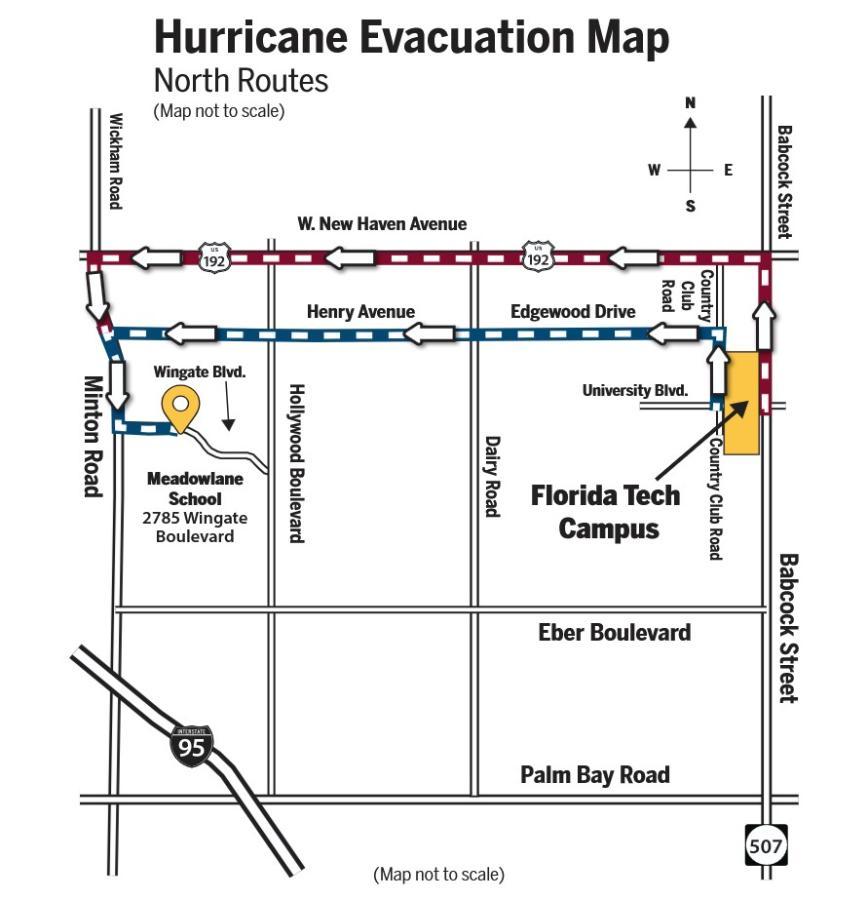
North Route 1:
From Campus Entrance on University Boulevard and Babcock Street:
- Go North on Babcock Street to West New Haven Avenue (US-192).
- Continue on West New Haven Avenue and turn south onto Minton Road.
- Follow Minton Road, then turn east onto Wingate Boulevard.
- Continue to Meadowlane School. (2785 Wingate Boulevard).
North Route 2:
From Intersection at Country Club Road and University Boulevard:
- Travel north on Country Club Road and turn west onto Edgewood Drive.
- Continue straight on Edgewood Drive as it becomes Henry Avenue.
- From Henry Avenue, turn south onto Minton Road.
- Follow Minton Road, then turn east onto Wingate Boulevard.
- Continue to Meadowlane School (2785 Wingate Boulevard).
South Routes
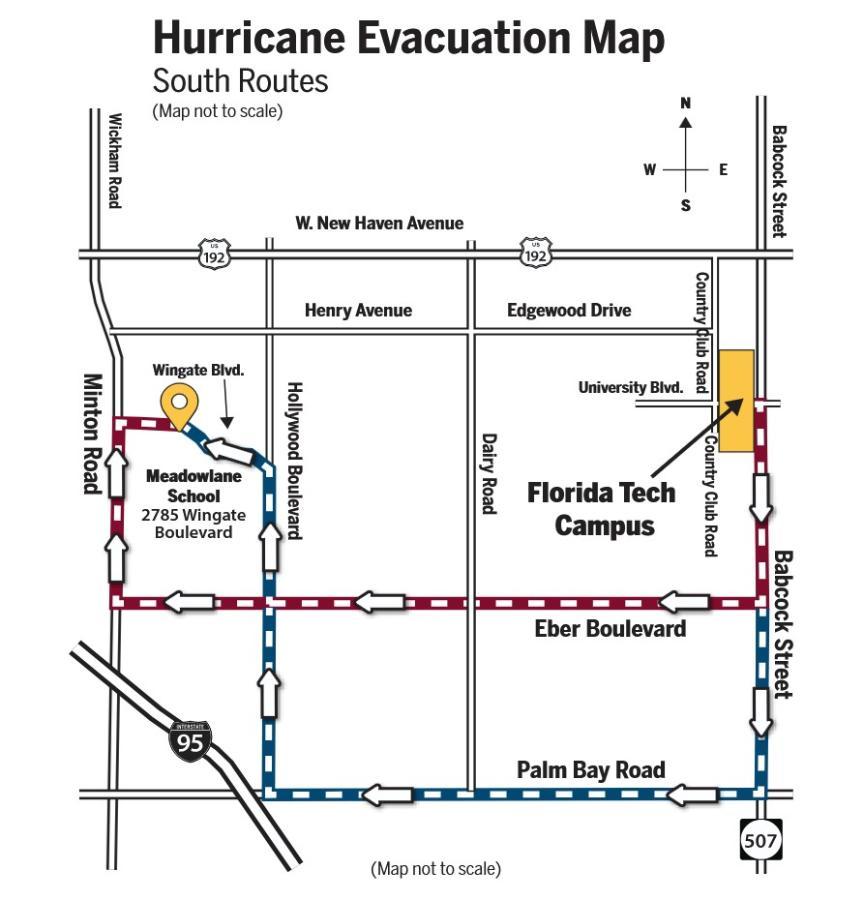
South Route 1
From Campus Entrance on University Boulevard and Babcock Street:
- Go South on Babcock Street and turn west onto Eber Boulevard.
- Continue on Eber Boulevard and turn north onto Minton Road.
- Follow Minton Road, then turn east onto Wingate Boulevard.
- Continue to Meadowlane School (2785 Wingate Boulevard).
South Route 2
From Campus Entrance on University Boulevard and Babcock Street:
- Go South on Babcock Street and turn west onto Palm Bay Road.
- Continue on Eber Boulevard and turn north onto Hollywood Boulevard.
- Follow Hollywood Boulevard, then turn west onto Wingate Boulevard.
- Continue to Meadowlane School (2785 Wingate Boulevard).
Tropical Cyclone Classification
| Storm Type | Wind Speed (Knots) |
|---|---|
| Tropical Depression | 20-34 |
| Tropical Storm | 35-63 |
| Hurricane | 64+ |
Hurricane Classification
| Strength | Wind Speed (Knots) | Wind Speed (MPH) | Pressure (Milllibars) | Pressure (Millimeters of Mercury) |
|---|---|---|---|---|
| Category 1 | 64-82 | 74-95 | >980 | 28.94 |
| Category 2 | 83-95 | 96-110 | 965-979 | 28.50-28.91 |
| Category 3 | 96-113 | 111-130 | 945-964 | 27.91-28.47 |
| Category 4 | 114-135 | 131-155 | 920-944 | 27.17-27.88 |
| Category 5 | >136 | >155 | 919 | 27.16 |
Campus Health and Safety Locations
Purpose
This plan has been created for Florida Institute of Technology (Florida Tech) to better prepare for a possible infectious disease (agent) incident or an outbreak (commonly referred to as a “pandemic”). It outlines the steps to take before, during, and after an outbreak to further reduce/eliminate the possibility of exposure to employees, students, residents, and the general public.
This plan is based off peer reviewed data and industry standards from numerous resources—both authoritative and from a guidance standpoint. Additionally, it will contain general information for educational purposes and site-specific (Florida Tech) information for procedural and implementation purposes.
Every attempt has been made to design this plan as user-friendly and informative as possible. Doing so will allow university employees at any level of knowledge regarding incident response and infectious materials to have a full understanding as to the appropriate procedures and actions to take. Additionally, it allows for an effective directive at the same time more freedom for individuals involved to address the situation on a case-by-case basis as the incident unfolds.
The term, “Patient” will be utilized throughout this plan. Unless specifically stated, “Patient” represents an individual who is either suspect of having or is confirmed to be infected with an infectious agent.
Scope
This plan is not designed to be all-inclusive; rather, it has been developed specifically for Florida Tech in relation to a biological outbreak (infectious disease). The University’s Emergency Plan serves as the overall plan for emergencies—this plan is just one aspect of that document.
Definitions & Clarifications
Transmission: Airborne vs. Droplet vs. Contact
- Airborne Infection: Airborne agents float through the air after a person talks, coughs, or sneezes landing in the eyes, mouth, or nose of another Direct contact with the infected person is NOT needed for someone else to be infected by an airborne agent. Infection usually occurs by the respiratory route (but not always), with the agent present in aerosols. Airborne agents can remain (suspended) in the air for a long period of time (sometime hours). Airborne transmission differs from respiratory (droplet) transmission, in that, respiratory disease agents are carried in the mouth, nose, throat, and respiratory tract.
- Droplet nuclei < 5μm (e.g. tuberculosis, chickenpox, measles).
- Droplet Infection: Droplet agents travel inside droplets that are coughed or sneezed from a sick person and enter the eyes, nose, or mouth of another Droplets travel short distances from one person to another. A person might also get infected by touching a surface or object that has agents on it and then touching their mouth or nose.
- Droplet nuclei > 5μm in diameter (e.g. flu, common cold, Coronavirus, Ebola).
- Contact Infection (direct or indirect): Infection occurs through direct contact between the source of infection and the recipient or indirectly through contaminated objects like door handles, food, water, skin, mucus membranes, blood, or other bodily fluids (e.g., Hepatitis A, HIV, Salmonella).
SPECIAL NOTE
Many actions or procedures cause “aerosolization”. This is often confused with airborne. An agent can be considered “non-airborne” but when aerosolized, becomes a heightened risk. The difference is that airborne agents do not require an intentional physical means to become “aerosolized.”
Aerosol Example (Non-Laboratory): Non-airborne infections agents may be present in a toilet posing little hazard. However, when the toilet is flushed, those agents can be aerosolized, causing potential risk of infection.
Aerosol Example (Laboratory): Procedures involving the use of a vortex, sonicator, centrifuge, etc.
Isolation vs. Quarantine (as defined by the CDC and HHS)
- Isolation is used to separate ill (confirmed positive) persons who have an infectious disease from those who are healthy. Isolation restricts the movement of ill persons to help stop the spread of certain For example, hospitals use isolation for patients with infectious tuberculosis.
- Quarantine is used to separate and restrict the movement of well persons who may have been exposed to an infectious disease to see if they become ill. These people may have been exposed to a disease and do not know it, or they may have the disease but do not show Quarantine can also help limit the spread of disease.
Endemic vs. Epidemic vs. Pandemic
- Endemic refers to the constant presence and/or usual prevalence of an infectious agent in a population within a geographic area.
- Epidemic refers to an increase, often sudden, number of cases of a disease above what is normally expected in that population in that area.
- Pandemic refers to an epidemic that has spread over several countries or continents, usually affecting a large number of people.
Essential Personnel
In emergencies, Essential Personnel are required for business continuity to continue daily business functions. These individuals are not expected to be more at risk than when in the general public. Therefore, they may or may not interact with potentially infected people (asymptomatic) while on campus as part of performing their job duties.
Pandemic Response Personnel (PRP)
Individuals who are considered Essential Personnel AND are tasked with duties that are expected to place them in close contact with a reasonably suspected infected, confirmed infected, isolated, or quarantined individual, are designated as Pandemic Response Personnel (PRP). This can also represent personnel in close or physical contact with items used by the patient that could be a risk of exposure (e.g., the repair or unclogging of a patient’s toilet).
Examples of Pandemic Response Personnel may include specific individuals from the below departments (but are not limited to):
- Campus Dining
- Campus Services (Housing)
- Custodial Staff
- Environmental, Health & Safety
- Facilities
- Holzer Health Center
- Security Officers
The determination as to who is considered PRP will undoubtedly depend on each infectious agent case scenario. Whenever possible, the number of individuals designated as Pandemic Response Personnel will be limited to reduce exposure to an unnecessary number of personnel. This will aid in limiting confusion and will allow for efficient and a more direct line of communication.
Additionally, PRP may require additional PPE and protective measures to avoid occupational exposure to an infectious agent.
Responsibilities
Environmental Health & Safety (EHS) Office
Within the EHS Office, the Biosafety Officer is designated the Institutional Official and will oversee the Infectious Disease Response Program. EHS Office responsibilities may include:
- Retrieval of biohazardous waste (if applicable);
- Provide training and fit testing for respirator usage;
- Provide overall biosafety, containment, and infectious agent guidance and advice
Campus Services
Includes: Housing, Retail, and Dining
- Identify housing units that can be used for quarantine/isolation;
- Arrange for the delivery of food, drinks, and possible common goods to patients;
- Ensure procedures are taken to reduce infectious agent spread in all retail/dining locations.
Employee Responsibilities
Employees must follow the directive of their supervisors and report illness or unsafe conditions to their supervisors immediately.
Executive Management
In order for departments to effectively prepare and handle an outbreak, Executive Management must strongly consider the recommendations from various resources (e.g., State of Florida, Federal Government, Departmental Leadership, and designated internal committees tasked with pandemic response). Executive Management holds the responsibility to provide the university with the resources (through authoritative and/or financial) in order to mitigate an infectious agent outbreak.
Pandemic Response Team (PRT)
To be discussed in detail later in this document.
Individual Departments
Each department will be responsible for ensuring their staff/students are informed as to the proper procedures. Additionally, they must make every effort to follow the guidance of the university officials and committees that advise on such matters.
Information Technology & Telecommunications Department
Provide the means necessary for the university to continue communications for various reasons (classroom instructions, employment task, and media/exterior outlets).
Student Life
Ensure students are keep apprised to directives from university leadership.
Pandemic Response Team (PRT)
The Pandemic Response Team (PRT) will serve as the committee dedicated to providing advice to Florida Tech leadership (Executive Management) during an infectious agent outbreak.
Committee Responsibilities:
- Assist in developing policies, procedures, and/or plans necessary to effectively mitigate an infectious agent outbreak;
- Make recommendations to executive management and campus departments as to what actions to take;
- Ensure campus communications by keeping employees, students, parents, and the general public apprised as to the situation;
- Keep all committee members and the campus community current on events relating to infectious disease topics as it relates to Florida Tech;
- Meet regularly (in-person or virtually) to discuss the program during outbreaks (consideration should be made to meet at times of no outbreak as well);
- Maintain communications and a professional, ongoing relationship with Local, State, and Federal authorities as well as other peer institutes (e.g., Department of Health, CDC, FBI, Fire Department, Police Department, local and national colleges, );
- Review and update this plan as necessary
Committee Membership:
The committee will be comprised of representatives from major departments/divisions within the university as well as subject matter experts relating to the containment, spread, and other various concepts of infectious agents.
A “Committee Chair” will serve as leadership for the committee and may also act as “Incident Commander” during an infectious agent outbreak.
Committee Roster:
Considerations will be made to include representatives from the following departments (this may not be an all-inclusive list of members):
- Academic Leadership
- Athletics Department
- Campus Security
- Campus Services (includes Retail, Residence Life, and Campus Dining)
- Custodial Services
- Environmental, Health & Safety
- Executive Management
- Facilities Management
- Holzer Health Center
- Human Resources
- Information Technology
- Information Technology & Telecommunications Department
- Library Services
- Marketing and Communications (Media Relations) Department
- Risk Management
- Student Life
Infectious Disease Response Protocol
This section outlines the generalized response protocol that will be implemented during an infectious agent outbreak. Why “generalized”? Because each scenario will be taken on a case-by-case bases, and it’s difficult (sometimes impossible) to predict the movement or characteristic of an infectious agent. This section is designed to be broad in nature—hence, more general, which allows for more freedom during the decision-making process—being each event will be treated as unique. For those actions that warrant more specific procedural tasks, separate “APPENDICES” are dedicated in this plan to address such actions.
During an infectious agent outbreak, there are considerations that must be evaluated in order to effectively continue daily functions (to the extent possible), at the same time to prevent exposure and spread. The characteristics of the disease (route of exposure, severity, and treatment availability), impact on daily routine, previous infectious agent outbreaks, and directives from authoritative entities all play a fundamental role for actions taken by the university.
Typically, decisions are (but not always) made in conjunction (or response) to a particular ACTION LEVEL of threat—this action level is usually provided by federal/state/local authorities. Unfortunately, the COVID-19 pandemic highlighted that action levels can change at any time, which can cause confusion and more difficulty to mitigate—various governing agencies may classify them differently. For this reason, all action levels and their corresponding responses will be taken on a case-by-case basis per the guidance of regulatory authorities and any applicable best practices.
SPECIAL NOTE
All procedures specified in the Appendices are primarily based on outbreaks involving a “respiratory” infectious agent. Infectious agents that have different routes of exposure may require less PPE and/or alternative measures. The Biosafety Officer and the PRT will assist in ensuring personnel understand what procedures are necessary to mitigate exposure and not spread disease.
Personal Protective Equipment (PPE)
When the appropriate PPE is used properly, it can be an effective tool for mitigating hazards. Unless specified otherwise, it will be the responsibility of each department to provide their employees with PPE and training on how to use the PPE—at NO COST to the employee. The Florida Tech EHS Office can assist in the proper selection of PPE and training.
PPE required to mitigate an infectious agent exposure will be dependent on the following criteria:
- The infectious agent involved (e.g., exposure route, severity, etc. )
- Recommendations from authoritative entities (e.g., CDC);
- The availability of PPE;
- The level of risk the employee will be exposed;
During an infectious agent outbreak, some common types of PPE utilized by employees may be:
- Gloves—surgical (always disposable and preferably made of nitrile or similar)
- Gowns (usually disposable but may be non-disposable with proper launder procedures)
- Eyewear (usually non-disposable, safety glasses/goggles)
- Face Shield (usually non-disposable, but can be disposable)
- Respirators (usually disposable, typically N95 or better, see below SPECIAL NOTES)
SPECIAL NOTE (RESPIRATORS):
Although an N95 might be considered nothing more than a mask to some, OSHA considers them to be actual “respirators”, and as such, all individuals who are required to wear one while on the job MUST be enrolled in Florida Tech’s Respiratory Protection Program. Individuals enrolled must receive a Medical Clearance, Training, and be Fit-Tested PRIOR to wearing a respirator—THIS IS LAW!
Successful enrollment, as mandated by OSHA’s Respiratory Protection Standard, is available through the EHS Office (ehs@fit.edu). During times of PPE shortage, extreme outbreak, and/or under the guidance of authoritative entities (e.g., CDC, FDA, OSHA), the use non-traditional, expired, or other PPE variations may be permitted—these are taken on a case-by-case bases (e.g., cloth masks—discussed later).
Employee Training
Infectious Materials
Although just one portion of infectious agent control, training on generalized hazards—such as Bloodborne Pathogens (BBP’s)—can further educate staff on protective and preventative measures for controlling exposure and spreading of infectious agents.
Therefore, due to the prevalence of BBP’s within the community, all personnel who have the potential of being exposed to infectious materials, must complete the Florida Tech’s online Bloodborne Pathogens (BBP) Training.
Incident Command System
Those individuals who are involved in committees, decisions, and are depended on during a crisis—such as a pandemic—must understand the Incident Command System and how it works as it relates to a potential infectious disease crisis at Florida Tech.
Training in Incident Command procedures is vital to allow for effective communication, resources, and strategy during a crisis. The Florida Tech EHS Office can assist in providing references for personnel to take such training.
Respiratory Protection
As discussed earlier in this plan, any employee who is required to utilize a respirator must receive training on the use of such PPE initially and at least annually thereafter.
Biomedical Waste and Bloodborne Pathogens
Those who are involved in the retrieval of biohazardous waste must be trained to do so per FL Chapter 64E-16. Therefore, all personnel involved in such tasks must receive both Biomedical Waste Training and Bloodborne Pathogens Training.
General Safety Precautions
Although some positions at Florida Tech have specific procedures that help reduce the risk of exposure, there are general precautions that can be taken by ALL individuals in order to prevent the spread of an infectious agent during an outbreak. The below outlines such actions:
- Remain a safe distance away (as determined by whatever agent is at large) from individuals that are either non-household-immediate members, suspect or confirmed infected (also known as “social distancing”;
- Avoid being present within large crowds;
- If required to wear PPE, do so in the appropriate manner;
- Avoid touching your face, eyes, and nose;
- Cover coughs/sneezes with your arm or hands (washing hands directly afterward);
- When washing your hands, use soap and warm water and rinse for at least 20 seconds;
- If soap and water are not readily available use an alcohol-based hand sanitizer with at least 70% alcohol;
- Maintain a balanced diet to manage a healthy weight;
- Stay physically active to the extent possible;
- Incorporate ways into tour daily routine to reduce stress;
- Reframe from the use of tobacco products, illegal drugs, and excess alcohol.
Additional Guidance:
Our main vectors of transmitting contact pathogens (and sometimes respiratory) to ourselves and others are our hands. Practicing good hand hygiene is one of the most important measures you can take to avoid exposure and to prevent the spread of an infectious agent.
SPECIAL NOTE (CLOTH or ALTERNATIVE MASKS):
The use of cloth masks or similar to avoid disease spread is widely popular throughout the world. It’s important to understand that if recommended, the purpose is not intended to act as PPE (protect the user); rather this method is to protect others from being exposed to disease (particularly respiratory agents).
The Reasoning Behind Wearing Masks:
Due to the possibility of individuals being asymptomatic, the more individuals wearing a mask has been shown to help reduce the likelihood of inadvertently spreading a respiratory disease—particularly when individuals are unaware that they are carriers of a disease.
Appendix A: Maintenance Personnel
When maintenance (e.g., repairs or routine maintenance) is required to be performed in housing units where a patient is under isolation/quarantine, the following procedures will be practiced:
- If possible, routine maintenance that does not impact the wellbeing of patient or the general public will be placed on a moratorium until the housing unit is vacant.
- If the maintenance of the facility cannot be postponed, Florida Tech Facilities Personnel will coordinate with Campus Services to ensure the occupant(s) are aware as to the reason for entering and when they plan to enter the area.
- Campus Services asks the occupant(s) to make arrangements to separate themselves in an area of the unit that maintenance will not occur (preferably behind a closed door). This is to better distance Florida Tech personnel from patient with the illness (or presumptive illness).
- If personal protective equipment (PPE) is required, Maintenance personnel don the appropriate PPE, provided by their department, before entering the area needed to mitigate exposure to infectious The Florida Tech EHS Office can assist in the determination of what PPE should be utilized (examples: gloves, safety eyewear, gown, respirator, etc.). However, in most circumstances, disposable gloves are considered sufficient PPE if the patient is in another closed room or a safe distance away (e.g., 6 feet).
- Maintenance personnel enter and perform the required During this time, they must conduct work using good hygiene practices (e.g., not touching any part of their face, eyes, and not touching items not absolutely necessary to perform the job task.).
- Upon completion, maintenance personnel will notify the patient verbally they are
- After exiting the area, all PPE should be Disposable PPE (e.g., gloves) is discarded in the trash and non-disposable PPE (e.g., eyewear) is rinsed thoroughly with soap and water, or an appropriate disinfectant (e.g., 70% Isopropanol Alcohol).
- Report any illness that occurs within 14 days of entering the area to your supervisor immediately as well as your preferred medical professional.
SPECIAL NOTE:
Per federal law, wearing a respirator (e.g., N95) on the job requires enrollment in the Florida Tech’s Respiratory Protection Program that includes: Medical Evaluation, Training, and a Fit Test.
Appendix B: Security Personnel
Due to the job environment that security personnel are often required to be involved—notably, the proximity of other persons (e.g., transport of persons, apprehension, and general investigation). These actions place security personnel at a greater risk of being exposed to potential pathogens. This section identifies procedures for security personnel to mitigate occupational exposure during an infectious agent outbreak (particularly, a respiratory infectious agent).
Whenever Personal Protective Equipment (PPE) is required, the Florida Tech EHS Office can assist in the determination of what PPE should be utilized.
In general, the below practices should be implemented to help eliminate or reduce occupational exposure (as it applies to an infectious disease outbreak).
- While on the job, implement good hygiene practices (e.g., not touching any part of your face, eyes, and not touching items not absolutely necessary to perform the job task).
- If the incident you are responding to allows, make every attempt to keep a safe distance from an individual in isolation/ quarantine (e.g., 6 feet). If the incident requires proximity or physically touching the patient, the use of gloves, a respirator, and eyewear is
- When transporting individuals (suspect or confirmed infected) by vehicle (e.g., golf-cart, car, or by walking), the use of gloves, a respirator, and safety eyewear is recommended (unless a distance of at least 6 feet can be accomplished throughout the transport—in this case, no PPE is required).
- Disposable PPE (e.g., gloves) is discarded in the trash immediately after use and non-disposable PPE (e.g., eyewear) is rinsed thoroughly with soap and water, or an appropriate disinfectant (e.g., 70% Isopropanol Alcohol).
SPECIAL NOTE:
Per federal law, wearing a respirator (e.g., N95) on the job requires enrollment in the Florida Tech’s Respiratory Protection Program that includes: Medical Evaluation, Training, and a Fit Test.
If you do not have a respirator and/or safety eyewear immediately available, a face shield is can help mitigate exposure (this PPE does not require enrollment in a program).
Exposure to Blood or Other Potentially Infectious Material (OPIM):
When you have been exposed to blood or OPIM, you will treat your exposure no differently than you would if the infectious agent at large did not exist—this is because Bloodborne Pathogens (BBP’s) do exit.
When exposed to BBP’s, the following procedures will be implemented:
- Wash the body part that received exposure thoroughly with soap and water.
- Launder contaminated clothing as normal.
- Disposable PPE (e.g., gloves) is discarded in the trash and non-disposable PPE (e.g., eyewear) is rinsed thoroughly with soap and water, or an appropriate disinfectant (e.g., 70% Isopropanol Alcohol).
- Report to the Holzer Health Center at Florida Tech.
- Report the incident to your supervisor and EHS.
- If you believe the incident to be an immediate risk to life, seek medical attention at the nearest hospital emergency room.
Reporting Illness:
Report any illness that occurs within 14 days of close contact with the patient to your supervisor immediately as well as your preferred medical professional.
SPECIAL NOTE:
Due to the prevalence of BBP’s and the nature of security personnel being at higher risk as well as their role of “first responders”, all security personnel must complete the Florida Tech’s online Bloodborne Pathogens (BBP) Training.
Appendix C: Florida Tech Vehicles (Buses & Trolleys)
This section pertains to procedures involved for buses and trolleys at Florida Tech. The department with responsibility of all vehicles will be termed “Transportation Department.”
DEFINITIONS
- Vehicle
For the purposes of this appendix, both buses and trolleys will collectively be termed “vehicles” Some examples of Florida Tech vehicles are (but limited to):
- Passengers
Individuals who are being transported by a vehicle.
- Operators
Employees or students who are operating a vehicle. If two or more employees are within the vehicle for the purpose of a work-related task, they are all considered operators. Note: if students are operators, the Florida Tech employee who is tasked with supervising the students is responsible for ensuring the students adhere to this Appendix.
PROCEDURES
During an infectious disease outbreak, frequently occupied vehicles are more likely to harbor the biological hazard at large. This is due to the environment often being of close quarters in nature, the number of people gathered in one general area, and the increased instances of surface touching by passengers and operators. Florida Tech will take the necessary precautions to reduce the risk of disease spread and exposure to passengers and operators by implementing the below practices:
- Alternating Vehicles
- Disinfecting Vehicles
- Limiting Vehicle Capacity
- Practicing Hygiene Etiquette
Alternating Vehicles
Whenever possible, the Transportation Department will alternate usage of duplicate vehicles (or vehicles used for the same purpose) to allow for more thorough disinfections.
Example: One strategy is to alternate the use the same bus every other day on a route. This would allow for a bus utilized on Monday to be free of passengers on Tuesday, therefore, allowing the bus to be more thoroughly disinfected. The bus is then placed back into service on Wednesday. Conversely, the bus utilized Tuesday is disinfected on Wednesday, and then placed back into service on Thursday.
Disinfecting Vehicles—Disinfection Type
EPA registered disinfectants are recommended as a disinfection chemical (specifically, ones shown to be effective against whatever agent is at large). Whenever electronics are involved or EPA products are not available, an alcohol-based solution of at least 70% is recommended. Although a 10% bleach solution (water-bleach) is effective against most infectious diseases, care should be taken to consider rust issues on certain surfaces. Therefore, when sourcing disinfectants, consideration should be taken as to what type of material the product is intended to be used on.
Disinfecting Vehicles—Frequency
The frequency of disinfection will be determined by the frequency of usage; however, all vehicles will be cleaned and disinfected after every use and more often as necessary.
The following procedures will be implemented:
- All vehicles utilized shall be disinfected at the end of each work shift or more often as described below.
- Whenever a vehicle is to be used by other personnel who were not originally occupying the vehicle within the same workday, it shall be disinfected.
- If the vehicle transported passengers other than Florida Tech personnel, spot disinfection in between pick-ups should occur whenever Note: consideration should be taken when using chemicals in proximity of passengers. For this reason, wipes instead of sprays may be more suitable for these types of instances.
- If an individual has entered the vehicle who is known or reasonable expected to be infected, the vehicle shall be thoroughly disinfected after that individual has exited and before any other passenger enters.
- Operators should utilize Nitrile gloves (or similar) when disinfecting or handing disinfectants; other than when using hand sanitizer for their hands.
Disinfecting Vehicles—Operators
Whenever possible, operators should wash their hands before entering and upon exiting a vehicle. If hand wash stations or a sink is not readily available, they should disinfect their hands with an alcohol-based solution (e.g., hand sanitizer) of at least 70% or higher. Keeping a supply of hand sanitizer within the vehicle is recommended.
Disinfection—Procedures (Bus & Trolley Specific)
Disinfection will be as thorough to the extent possible. Before disinfection, cleaning of any debris will occur. During operating hours:
- Don the appropriate gloves.
- Spray handrail after each trip with passengers
- Use provided product that combats the agent at large (e.g., Coronavirus)
- Let product sit on surface as long as possible before wiping away
- Wipe the surface once, from end to end
- Use a new paper towel for each surface
- Discard used towels in receptacle
- Sanitize hands with alcohol-based hand sanitizing gel or alcohol spray 70% solution
- When changing of drivers occurs disinfect the following:
- Control knobs & buttons (radio, door open, A/C)
- Seat belt latch
- Wiper arm
- Directional arm
- Door hand
- Steering wheel
Upon being disinfected, the vehicle not on route will not be utilized for at least 24 hours unless there are circumstances that warrant the use before this time (e.g., the mechanical failure of another vehicle providing the same service).
- Spray provided product on non-porous surfaces and let sit.
- Use mist sprayer or spray provided product on porous surfaces and let sit.
- Wipe away, using one paper towel per swipe along a surface.
- Discard paper towel appropriately.
NOTE: Never soak or saturate towels with chemicals or leave puddles of chemicals behind.
Limiting Vehicle Capacity
In order to effectively practice social distancing, limiting the number of passengers (and operators) inside a vehicle may be required. There are times this may not be feasible (e.g., golf carts) but is a more doable option for other vehicles like busses and trolleys.
Whenever possible, if room inside the vehicle allows, passengers should be required to sit so that there is enough spacing between each person—who do not share a family household—to be considered social distancing. One method may be to temporary block seats by means of signs, tape; another may be to make seating arrangement designated by a seating chart; or place objects in a manner that specifies and prevents the seating location is not available.
Practicing Hygiene Etiquette
Encouraging passengers and operators to practice good hygiene etiquette is fundamental to avoid the spread of AND the exposure of infectious diseases. Passengers can be informed of proper practices by means of signage. All operators will be instructed as to proper etiquette by their supervisors. The proper hygiene etiquette is as follows:
- Wash your hands often with soap and water for at least 20 seconds, especially after you have been in a public place, or after blowing your nose, coughing, or sneezing.
- If soap and water are not readily available, use a hand sanitizer that contains at least 70% alcohol by covering all surfaces of your hands and rub them together until they feel dry.
- Avoid touching your eyes, nose, and mouth with unwashed hands.
- Cover your mouth and nose with a cloth face cover when around If you don’t have a tissue, cough or sneeze into your elbow, not your hands.
- Avoid touching surfaces inside and outside the vehicle unnecessarily.
- Practice social This means avoiding seating next to someone if other seats are available.
- Do not enter a Florida Tech vehicle if you are sick, unless it is for emergency purposes only.
- Stay home if you are sick.
Exposure to Blood or Other Potentially Infectious Material (OPIM):
When you have been exposed to blood or OPIM, you will treat your exposure no differently than you would if the infectious agent at large did not exist—this is because Bloodborne Pathogens (BBP’s) do exit.
When exposed to BBP’s, the following procedures will be implemented:
- Wash the body part that received exposure thoroughly with soap and water.
- Launder contaminated clothing as normal.
- Disposable PPE (e.g., gloves) is discarded in the trash and non-disposable PPE (e.g., eyewear) is rinsed thoroughly with soap and water, or an appropriate disinfectant (e.g., 70% Isopropanol Alcohol).
- Report to the Holzer Health Center at Florida Tech.
- Report the incident to your supervisor and EHS.
- If you believe the incident to be an immediate risk to life, seek medical attention at the nearest hospital emergency room.
REPORTING ILLNESS
Report any illness that occurs within 14 days of close contact with the patient to your supervisor immediately as well as your preferred medical professional. Additionally, it is the responsibility of the employee to inform their supervisor if they feel ill. Employees who show signs of illness or report they are ill should be instructed to leave work and should be restricted to operating Florida Tech vehicles during times they are ill.
Appendix D: Custodial Personnel
See below section titled, “Appendices D, E and F.”
Appendix E: Campus Dining Personnel
See below section titled, “Appendices D, E and F.”
Appendix F: Isolation/Quarantine Protocol
See below section titled, “Appendices D, E and F.”
Appendices D, E and F
Custodial Services, Dining Services, and Isolation/Quarantine Protocols will be utilized and constructed greatly according to the nature of what agent at large is involved and its impacts. Specifically, the route of exposure, severity of disease, mandates by governing authorities as well as Florida Tech resources.
The delivery of meals, laundry and cleaning services, and isolation/quarantine availability will be continually assessed as an ongoing strategy.
Because the safety of staff, students, and the general public is priority to Florida Tech, every measure will be implemented to ensure a level of service is provided for each area; however, as a specific type of pandemic is unpredictable, staff availability and the availability of resources such as goods and services nationally (and/or locally) may impact services provided.
During an epidemic or pandemic, meetings will be convened with stakeholders from each area to ensure the most efficient and optimal provisions are taken. Additionally, instructions and guidance provided by governing authorities (e.g., CDC and Florida Health Department) will be monitored continuously so that adjustments, if required, can be made to internal Florida Tech response procedures.
SPECIAL NOTE (Custodial Personnel)
Per federal law, wearing a respirator on the job requires enrollment in a Respiratory Protection Program. Due to Florida Tech’s contractual relationship with an outsourced custodial services all personnel requiring respiratory protection must be enrolled in their employers Respiratory Protection Program and that employer must supply the necessary PPE).